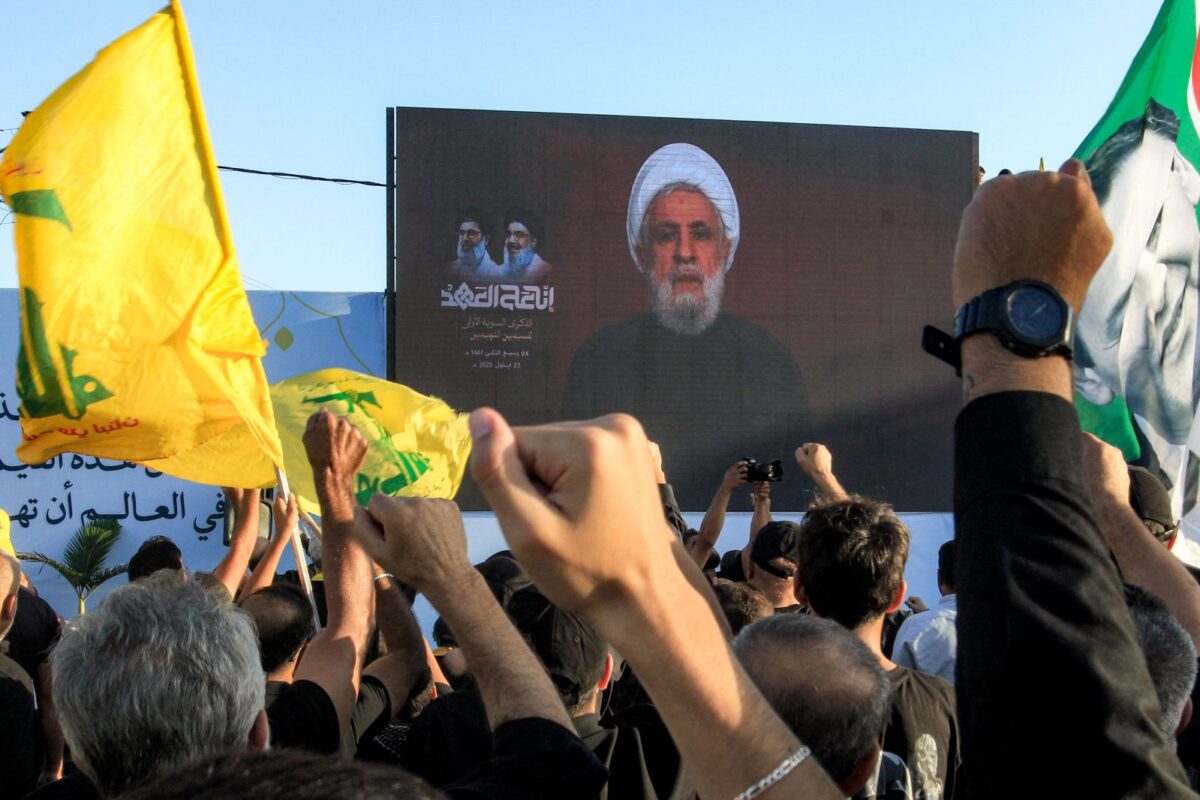
Naim Qassem, current leader of the Lebanese Shiite movement Hezbollah, addresses mourners through a screen in a televised address during a ceremony marking the first anniversary of Israel's assassination of the group's longtime leader Hassan Nasrallah and other group leaders, in the town of Deir Qanoun al-Nahr near Tyre in southern Lebanon on September 27, 2025.
The Iran-backed group, weakened by a deadly war with Israel last year, has organised a series of commemorative events to mark Nasrallah's death.
[responsivevoice_button voice="UK English Male" buttontext="Listen to Post"]
Driving the news:
In a long speech framed as a tribute to “scholar-martyrs,” Hezbollah deputy leader Naim Qassem used religious language and the backdrop of Pope Leo’s visit to restate a simple political line: Hezbollah’s weapons are permanent, non-negotiable — and above the Lebanese state.
Why it matters
- Direct hit on sovereignty: Qassem repeats that neither the U.S. nor Israel — nor, in practice, the Lebanese state — has any authority over Hezbollah’s arsenal or “defense strategy.” Disarmament is ruled out in advance, no matter what any negotiation produces.
- Ceasefire mechanism under fire: He slams the government’s decision to send a civilian to the Lebanon–Israel ceasefire committee as a “free concession” and a “fall,” signaling that any diplomatic track not controlled by Hezbollah is automatically suspect.
- Religious cover for permanent militarization: By glorifying clerics killed in battle and blending “jihad of the soul” with armed struggle, Qassem turns endless mobilization into a moral duty and labels critics as agents of Israel or the West.
What Qassem is really saying
Behind the pious rhetoric, three core claims stand out:
- Hezbollah is the real republic: Scouts, schools, clerics, “the people” – all are folded into one narrative that presents the party as the true guardian of Lebanon’s identity, diversity, and dignity. The actual state is reduced to a service provider.
- UN resolutions are one-way: Israel must be bound by agreements and borders; Hezbollah’s compliance is voluntary, and any internal discussion of 1701 or a defense strategy stops where its arsenal begins.
- Dialogue on Hezbollah’s terms only: Qassem says he’s open to a “national defense strategy,” but only if it preserves Hezbollah’s independent capacity to wage war and veto policy.
The bottom line
Qassem’s speech is not a vision for a shared state; it is a manifesto for a parallel one. As long as weapons remain sacred and above scrutiny, no envoy in Naqoura and no papal blessing in Beirut can turn Lebanon back into a normal republic.