One year after his election, President Joseph Aoun chose to present what he framed as a “year in review” of his presidency. But what we heard was not a reckoning—it was a recycling of promises, a softening of the problem, and a strategic evasion of Lebanon’s core crisis: a weapon outside the state that consumes the state, and then asks us to believe the state is “restoring its authority.”
Throughout the interview, the president insisted that “the decision has been made,” that implementation must proceed “according to circumstances,” “according to the army’s capabilities,” and “according to geographic constraints.” He warned against emotionalism and called for realism. But realism is not a political alibi for avoiding sovereignty. Circumstances are not natural disasters; they are the product of political choices. And there is a crucial difference between managing a problem and ending it.
Management treats Hezbollah’s arms as a permanent fact that the state must negotiate around. Ending it means redefining the state itself as the sole authority over war, peace, and decision-making. This is not a semantic distinction—it is the difference between having a state and administering one under conditions imposed from outside it.
What was most troubling was not the president’s acknowledgment of the difficulty of the task, nor his appeal to the “other side” to act responsibly. It was the implicit framing of Hezbollah’s weapons as an administrative file—something to be phased in, adjusted, and handled gradually—rather than a constitutional rupture that empties the republic of meaning.
Once the state’s monopoly on force becomes a “project” dependent on funding conferences, battlefield assessments, and international calibrations, sovereignty ceases to be a principle and becomes a bureaucratic aspiration.
The president stated that restoring the state’s authority is a “domestic demand, not a foreign one.” Good. But then why is it always spoken of defensively? Why is the language one of constant justification? Why do we hear about “partial cooperation” with an armed organization that maintains its own territory, warehouses, logistics networks, and an independent war-and-peace doctrine?
What kind of state requests cooperation from a militia in order to exercise sovereignty? Sovereignty is not a negotiated clause. It is not measured by decrees or speeches, but by whether the state’s rules apply to everyone—without exception.
There is another contradiction. The president spoke at length about reform: governance, digitization, transparency, banking recovery, forensic audits, and anti-corruption measures. All of this is necessary. But reform in Lebanon without disarmament is not reform—it is renovation without foundations.
Weapons outside the state do not merely shield corruption; they structure it. They allow judicial paralysis when needed, sabotage accountability when it becomes inconvenient, and reframe citizens’ rights as “sectarian sensitivities.” This is how constitutions are hollowed out—not because the text is flawed, but because political elites treat Hezbollah’s arms as a detail to be lived with, a problem to be managed, or a burden to be softened—never as a disease to be eliminated.
Talk of “positive neutrality” and “not turning Lebanon into a platform” remains hollow if it is not translated into one basic truth: Lebanon cannot be a platform if no one owns the platform except the state. Arresting a cell here or intercepting a shipment there while leaving the structure intact is not neutrality. It is cosmetic maintenance.
At one point, the president said he wants to “prioritize the power of logic over the logic of power.” But the logic of power in Lebanon is not just excess arms—it is an entire political system that ties weapons to elections, diplomacy, economic survival, and even the definition of borders. Logic does not defeat this by appeals. It defeats it through a clear political path: a public timeline, sequenced steps, transparent accountability, and a declaration that places all political forces—especially those that justify, normalize, or excuse—before their responsibilities.
Lebanon does not need a president who reassures us that “the decision has been made.” It needs a president who declares that the era of managing illegal weapons is over. Legitimacy is not a sentiment—it is a practice.
Any reform that avoids confronting arms outside the state will remain cosmetic. Any constitution that coexists with parallel power will remain decorative. Any republic that tolerates two sovereignties will remain a republic in name only.
If this presidency truly seeks to restore the state, then the beginning is not promises—it is breaking the cycle that empties every promise of meaning: no state with two armies, no reform under armed tutelage, no constitution under negotiated sovereignty.
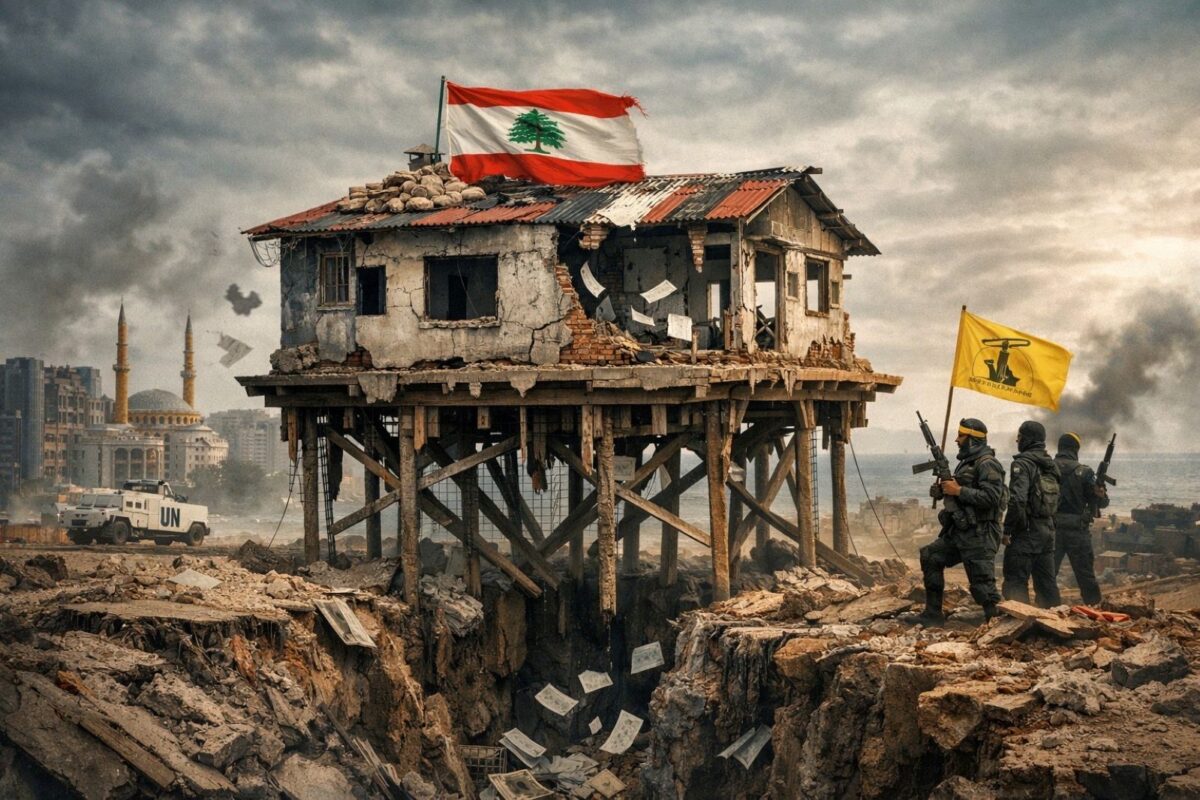
Without that, Lebanon will continue to renovate a collapsing house—without foundations.
This article originally appeared in Elaf
Makram Rabah is the managing editor at Now Lebanon and an Assistant Professor at the American University of Beirut, Department of History. His book Conflict on Mount Lebanon: The Druze, the Maronites and Collective Memory (Edinburgh University Press) covers collective identities and the Lebanese Civil War. He tweets at @makramrabah