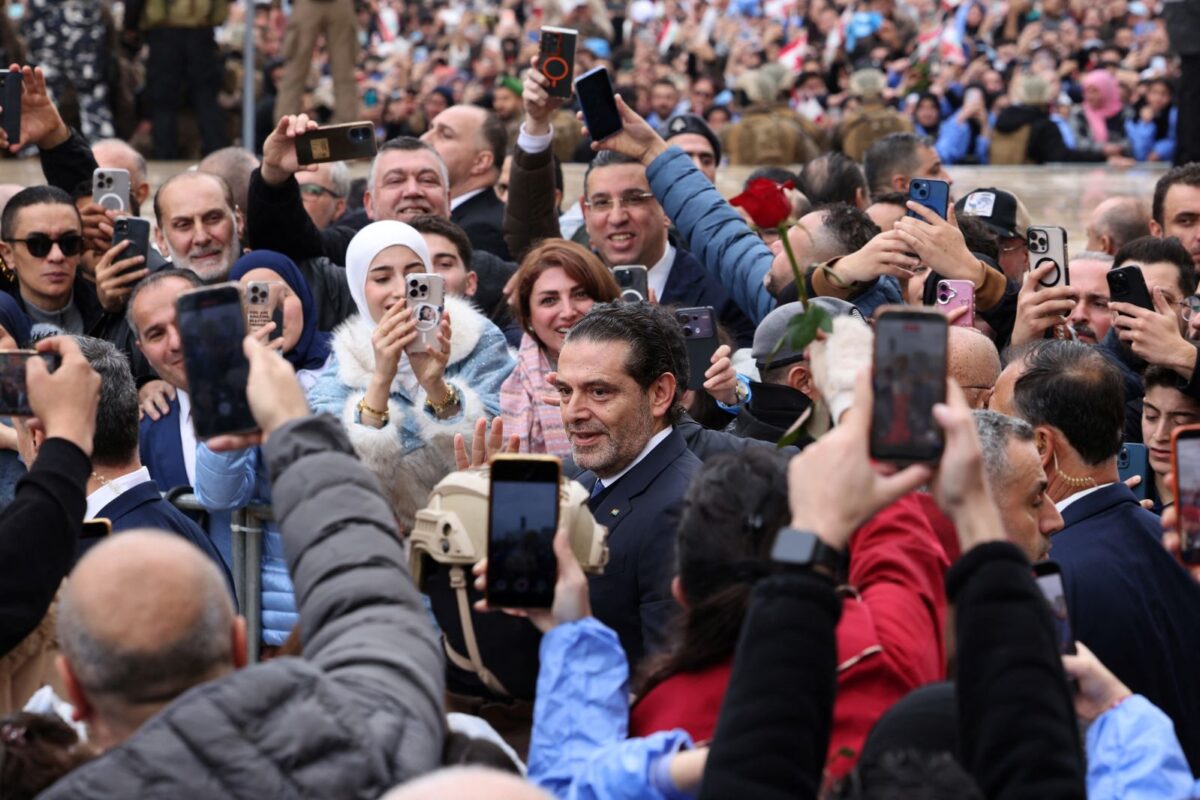
Thousands gathered in Beirut’s Martyrs’ Square on Saturday, hoping for a sign that former Prime Minister Saad al-Hariri would re-enter Lebanon’s turbulent political arena. He indicated his party, the Future Movement, would participate in the upcoming elections but left open the possibility of his own political comeback.
Saturday marks the anniversary of the assassination of former Prime Minister Rafiq al-Hariri — the father of Saad al-Hariri. Many speculated that he would use the day to announce his plans for the parliamentary election. Today he neither denied nor confirmed whether he would run again, instead saying that members of the Future Movement might play a role in the elections.
“Tell me when parliamentary elections will be held, and I will tell you what the Future Movement will do,” Hariri said today. He therefore indicated he would share more details about his strategy until the official announcement of the parliamentary elections. Due to the current discussions about the diaspora vote, the parliamentary elections might be delayed. The moment of the Future Movement was “approaching,” he said, but “it might be a little farther away than you hoped.”
With a potential return of the Future Movement to the Lebanese political scene, the question arises whether Saudi Arabia will allow back it. Hariri’s previous rise to power as Lebanon’s Prime Minister was inseparable from Saudi support. For years, Riyadh viewed him as its Sunni ally in Lebanon — a legacy he inherited from his father, Rafiq al-Hariri, who founded the Future Movement and ensured Saudi backing.
Over time, Saad al-Hariri lost the support of Saudi Arabia due to his pragmatic ties with Hezbollah, including coalition-building and electoral deals that did not sufficiently curb the group’s influence. He ultimately resigned in 2017 and five years later, he announced his retirement from politics.
The past months were filled with expectations from his supporters about a possible return. “You need to differentiate between aspiration and capabilities,” a Lebanese official who preferred to stay anonymous due to the sensitivity of the matter, told Now. There are several severe factors holding him back — many of them dating back to his time in office. Saad al-Hariri’s connection to Hezbollah, however strong it might be, is “the primary factor preventing him from running personally, as the political cost of defying Riyadh would be far too high for him to bear,” election analysts Nazih Darwish told Now.
The Future Movement started as a coalition under Rafiq al-Hariri in 1995 and transformed itself into an official political party in 2007. Saudi Arabia strongly supported the Future Movement, because it opposed Iran and its proxies like Hezbollah and wanted strong Sunni leadership within the sectarian political system of Lebanon. Over time, Riyadh grew skeptical of Saad al-Hariri’s engagement with Hezbollah, leading to the withdrawal of Saudi support in 2017.
Another geopolitical ally to Saad al-Hariri could be the United Arab Emirates, where he has long lived and built political connections. But analysts say support from them is unlikely. The former allies Abu Dhabi and Riyadh have fallen out with each other, a split accelerated by their opposing positions in Yemen. With regard to Lebanon, “I suspect the UAE’s primary motive currently is merely to needle the Saudis,” Darwish said.
Another problem for the UAE — apart from the confrontation with the Saudis — would be their ties to Israel. “It doesn’t make sense for the UAE to be regionally aligned with Israel… and then support Saad al-Hariri, who is soft on Hezbollah,” the Lebanese official said. This leaves Hariri with little international support. But playing the regional powers against each other under these circumstances would be suicide for the Future Movement, he added.
“The only way he can come back is through Hezbollah — because the other side is blocked,” the Lebanese official said. But living in the UAE does not make him more favorable to Iran, which opposes Israel. Hezbollah could stand to benefit the most from this infighting. “It always helps Hezbollah to sow dissent and fragmentation among the Sunnis, who are practically the only ones who can really threaten their demographic control,” the Lebanese official said.
The Sunni political landscape in Lebanon remains scattered. “It is clear there is a massive leadership vacuum in the Sunni community right now, largely caused by Saad al-Hariri’s withdrawal,” Darwish said. His return could fill that void — but also challenge the position of the current Prime Minister Nawaf Salam.
But Hariri finds himself amidst the interest of international powers — with Saudi Arabia opposing him, the UAE most likely avoiding conflict and Hezbollah dealing with international pressure as well as some inside Lebanon.
While Saad al-Hariri put on a big show on Saturday, both analysts agree that it is unlikely he will run again. Instead, he could try to promote other members of his family — such as his aunt or his cousin, Ahmed al-Hariri — as Future Movement candidates. However, the Lebanese official noted that Riyadh would likely block their rise, using financial and political influence to prevent the party from regaining its footing. “If the Future Movement misses two elections in a row, they will practically be non-existent,” he concluded.
Laura is a German journalist. She has previously worked in Brussels and Berlin for POLITICO Europe.
The views in this story reflect those of the author alone and do not necessarily reflect the beliefs of NOW