
Charles Hayek’s Between History and Hallucinations, Franck Salameh’s response, and Eli Khoury’s comment inspired me to share my thoughts. However, I must first clarify a few things. Before I pursued a career in public policy, I was trained in history and was actively pursuing an academic career. History remains my passion. Over the years, I have gradually shifted my perspective from Charles’s viewpoint to Franck and Eli’s.
My mentor, Kamal Salibi, was renowned for his book, The Bible Came from Arabia. His hypothesis suggests that, before migrating to the southern Levant region, the Israelites resided in the Hijaz. Salibi argued that most events recorded in the Bible depict the history of this community in what is now Saudi Arabia, rather than Israel. While Salibi was prepared to engage in debates and face rebuttals from fellow historians, he faced significant criticism from non-historians. They accused him of granting Israel a claim to the Western side of the Arabian Peninsula. Interestingly, Palestinians embraced Salibi’s hypothesis, using it as evidence to assert that Jews lacked a history in Israel. However, Salibi did not dispute the geographic location of Jewish history, which began with the Hasmoneans, approximately two millennia ago. Instead, he challenged the earlier history of Abraham, Moses, David, and Solomon.
Shortly before his passing, Salibi was about to publish his final book and requested that I write the introduction. He had a specific reason for this. He sought a historian whose daily practice was rooted in policy. Both Salibi and I believed that history should be written for the sake of history itself, not to shape the present. When we begin writing history with present political considerations in mind, we inadvertently compromise both history and policy. This is precisely where Charles made his significant error. He argued that the historian’s role was to present “the truth” as an exercise in clarity for the present and future. This notion is fundamentally flawed.
History lacks absolute truth. It is a modern endeavor to present the most plausible version of past events. Often, a historical narrative is reconstructed from fragments of evidence that, on their own, offer little to no concrete information. Historians, relying heavily on conjecture, examine contemporary evidence and the unreliable literature passed down from previous generations to form hypotheses. Some of these hypotheses gain mainstream acceptance and are recognized as history. Others, which are not as widely accepted, are referred to as alternative or revisionist history.
Therefore, there is no singular “truth” in history; instead, there are suggestions. The reason we consider literature unreliable is that it is rarely written by eyewitnesses reporting from the scene. Instead, it is often composed by chroniclers from centuries later. These chroniclers are typically court propagandists and hagiographers who manipulate the narrative to serve their sponsors at the time of writing.
Returning to the debate, before the emergence of nation-states, kings constructed their histories in a manner that they believed validated their legitimacy as “the shadow of God on earth.” With the rise of nation-states, the divine mandate for the sovereign was replaced by approval from the nation. However, who defines the nation? Once again, history emerges as a tool to distinguish one nation from another, often granting certain nations, similar to ancient times, real estate and sovereignty rights over the territories they occupied.
Salibi, who himself evolved and repositioned himself on the political spectrum as he aged, was not a fan of nationalism. He used to say that nationalism is an imagined history, created by a poet and a musician to compose a national anthem.
As the Ottoman provinces began to break away from Istanbul, the intellectuals of the time engaged in a debate about their future. Some desired to remain within the Muslim empire, even as the sultanate itself was shedding its Islamic identity and adopting Turkification. Others aspired for an independent pan-Arab nation. However, the outcome was determined by colonial interests centered around the extraction of Iraqi oil to the Mediterranean coast. The competition between the British and French empires also played a significant role.
The British allied themselves with the Sunni Arab majority and supported the pan-Arab nation scheme. France, on the other hand, was left with the minorities and had to adopt the idea of independent smaller nations. France was so generous with the minorities that it divided the Levant into five states: one Christian, one Alawite, one Druze, and two Sunni.
The Christian population in Lebanon was sufficient to make them a majority in Greater Lebanon, but they would have been a minor faction in a pan-Arab or pan-Muslim nation. Although pan-Arabism promised secularism, it could not envision a founding legend independent of the rise of Islam and the Prophet Muhammad. Consequently, the founders of secular pan-Arabism themselves converted to Islam.
Each of the newly formed nations—Lebanon, Syria, Iraq, Jordan, and Egypt—began constructing their own imagined national history. The Iraqis revived Mesopotamia, while the Egyptians resurrected their Pharaohic past. This was facilitated by colonialism, which had decades earlier unearthed a significant amount of archaeology that retold histories suppressed by the mainstream Islamic narrative for centuries.
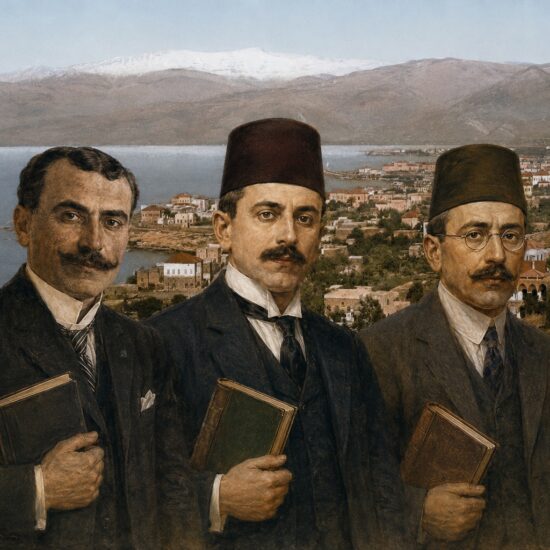
Lebanon was no exception. Similar to Iraq and Egypt, Lebanon revived its pre-Islamic history and portrayed its modern nation as a continuation of that ancient Phoenician past. While this continuity was a stretch, the lingering influence of this ancient civilization was undeniable.
For brevity, I will conclude with a brief word on history and the present and future.
Phoenicians were not a nation-state but a civilization whose competing city-states, and sometimes Thessalocracies, dominated the Mediterranean basin. They emerged around 1200 BCE and began Arabizing (my own hypothesis) between 200 and 500 CE. Over 1400 years is a long period, almost equivalent to the age of the Arab civilization today. We know that Phoenician, the closest Semitic relative to Hebrew, evolved into Punic. Therefore, viewing Phoenician as a nation-state with a single language or style contradicts our understanding of their civilization, which originated in what is now Lebanon. What we do know is that the Lebanese still share many Phoenician traits that distinguish them from other Arabs today.
Lebanon, the oldest nation-state in the Arab League and Israel, has a rich history. Mount Lebanon emerged in 1840 and gained more defined boundaries in 1860. This development wasn’t due to Lebanese self-identification as Phoenicians but rather their status as non-Muslims, a division that persisted even after the creation of Greater Lebanon and continues to this day.
However, history is history. Lebanon must adopt a modern approach, akin to America, and build its nation on principles rather than national legends. Concepts like liberty, equality, and freedom are foreign to most Lebanese. As long as this remains the case, the defining characteristics of their nation will remain the dispute over who is Phoenician and who is Arab, both imagined identities.
Self-determination is the foundation of statehood. The fault line should lie between those who desire Lebanon as a nation-state and those who insist on transnational platforms that make Lebanon an extension of one foreign nation or another.
If the rift between the Lebanese nation and the Lebanese transnationalists cannot be resolved, federalism is not the solution; total partition is.
Hussain Abdul-Hussain is the author of The Arab Case for Israel and a research fellow at The Foundation for the Defense of Democracies (FDD)
The views in this story reflect those of the author alone and do not necessarily reflect the beliefs of NOW.