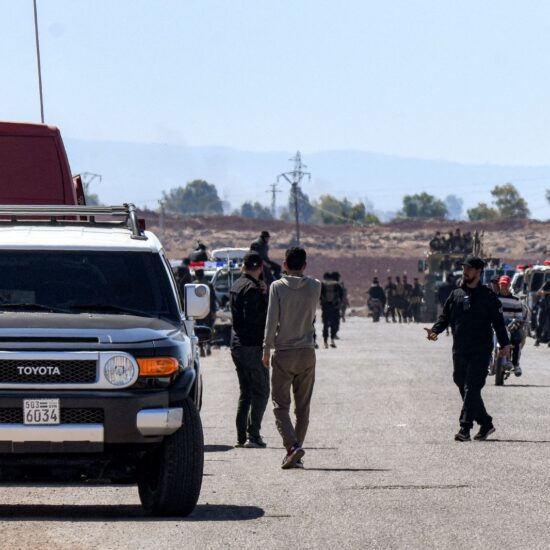
The politics of memory unfolding in Tripoli reveal less about history than about the failures of the present. In Lebanon, the past is a political instrument: recalled, repackaged, and returned to the public in the service of present-day narratives, most often as a consolation for populations denied basic rights and dignified futures. Rather than being invited to imagine what their country could become, citizens are handed a selective, reconstructed past and told to march in its honor. Tripoli, Lebanon’s second city and among its most economically abandoned, has been offered precisely this bargain.
Since 2004, at the initiative of local historians Omar and Khaled Tadmori, the municipality of Tripoli has commemorated what it calls the “Liberation of Tripoli from Crusader Rule”, the Mamluk Sultan Qalawun’s capture of the city on April 26, 1289 (1). The event has, with some interruptions, grown into a civic ritual: a parade through the city involving municipal officials, religious authorities, and civil society actors. It is framed explicitly as a “founder’s day“, a moment of origin, identity, and pride. Even if this year the commemoration took no public dimension due to the current situation, it nonetheless had its share of articles and social media posts celebrating the event (2).
The model is transparent. The commemoration is consciously fashioned after Istanbul’s Conquest Day (İstanbul’un Fethi), celebrated annually on May 29 to mark the Ottoman capture of Constantinople in 1453. That the Ottoman Empire itself never institutionalized an annual commemoration of that event deserves emphasis: the large-scale public celebration of May 29 is a creation of the Turkish Republic, amplified specifically under the AKP government as a vehicle for fusing Turkish nationalism with Sunni Islamic identity.
The justification for choosing 1289 over any other moment in Tripoli’s long history of changing hands deserves direct scrutiny. In the commemoration’s framing, the Crusader period is cast as uniquely destructive, uniquely alien, and uniquely worthy of repudiation, reduced in the article to the rhetorical formula of “the usurping Frankish occupation” (3). This leaves little room for historical nuance, and still less for the context of the conquest itself. The violent transition from Crusader to Mamluk rule, and the punitive campaigns the Mamluks organized to consolidate control over the Lebanese highlands. These campaigns, launched between 1268 and 1305, targeted areas inhabited by Maronites, Alawites, Druze, and Shiites. They culminated in the notorious Jibbeh and Kisrawan campaigns between the 1280s and 1305, and served to secure the hinterland ahead of the fall of Tripoli, all within the context of the truce agreement between the Mamluks and the County of Tripoli. Their violence was so enduring that it left its mark on the very nomenclature of the landscape. After the Mamluks secured control of the mountainous areas, they renamed places to reflect this legacy: al-Dinniyeh (People of Suspicion) and al-Futūḥ (The Conquered Land), toponyms that continue to carry that memory.
This period is well attested in both Mamluk and local primary sources. From the centre of power, Ibn ʿAbd al-Ẓāhir (1223–1293), chief scribe of the Mamluk chancery in Cairo, documented these events. They are echoed, from the perspective of the peripheries, in later local voices: the zajaliyyāt (4) of Sulaymān al-Ashlūḥī (13th century?) and of Ibn al-Qilāʿī (c. 1490), the chronicle of Ṣāliḥ Ibn Yaḥyā (d. c. 1436), the writings of Ibn Sibāṭ (d. 1520), and the Tārīkh al-Azmina of Patriarch Duwayhī (c. 1680s).
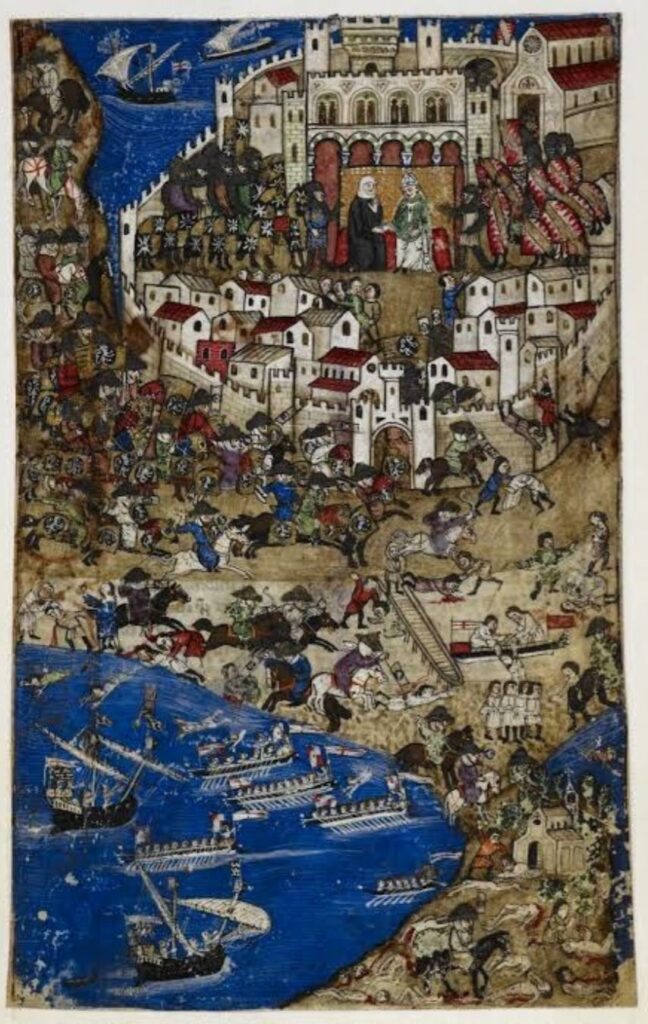
The capture of Tripoli by Qalawun, depicted in the early 14th century. British Library MS MS Add. 27695, fol. Sr
Two contemporary eyewitness accounts crystallize what the commemoration further suppresses. The first is by Abū al-Fidāʾ (1273–1331), an Ayyubid prince, historian, and geographer born in Damascus, who later ruled as a local emir of Hama under the Mamluk Empire. He is best known for his universal chronicle al-Mukhtaṣar fī akhbār al-bashar. He was present at the conquest, sixteen years old when he took part in it alongside his father, and offers the perspective of a Muslim prince on the events of the siege. He describes the fall of the city in the following terms:
“…This too is among the things I witnessed and was present at, alongside my father, King al-Afḍal, and my cousin, King al-Muẓaffar, lord of Hama. When the Muslims had finished killing the people of Tripoli and plundering them, the Sultan ordered the city demolished and razed to the ground. In the sea, close to Tripoli, there was an island on which stood a church called the Church of Saint Thomas, lying between the island and Tripoli’s harbour. When Tripoli fell, a great multitude of Franks and women fled to that island and to the church. The Muslim troops plunged into the sea and crossed over; they killed all the men they found there and took the women and children as spoils. After the plundering was done, I crossed to that island by boat and found it filled with corpses to such a degree that a person could not stand upon it for the stench of the dead.
When the Sultan had completed the conquest of Tripoli and its demolition, he returned to Egypt…” (5)
The second witness, Sulaymān al-Ashlūḥī al-ʿAkkarī, was probably a priest from the Akkar region and a member of the local Melkite Christian community, for whom the city’s fall was catastrophic. He narrated the event in vernacular zajal, and the following verses are extracted from his elegy of the city:
“O the grief of my heart leaving nothing but sorrows
And the heart from grief is set ablaze with fire.
In Tripoli began this tale of sorrow and words,
before this account, had already failed.
The Christians were once the finest in all the land
and now no trace of them remains, nor standing…” (6)
Both accounts bring forth what the commemoration fails to present: a historically complex and violent event that resists clean moral architecture. This complexity extends beyond the conquest itself.
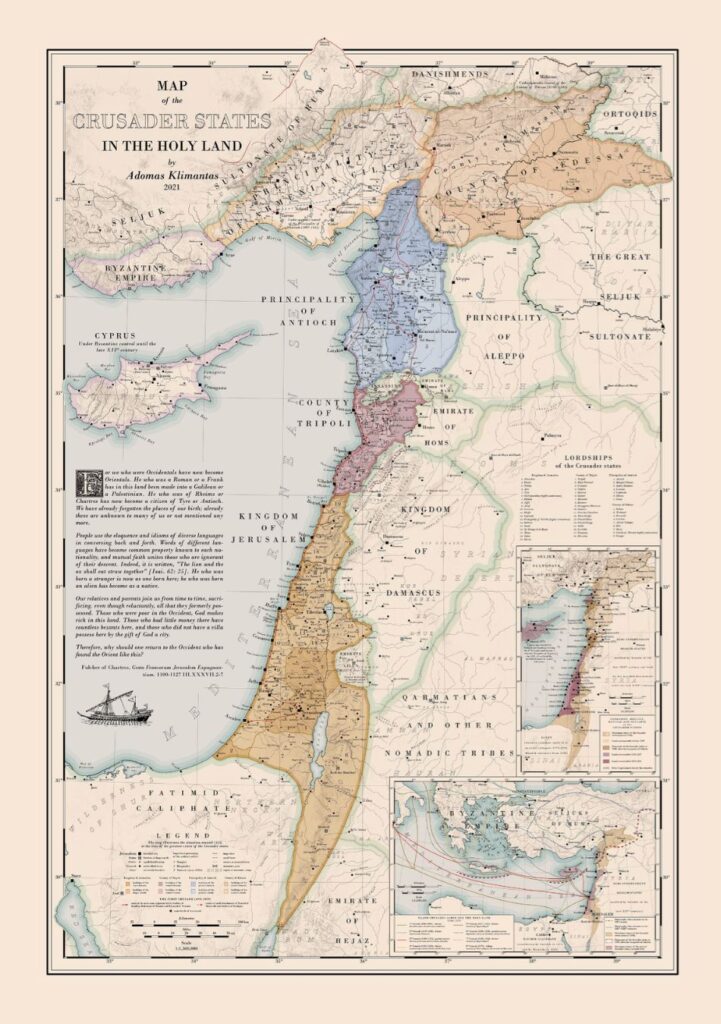
MAP OF THE CRUSADER STATES IN THE LEVANT, INCLUDING THE COUNTY OF TRIPOLI ©️ MAPKLIMANTAS. WIKIMEDIA COMMONS: HTTPS://COMMONS.WIKIMEDIA.ORG/WIKI/FILE:MAP_OF_THE_CRUSADER_STATES_AND_CASTLES.PNG.
The framing that reduces the County of Tripoli to an era of occupation terminated by liberation erases 180 years during which the County was, for the first time in the city’s history, the political centre of a territorially defined, administratively organised state. Established in 1109 when Bertrand of Toulouse captured the city with a Genoese fleet and the support of King Baldwin I of Jerusalem, following his father Raymond de Saint-Gilles’s death before the walls in 1105, the County of Tripoli governed a territory stretching from Nahr al-Kalb to Maraclea (7), encompassing what is now northern Lebanon and the Syrian coast. Its second city was Tartous. Its built heritage was exceptional: the inner nucleus of the Saint-Gilles Citadel in Tripoli (8), the castle of Giblacar (Akkar al-ʿAtīqa), the Cathedral of Our Lady and castle of Tartous, and the Krak des Chevaliers. It governed this territory under a structure of charters and legal institutions, with a documented population diversity, local Christians, Maronites, Greek Orthodox, Alawites, Sunnis, and Franks sharing administrative, commercial, and cultural life, that demands a more rigorous account than the commemoration allows (9).
What the commemoration presents as a moment of liberation is, in chronological terms, a fragment. The fall of Tripoli in 1289 was a decisive episode, but it was by no means the final act of Crusader presence in the Levant. The defining siege came two years later, when Qalawun’s successor al-Ashraf Khalil captured Acre in May 1291, the event that effectively ended the Latin Kingdom of Jerusalem. Tyre, Sidon, Beirut, and Tartous fell in the same year. Gibelet (Jbeil), held by the Embriaco family, preserved its status as a Crusader seigneury for a further decade under nominal Mamluk suzerainty. The last act came in 1302–1303, with the fall of Arwad, whose besieged garrison surrendered after being promised safe conduct that was never honoured (10). This chronology, stretching across fourteen years and encompassing the entirety of the Levantine coast, is entirely absent from the commemoration’s framing, which isolates 1289 from the sequence it belongs to and elevates a single episode into a conclusive moment of closure that the historical record does not support. The commemoration also passes over the urban dimensions of the conquest entirely. The old Crusader city, present-day al-Mīnā, was razed to the ground, and “Ṭarābulus al-Mustajidda” (New Tripoli), the Mamluk city built in its place, was still under construction in the first decades of the fourteenth century. It was not an ex nihilo Mamluk creation: relocated inland alongside the Abū ʿAlī river, it was built in all likelihood on one of the suburbs of the Crusader city known as Montpèlerin, at the foot of the citadel (11). The new site proved insalubrious, and it was not until around 1309 that a functioning city began to take shape. It would go on to become an important Mediterranean hub and the centre of a Mamluk mamlaka, an administrative unit, but that emergence was a gradual process, not the immediate triumph the commemoration implies (12).
This framing also erases the longue durée history of the city across a far longer arc. Tripoli’s history begins well before any of these episodes. The city was established as a joint Phoenician trading station in the eighth century BCE, its three distinct quarters maintained by colonists from the kingdoms of Arwad, Tyre, and Sidon. Tripoli has passed through the hands of Babylonians, Achaemenid Persians, Hellenistic rulers, Romans, Sassanid Persians, Byzantines, the Rashidun caliphate, Umayyads, Abbasids, Fatimids, the Banu Ammar, Crusaders, Mamluks, Ottomans through multiple provincial successions, Egyptians under Ibrahim Pasha, Ottomans again, the Allied forces, the French Mandate, Vichy, Free French, Lebanese Republic and the Syrian occupation.
Which brings us, finally, to the unavoidable question: who is Tripoli’s Liberation Day actually for, and what is it for? Tripoli’s diverse population includes Sunni, Alawites, Christians (Orthodox, Maronites, Melkites, Protestants, Armenians). Which of these communities is invited to identify with a Mamluk military victory as a founding moment? That choice reveals something about the anxieties driving the commemoration. A city secure in its identity draws on history with generosity, acknowledging complexity and distributing pride across chapters. A city that needs to reenact a conquest annually as proof of ownership reveals, in that very need, a profound anxiety about belonging, a compulsion to confirm possession of a space whose plural past renders exclusive ownership an uncomfortable fiction. Tripoli’s residents deserve a public history commensurate with three thousand years of continuous habitation, one that is grounded in evidence, honest about violence, and open to all the communities that have made the city what it is. A commemoration that cannot meet that standard is an act of political appropriation, not historical remembrance.
Charles al-Hayek is a public historian and the founder of Heritage and Roots.
The views in this story reflect those of the author alone and do not necessarily reflect the beliefs of NOW.
Notes
- Municipality of Tripoli, “محاضرة مصوّرة لتدمري في يوم طرابلس ٢٦ نيسان ومرور ٧٣٥ عاماً على تأسيس المدينة برعاية المرتضى,” official website of the Municipality of Tripoli, April 29, 2024, https://tripoli.gov.lb/archives/3316/.
- Ghassan Rifi, “اليوم ذكرى تحرير طرابلس من الصليبيين!,” Safir al-Chamal, April 26, 2026, https://safiralchamal.com/2026/04/26/691534/.
- Municipality of Tripoli, “محاضرة مصوّرة لتدمري في يوم طرابلس ٢٦ نيسان ومرور ٧٣٥ عاماً على تأسيس المدينة برعاية المرتضى,” official website of the Municipality of Tripoli, April 29, 2024, https://tripoli.gov.lb/archives/3316/; “والحقبة الفاطمية في العصور الوسطى التي تبعها الاحتلال الإفرنجي الغاصب إبّان الحملات الصليبية التي اجتاحت بلاد الشام وبيت المقدس ودام حكمهم لكونتية طرابلس قرابة ١٨٠ عاماً، إلى أن تمكن السلطان المملوكي المنصور قلاوون من إعادة فتحها وتحريرها في ال ٢٦ من نيسان عام ١٢٨٩م حيث فر الإفرنج عبر البحر هاربين ليعودوا أدراجهم إلى حيث قدموا من أوروبا.”
- Zajaliyyāt, sing. zajal, vernacular sung poetry of the Levant, inscribed on the UNESCO list of Lebanese intangible heritage since 2014.
- ʿImād al-Dīn Abū al-Fidāʾ Ismāʿīl b. ʿAlī, al-Mukhtaṣar fī akhbār al-bashar, Dār al-Maʿārif, Cairo, vol. 4, pp. 32–33. (Translation from Arabic by the author).
- Ibrāhīm Ḥarfūsh, “زجلية على خراب طرابلس وأخذها من يد الصليبيين,” Al-Sharekh Archive, no. 6 (June 15, 1911) https://archive.alsharekh.org/Articles/108/8584/176824. (Translation from Arabic by the author).
- Maraclea: Marqeh in present-day Syria.
- “Qalʿat Ṭarābulus min ḫilāl baʿḍ al-dirāsāt al-ʿarabiyya al-ḥadītha (Le Château de Tripoli à travers quelques recherches arabes récentes),” in Itinéraires de cultures croisées: De Toulouse à Tripoli, Actes du colloque sur les Croisades organisé par l’Université de Balamand et l’Université Toulouse-Le Mirail (Université de Balamand, Liban, 30 October–2 November 1995) (Balamand: Publications de l’Université de Balamand, 1997), 165–176.
- K. J. Lewis, review of Le comté de Tripoli: État multiculturel et multiconfessionnel (1102–1289), ed. Gérard Dédéyan and Karam Rizk, Journal of the Society for the Study of the Crusades and the Latin East (2012).
- M. Cecilia Gaposchkin, Andrew Jotischky, Thomas Madden, and Jonathan Phillips, eds., The Cambridge History of the Crusades, vol. 1, Sources and Crusading to the Holy Land, and vol. 2, Crusade and Settlement (Cambridge: Cambridge University Press, forthcoming 2026).
- Mathias Piana, “From Montpèlerin to Ṭarābulus al-Mustajadda: The Frankish–Mamluk Succession in Old Tripoli,” in Egypt and Syria in the Fatimid, Ayyubid and Mamluk Eras VI, ed. U. Vermeulen and K. D’Hulster (Ghent, 2010), 307–355.
Ilyās al-Qaṭṭār, Niyābat Ṭarābulus fī ʿAhd al-Mamālīk (688–922/1289–1516) (Beirut: Lebanese University, 1998).