Photo by ANDREW THOMAS / NURPHOTO / NURPHOTO VIA AFP
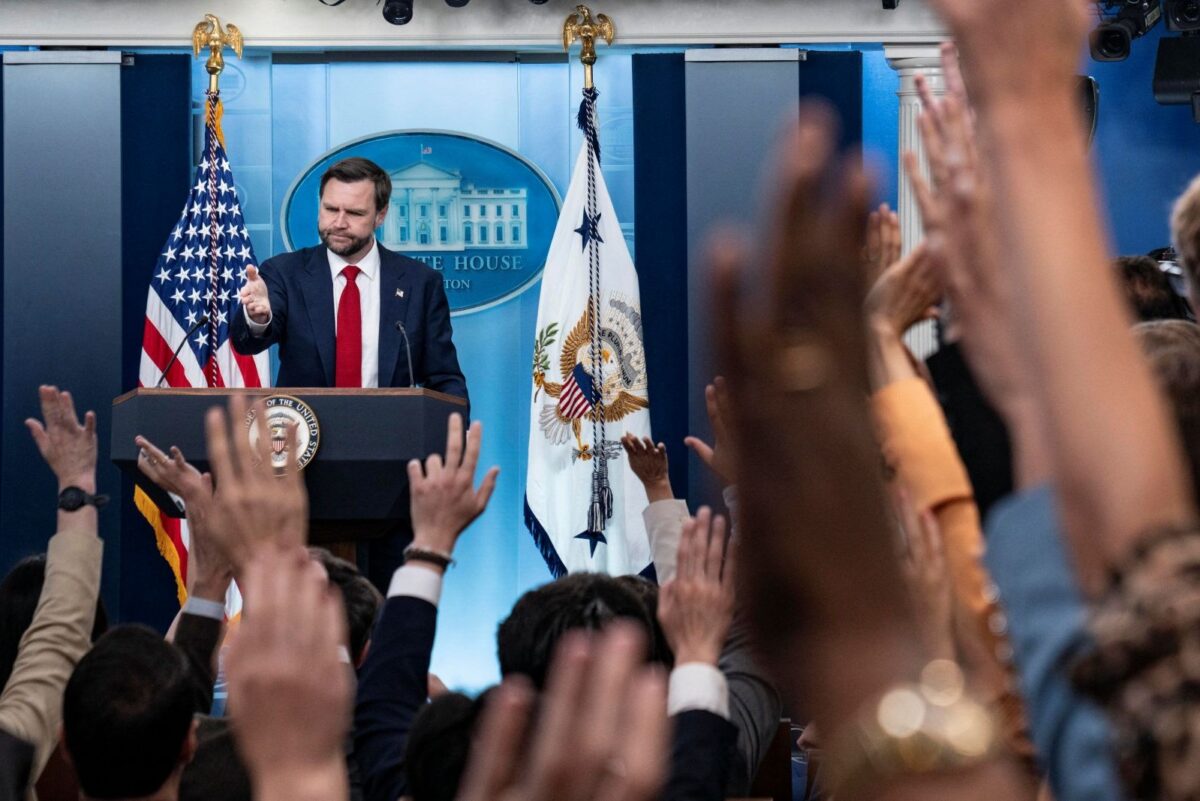
Vice President Jd Vace holds a White House press briefing in Washington, United States, on June 18, 2026. He discusses the peace deal with Iran and its implications during the briefing. (Photo by Andrew Thomas/NurPhoto)
The reported interim framework gives the parties roughly 60 days to negotiate the nuclear file, with Iran expected to dilute or address highly enriched uranium under IAEA supervision, while sanctions relief and reopening of Hormuz are phased in. The key weakness is that the hardest issues — enrichment, missiles, proxies, verification, and enforcement — remain unresolved.
Saudi Arabia’s foreign minister has already identified the central test: verification. Without intrusive, durable inspection mechanisms, any agreement risks becoming a political ceasefire rather than a strategic settlement.
White scenario: Iran complies and re-engages
In this scenario, Iran respects the agreement, accepts meaningful IAEA verification, limits enrichment, avoids proxy escalation, and prioritizes economic recovery.
US reaction: Washington would claim a major diplomatic success, gradually release sanctions relief, encourage Gulf and European economic engagement, and try to lock the deal into a broader regional settlement. The US would likely reduce visible military pressure while keeping intelligence, naval, and air assets positioned as insurance.
Israeli posture: Israel would remain skeptical. Even under compliance, Israel would demand zero tolerance on weaponization, missiles, and Hezbollah. Netanyahu has already framed the issue absolutely: Iran must not acquire nuclear weapons “with or without an agreement.” Israel would probably intensify intelligence collection, covert monitoring, and pressure on Washington to keep snapback mechanisms credible.
Probability: Low to moderate. Iran may accept economic relief, but full strategic reorientation would require the regime to subordinate its revolutionary-security doctrine to economic normalization.
Black scenario: Iran openly reneges
Here Iran walks away, resumes high-level enrichment, rebuilds missile production, reactivates proxies, and challenges Israel and Gulf shipping.
US reaction: The US would likely restore maximum sanctions, reimpose maritime and financial pressure, and consider targeted strikes if intelligence indicates a renewed dash toward weaponization. Given the recent war context and CIA’s public statement that Iran’s nuclear facilities were severely damaged by previous strikes, Washington would probably first use coercive diplomacy, then limited military force if necessary.
Israeli posture: Israel would be forward-leaning. Mossad’s recent public messaging suggests Israel sees the Iran campaign as unfinished and intends to preserve covert freedom of action. In a black scenario, Israel would likely conduct sabotage, targeted killings, cyber operations, and possibly overt airstrikes against nuclear, missile, IRGC, and proxy infrastructure.
Probability: Moderate but not the highest. Iran may avoid openly breaking the deal because doing so would restore US-Israeli legitimacy for renewed force.
Grey scenario: partial compliance, covert rebuilding
This is the most plausible scenario. Iran respects visible parts of the deal, avoids open confrontation, offers limited nuclear concessions, but quietly rebuilds dual-use nuclear capacity, missile production, air defenses, and proxy networks.
US reaction: Washington would try to preserve the deal publicly while tightening verification demands privately. The US would likely use phased sanctions relief as leverage, delay major asset releases, and threaten snapback. The danger is that Washington may tolerate ambiguity to preserve a diplomatic achievement.
Israeli posture: Israel would treat the grey scenario almost as black in slow motion. Israeli analysts already worry that a nuclear-only deal would leave missiles and proxies untouched, especially Hezbollah, Iraqi militias, and the Houthis. Israel would likely maintain covert operations, oppose any large sanctions windfall, and reserve the right to strike if Iran crosses technical thresholds.
Probability: High. It fits Iran’s traditional method: comply enough to gain time and resources, evade enough to preserve strategic options.
Other possible variants
A “freeze-for-cash” scenario: Iran freezes the most visible nuclear activities in exchange for oil revenue and asset releases, while avoiding a final strategic settlement. This gives Washington calm, Tehran money, and Israel anxiety.
A “regional bargain” scenario: Iran reduces overt proxy activity in Lebanon, Iraq, and Yemen, not because it has changed ideology, but because it needs reconstruction funds and sanctions relief. This is possible but fragile.
A “deal collapse by Israel” scenario: Israel concludes that the agreement endangers its security and acts unilaterally, especially if it detects covert enrichment or missile rebuilding. This could force Washington to choose between restraining Israel and rejoining escalation.
A “internal Iranian split” scenario: The elected government favors economic opening, while the IRGC preserves the nuclear/missile/proxy architecture. This would produce formal compliance and practical evasion.
Bottom line
The decisive question is not whether Iran signs. It is whether the deal creates verification, enforcement, and consequences strong enough to change Iranian behavior.
My reading: the most likely outcome is Grey — a tactical truce, partial nuclear restraint, economic relief, and covert strategic rebuilding. The US will try to manage ambiguity; Israel will try to expose or disrupt it.
The views in this story reflect those of the author alone and do not necessarily reflect the beliefs of NOW.