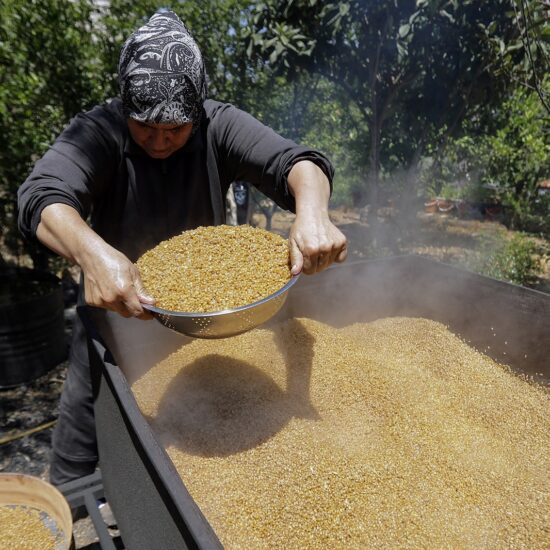
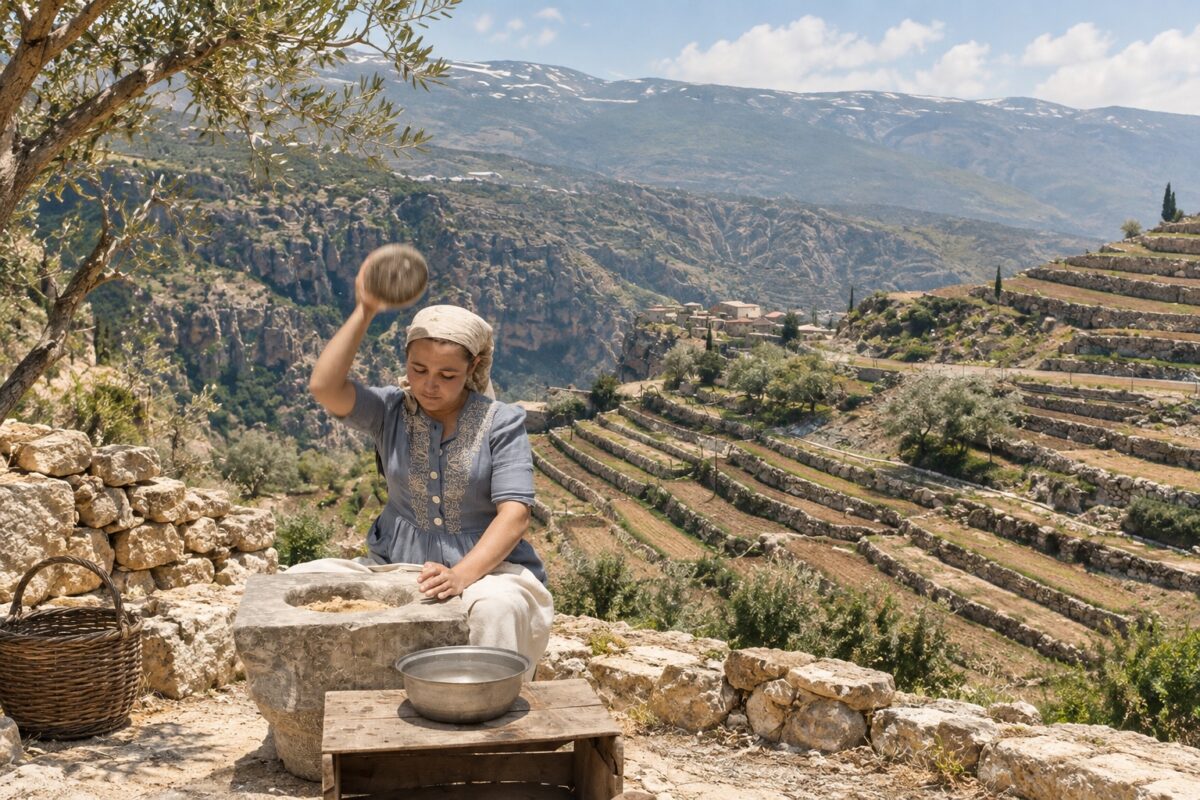
September marks the season of the mouneh, the Levantine practice of preserving seasonal food for the winter months. The term derives from the Arabic verb mawwana, “to store” or “to provision”. This age-old practice offers a window onto how local populations have understood the land they have inhabited for thousands of years; through it, generations built an entire food system. What, then, shaped this system? And what’s really on your plate?
Culinary practices are part of the intangible heritage of communities. Tracing the history of this intangible heritage is always difficult, in the light of the scarcity of written sources. How, then, can we reconstruct foodways across the centuries? First, we need to rely on Archaeobotany, the study of ancient plant remains.
Like the rest of the Levant, present-day Lebanon experienced the Neolithic Revolution, the gradual domestication of wild cereals, particularly barley and wheat (einkorn and emmer), between roughly 10,000 and 8,000 BC. Several sites across Lebanon bear witness to this transformation, including Byblos, Tabarja, Koubba, and Nachcharini in the Anti-Lebanon range. At some of these sites, grinding stones, early pottery, and circular ovens known as tannour attest to the processing of grain: grinding, mixing with water, and eventually baking bread. Bread thus emerged as both a dietary staple and a cultural technology, and the practices it required, cereal storage, milling, and baking, have remained central to Levantine foodways to this day.
The foodways of Bronze Age Lebanon (3500–1200 BC) can be reconstructed from three excavated sites: Tell Fadous-Kfarabida on the coast, Tell el-Kharayeb-Yanouh in the Byblos highlands, and Kamid el-Loz in the Beqaa. At Tell Fadous-Kfarabida, evidence points to a subsistence economy relying on animal husbandry and marine exploitation, with inhabitants keeping cattle, sheep, goats, and pigs; the site has also yielded the earliest positive identification of date palm (Phoenix dactylifera) in Lebanon. Excavations at Kamid el-Loz, capital of a small Bronze Age kingdom in the Beqaa, have similarly illuminated the period’s food practices: barley was the dominant cereal, while dwarf wheat and emmer were considerably less abundant, and among legumes, chickpeas and bitter vetch were the most common, followed by peas and lentils, with grapes also present. The inhabitants of Kamid el-Loz drew on a wide range of environments, forests supplied red deer, hare, wild boar, and brown bear; open habitats yielded onager; rocky terrain provided ibex; and lakes, rivers, and marshes offered wild duck and white-fronted goose, while sheep and goats remained the most abundant livestock, and marine fish bones, likely brought from the Mediterranean coast, attest to trade networks already linking inland and coastal communities. Further into the highlands of Mount Lebanon, Tell el-Kharayeb in Yanouh was settled by a sedentary and organized population that practiced terraced farming, reared cattle, made farming equipment, and produced a standardized form of pottery.
Instead of the unchanging culinary monolith these narratives circulate about Lebanese food, what emerges from the evidence is a dynamic culinary heritage, always open to change, take tabbouleh as its symbol: the tomatoes in tabbouleh, for instance, came from the Americas and were only added in the late 19th century!
For the Iron Age, written sources on everyday food are absent, so the cuisine is best approached through its ingredients. Archaeobotanical investigation at Tell el-Burak, a Phoenician settlement on the coastal plain south of Sidon occupied roughly between the 8th and 4th centuries BC, offers one such window: of the seed and fruit assemblage, cultivated plants were dominated by grapevine (Vitis vinifera), followed by cereals, chiefly barley and hulled wheat, legumes, mainly lentil and bitter vetch, and olive. Minor crops included pomegranate, fig, cucumber, coriander, and flax, along with occasional mastic seeds of uncertain cultivated or wild origin. The preponderance of grapevine at this site relates to a 2,600-year-old wine press discovered at Tell el-Burak, which sheds light on Phoenician winemaking and on the sailors who carried vineyards and wine production across the ancient Mediterranean, spreading a wine-drinking culture far beyond the Levant. In the Old Testament, the prophet Hosea invokes “the wine of Lebanon” as a byword for fragrance and renown, and Greek and Roman authors likewise praised the wine of Lebanon for its bouquet. The Greek term Byblinos, probably derived from Byblos, came to designate a wine of high quality, and ancient sources also mention the wines of Tripoli, Batroun, Beirut, and Tyre.
It is worth remembering that the olive tree and olive oil originated in the Levant, and olive oil has remained a fundamental component of the regional diet for thousands of years. The Phoenicians helped spread the olive and its oil across the Mediterranean, particularly through their colonies, such as Carthage and the cities they founded in Spain.
The Mediterranean food system remained largely stable through the Roman period, and in late antiquity Lebanon became a major supplier of olive oil and wine. From the seventh century onward, under Muslim rule, the region’s landscapes changed profoundly. Advances in irrigation and agricultural technique, encyclopedic works on botany and medicine, and the spread of new crops transformed agriculture. By the ninth century, under the Abbasids, the large-scale cultivation of citrus fruits, rice, artichokes, sugarcane, and eggplant, together with sugar refining, had reshaped both production and consumption across the region. The change appeared first in refined urban cuisine and in the cookbooks of the period, such as the Kitab al-Tabikh (Book of Cooking), compiled in Baghdad in the tenth century. Many of today’s Lebanese dishes trace their origins to this era, including maamoul, awaymet, knafeh, qatayef, and kibbeh arnabiyeh.
During the Mamluk period (1291–1516), the cities of the Lebanese coast, especially Beirut and Tripoli, became key hubs in a trade network linking India to Europe. Two luxury goods dominated this trade: spices and sugar. Spices came from India and Southeast Asia and passed through the Levantine ports, where Venetian and Genoese merchants bought them for European markets. Sugar was produced locally: sugarcane plantations are attested around these two cities as early as the tenth century, and their output was in high demand throughout the Mediterranean. Moghli, the spiced rice pudding prepared to celebrate a birth, brings these two trades together in a single dish, and its origins may well date to this period.
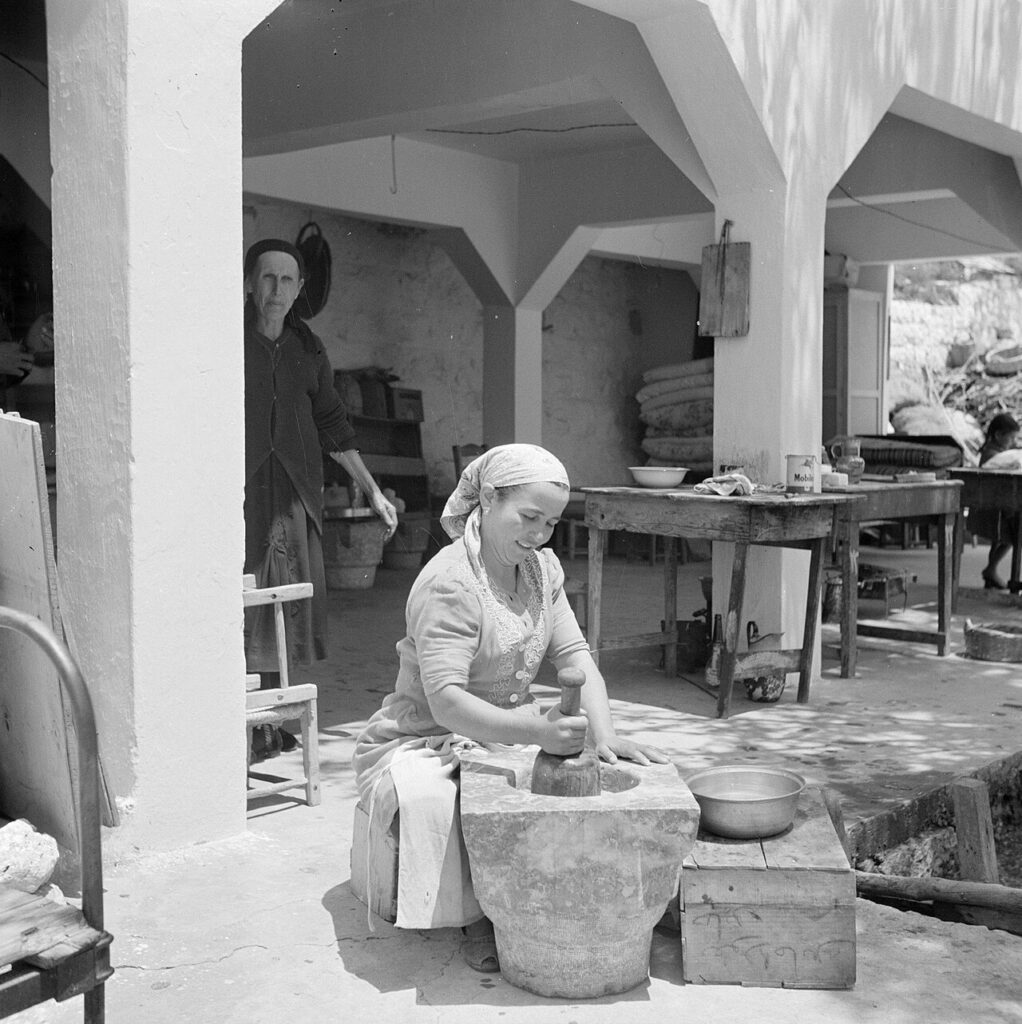
Woman preparing kibbeh in Lebanon, 1955, Van De Poll Collection, Dutch National Archives.
Recent popular narrative also attributes to the Mamluk period the creation of kibbeh nayyeh, the famous raw kibbeh. The claim, widely relayed on social media, holds that Christians of Mount Lebanon invented raw kibbeh to avoid the smoke of cooking fires while hiding from persecution in caves. This account conflicts with the region’s history and material practices. Meat was reserved for important celebrations, and preparing kibbeh requires a stone mortar and freshly slaughtered meat, conditions that sit poorly with a persecution narrative. Moreover, a besieged population sheltering in a cave would have had to slaughter its only source of fresh milk, fertilizer, fuel, and wool: a strategic folly for people trying to survive. The tale is best read as an invented culinary history, born of a modern crisis of identity and unsupported by historical evidence.
During the long Ottoman period (1516–1918), foodways in Lebanon changed unevenly. Most of the population kept a diet based on cereals, pulses, and processed staples such as burghul and kishk, along with other dairy products and the preserved foods of the mouneh. Bread held a central place, baked in the tannour, on the saj, or in the furn. The elite cuisine of the cities, by contrast, followed the models of Istanbul and relied heavily on rice and meat. Ottoman rule also reshaped daily habits beyond the table. Coffee, which spread through the empire in the sixteenth century, left a lasting mark on local custom: invitations to visit are still often phrased as “Come over for a cup of coffee.”
The same centuries brought the effects of the Columbian Exchange, the large-scale transfer of plants, animals, populations, technologies, and diseases between the Old World and the Americas that followed European colonization from the late fifteenth century. New crops such as maize, potatoes, tomatoes, pumpkins, peanuts, and chili peppers reached the region and were gradually adapted to Lebanon’s seasonal rhythms and local food system, supplementing rural production and giving farmers additional food. Some were integrated quickly; others, such as potatoes and tomatoes, entered everyday cooking only in the mid-nineteenth century, especially in rural areas.
In the second half of the nineteenth century, Lebanon’s integration into global markets, driven largely by the silk economy, transformed consumption habits. As a bourgeoisie and a middle class emerged, food served, as it always had, as a marker of prestige in the new red-tiled houses. Sugar imports quadrupled in the last third of the century, and burghul, long a staple of the Lebanese diet, began to give way to rice, whose imports through the port of Beirut rose from negligible levels in 1840 to 8,000 tons in 1885.
Today, the question of “traditional food” has become common currency worldwide, yet it is often used loosely, detached from the historical layering it describes. With the rise of food bloggers and tourism ads seeking to attract visitors with tales of ancient origins for certain dishes, this narrative obscures how much the exchange of foodstuffs and practices built Lebanese cuisine in the first place.
As trade expanded, Beirut and Zahle, both major commercial centers by the second half of the nineteenth century, needed new hotels, taverns, and restaurants. Their establishments took up an Ottoman custom: the mezze. Despite its place today at the heart of Lebanon’s culinary image, mezze is a relatively recent arrival, dating to the nineteenth century, and early travelers’ accounts of food in Lebanon make no mention of it. It developed in the meyhane (“house of wine”), the taverns of Istanbul, which served raki and wine with an array of small, appetizer-like dishes. Local cooks kept the format and replaced the Istanbuli recipes with dishes drawn from their own culinary heritage, reflecting the principles of Lebanese cooking: fresh local ingredients and a light hand with spices. Known locally as na’el, from the idea of small dishes passed around the table, the mezze of the time bore little resemblance to today’s spread.
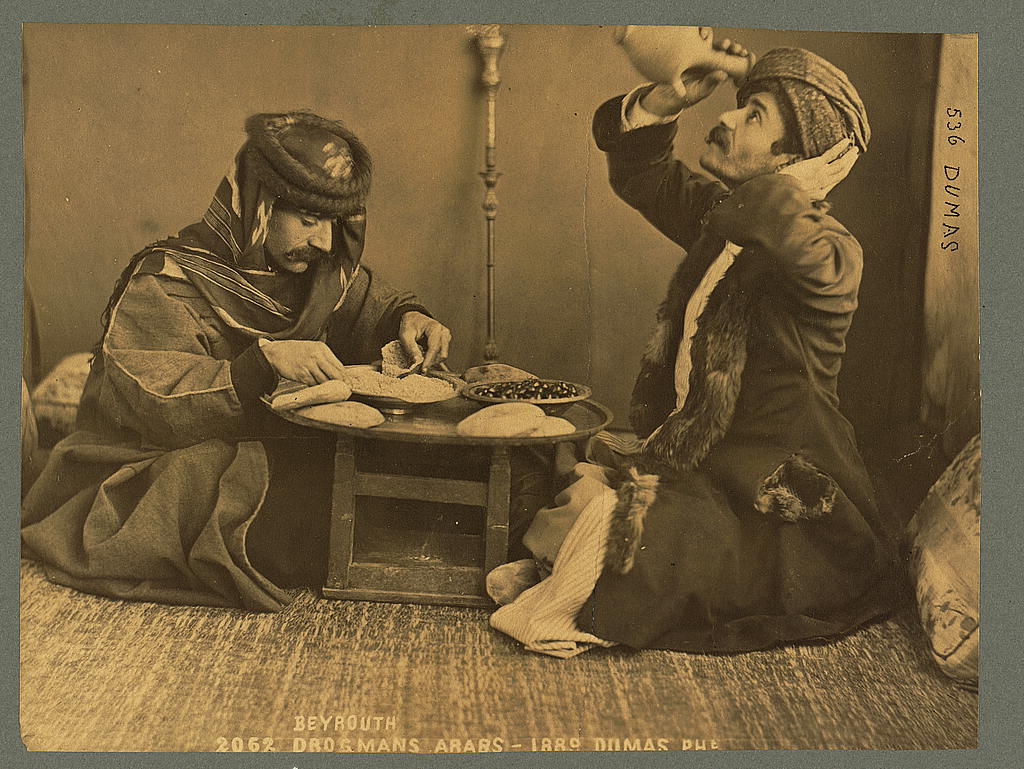
Drogmans (Interpreters) having a bite in beirut, by Alexandre Dumas, 1889.
The first documented cookbook in Beirut, Tadhkirat al-Khawatin wa Ustadh al-Tabbakhin, published by Khalil Sarkis in 1885, answered a growing need to standardize these recipes, and the earliest documented description of mezze in Beirut dates from the same year. Written for two readerships, women running their households and male chefs working in restaurants, the book reflects the growing Western influence in the city: it is divided into Eastern and Western cuisine and includes chapters on etiquette. Missionaries, Western residents, and returning emigrants carried new foods and recipes into Beirut, while families from Aleppo and Damascus brought the refined urban cuisine of their cities to the growing metropolis.
Dyring the 20th century, Lebanon’s food scene has been transformed by the arrival of migrant and refugee communities and by successive foreign influences. Armenian cuisine, for example, has become part of everyday local fare. Under the French Mandate (1920–1943), French cuisine became a hallmark of fine dining in Beirut. In the 1950s and 1960s, American influence shaped fast food in the capital. In the same period, international cuisines gradually entered both the market and the home, helped by Beirut’s relative stability and prosperity and by the ties of the Lebanese diaspora. Also in this period, Lebanese diaspora communities took late Ottoman urban fast foods, such as shawarma, falafel, and hummus, and, alongside other Levantine communities, contributed to making them global fast foods.
Change also came as rural families moved to Beirut, bringing staple recipes with them. Manoushe, inscribed by UNESCO in 2023 as an emblematic culinary practice of Lebanon, is today an icon of the Lebanese breakfast, yet it began as a rural lunch dish, prepared once a week on bread-baking day. Rural women topped part of the dough with thyme, cheese, kishk, or herbs, turning the weekly baking into a quick family meal on a day that left little time for cooking. With the spread of modern ovens and the decline of communal ones, manoushe moved from lunch to breakfast and from the village to the city.
In 1951, as the tourism sector of the Lebanese Republic expanded, the renowned chef Georges Nassif al-Rayyes published The Art of Cooking in Beirut. The book codified the dishes now regarded as Lebanese classics, first served in restaurants and then adopted by a growing middle class. Its influence endures: many of the recipes cooked today in restaurants and homes can be traced to its pages.
Today, the question of “traditional food” has become common currency worldwide, yet it is often used loosely, detached from the historical layering it describes. With the rise of food bloggers and tourism ads seeking to attract visitors with tales of ancient origins for certain dishes, this narrative obscures how much the exchange of foodstuffs and practices built Lebanese cuisine in the first place.
Instead of the unchanging culinary monolith these narratives circulate about Lebanese food, what emerges from the evidence is a dynamic culinary heritage, always open to change, take tabbouleh as its symbol: the tomatoes in tabbouleh, for instance, came from the Americas and were only added in the late 19th century! Lebanese cuisine is a living heritage of knowledge and taste, constantly evolving and open to the new, yet carried by a distinct talent, the “nafas”, the ability to add a sentimental layer, a good taste, with the spirit of generosity and hospitality the Lebanese excel in. Sahtein!
Charles al-Hayek is a public historian and the founder of Heritage and Roots.
The views in this story reflect those of the author alone and do not necessarily reflect the beliefs of NOW.