A growing number of Lebanese no longer view the current political arrangement as a flawed compromise worth preserving, but as a direct path to collapse. What was once framed as coexistence has, in practice, become a system defined by imbalance, where one actor, Hezbollah, operates with military, political, and strategic autonomy that exceeds the authority of the state itself.
This shift has transformed the national question. It is no longer about reforming governance within the existing framework, but about whether that framework still functions at all.
For decades after the Lebanese Civil War, Lebanon’s political order relied on a delicate equilibrium among its communities. The Taif Agreement formalized this balance, redistributing power and reaffirming the authority of the central state.
Yet the post-war settlement encouraged a critical exception: Hezbollah retained its arms under the banner of “resistance.” What may have once been framed as temporary gradually became permanent, and then transformative.
Over time, Hezbollah developed into something far beyond a resistance militia. It became a military force independent of the Lebanese Armed Forces, a regional actor linked to Iran’s strategic agenda, and a domestic power capable of shaping, or halting, state decisions.
This evolution has eroded the premise on which post-war Lebanon was rebuilt: that no single actor would dominate the system.
This evolution has eroded the premise on which post-war Lebanon was rebuilt: that no single actor would dominate the system.
Recent patterns suggest not just consolidation, but expansion. Hezbollah’s presence, political, social, and in many cases security-related-has extended into areas that were historically outside its core base- thanks to its allies- including parts of West Beirut and segments of the coastal belt, Mount Lebanon and the North.
This expansion is not merely symbolic. It alters local power dynamics, influences municipal governance, and reshapes the balance between state institutions and non-state authority.
For communities in these areas, the implications are immediate.
The issue is no longer confined to traditional zones of influence. It is becoming national in scope.
Lebanon’s tendency to delay decisive action has often been justified as prudence, exactly what’s been used by President Joseph Aoun to explain “State Inaction”. Today, that instinct carries escalating costs.
The country is still reeling from the financial collapse that began in 2019, one of the most severe economic crises in modern history. Currency devaluation, banking restrictions, and institutional paralysis have devastated livelihoods. At the same time, Lebanon remains entangled in regional tensions, worst it became the parallel theater for war on the Iranian criminal regime due to Hezbollah and Berri pacts and unity with the Mullahs and the IRGC.
Within this environment, the continued existence of an autonomous armed actor whom terrorist activities stretching beyond borders amplifies risk. It is exposing Lebanon to conflicts it did not choose, complicating relations with Gulf and Western states, and undermines confidence in any recovery process.
Waiting for internal balance to somehow reassert itself is no longer a realistic strategy.
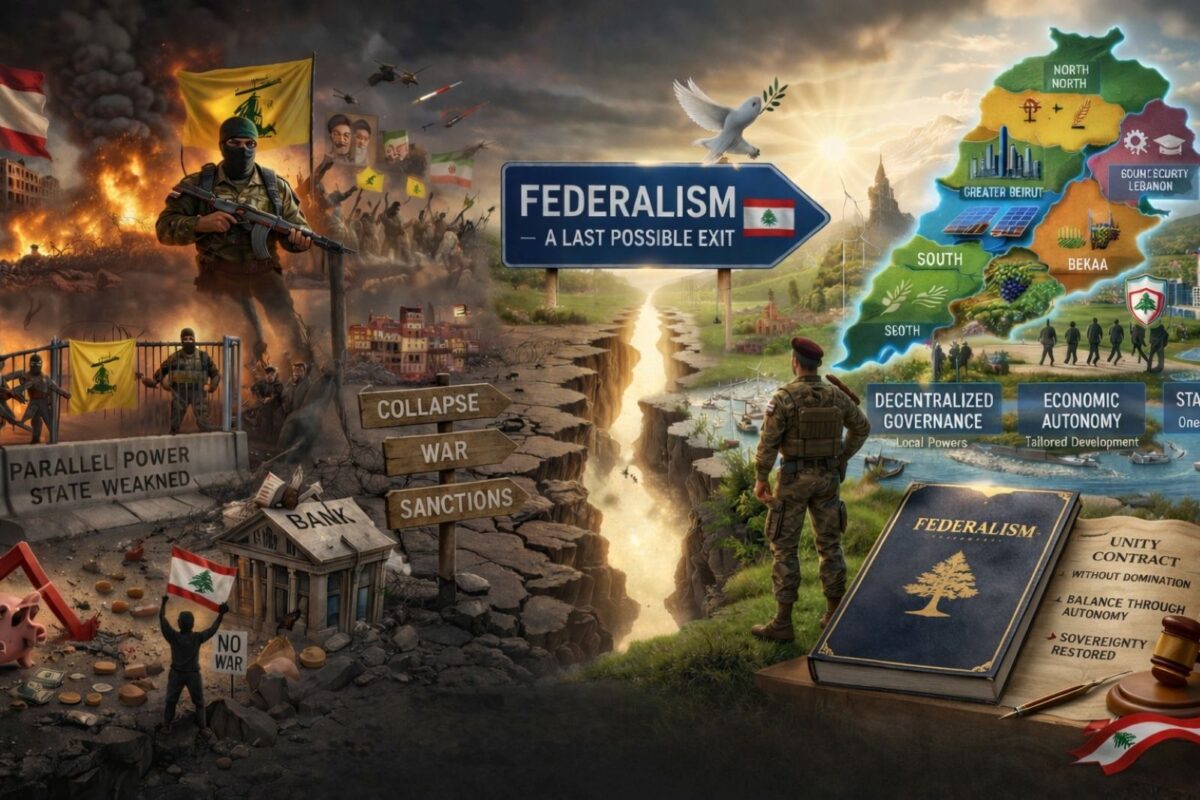
Ideas once considered untouchable are now entering mainstream debate. Among them is federalism, not as a slogan, but as a structural alternative to a system that many see as irreparably compromised.
Federalism, in this context, does not imply partition or secession. Rather, it proposes a reconfiguration of the state into regions with substantial autonomy, each capable of managing its own affairs while remaining part of a broader national framework.
It envisions decentralized governance, where regional authorities exercise legislative and administrative powers, alongside economic autonomy that allows localized fiscal policies to address uneven development. It also implies security structures aligned with state legitimacy, ensuring that official armed forces, not parallel organizations, retain authority.
For proponents, the argument is straightforward: if the center cannot function as a neutral arbiter, then power must be redistributed in a way that protects communities and restores accountability.
The call to disengage politically and physically from Hezbollah reflects more than tactical disagreement. It signals a rupture in the underlying logic of shared governance.
Lebanon’s system depends on consensus. But consensus presumes equality among participants. When one party holds coercive power outside the state, that equality is compromised.
Lebanon’s system depends on consensus. But consensus presumes equality among participants. When one party holds coercive power outside the state, that equality is compromised.
Refusing to “share a table” under such conditions is not simply an act of defiance, it is a rejection of a process perceived as structurally unbalanced.
This position carries significant implications. It challenges the viability of national-level decision-making, accelerates the search for alternative governance models, and forces a redefinition of what political participation means in Lebanon.
Critics of federalism warn, correctly, of its risks. Lebanon’s history is marked by sectarian divisions, and any move toward decentralization must avoid hardening those lines.
There are concerns about economic inequality between regions, administrative fragmentation, and the possibility of deepening political separation.
Yet the current system presents its own form of fragmentation, one that is less visible but equally consequential: a state that exists in name, while authority is unevenly distributed in practice.
The debate, therefore, is not between unity and division. It is between two different kinds of fragmentation: one acknowledged and managed, the other denied and worsening.
Any serious discussion of federalism would require constitutional reform grounded in broad consensus, clear delineation of powers between central and regional authorities, mechanisms to ensure national cohesion in foreign policy and defense, and economic frameworks that prevent extreme disparities.
These are complex tasks. But complexity alone cannot justify maintaining a system that no longer delivers stability or sovereignty.
Lebanon’s crisis is no longer confined to economics or governance. It is existential. The question is not how to tweak the current model, but whether it can still serve as a foundation for a functioning state.
For those who believe it cannot, federalism represents an attempt to preserve what remains, by adapting structure to reality rather than clinging to a framework that has already fractured.
The choice ahead is not easy, and it is not without risk. But neither is the path Lebanon is currently on.
Elissa E Hachem is a journalist and political writer specializing in regional affairs and governance. Former Regional Media Advisor at the U.S. State Department’s Arabic Regional Media Hub, with broad experience in strategic communication across government and private sectors.
The views in this story reflect those of the author alone and do not necessarily reflect the beliefs of NOW.