
Lebanon sees celebrations and tensions as Syrians mark Assad’s fall anniversary.”
Dozens of people took to the streets of Beirut and several other regions in Lebanon on Monday to mark the first anniversary of the fall of Bashar al-Assad’s regime in Syria. Scenes circulating on social media showed groups of young men riding in motorcycle convoys and waving Syrian flags as they moved through various neighborhoods of the capital.
Similar displays were reported across the country. In the southern city of Sidon, celebratory motorcades led to tensions when a group of young men clashed with others near the Qanaya roundabout at the entrance of Haret Saida. According to the state-run National News Agency (NNA), the altercation escalated from verbal disputes to physical fighting with sticks, resulting in damage to several cars. A Lebanese Army unit intervened quickly, cordoning off the area and dispersing those involved.
The unrest comes as Syrians both inside the country and abroad commemorate the first year since the collapse of Assad’s rule on December 8, 2024. His overthrow followed 11 days of opposition-led military operations launched from Aleppo as part of what was dubbed the “Deterrence of Aggression” campaign.
In Khaldeh, south of Beirut, hundreds of Syrian residents gathered on the coastal highway, temporarily blocking traffic before security forces reopened the road. Celebratory marches were also recorded in Damour, Corniche al-Mazraa, Raoucheh, and Aramoun, where participants carried Syrian flags and set off fireworks amid a visible security presence.
Further north, Lebanese Army units deployed in Tripoli after clashes broke out in Al-Nour Square. The confrontation involved the exchange of fireworks between groups of young men, prompting the army to intervene. Security forces reinforced their presence around the entrances to Jabal Mohsen and Talat al-Omari as part of broader measures to prevent further unrest.
The NNA reported a second clash in Sidon later in the day—again near the Qanaya roundabout—between local residents and participants in a car convoy celebrating the anniversary of Assad’s fall. The confrontation mirrored the earlier incident, escalating to stick fights and resulting in additional vehicle damage before the army stepped in to restore order.
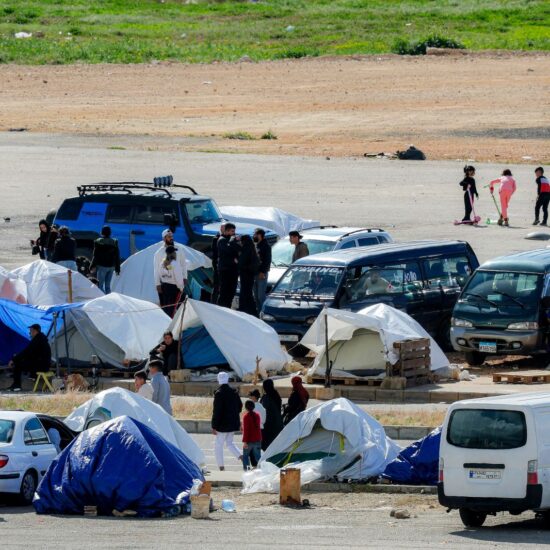
As Lebanon continues to host more than a million Syrians displaced by the war, Monday’s gatherings highlighted both the deep political resonance of developments in Syria and the fragile security dynamics inside Lebanon, where celebrations can quickly spill into provocation or tensions between communities.
A Look Back
The fall of Bashar al-Assad’s regime on December 8, 2024 marked one of the most unexpected turning points in the modern Middle East. After more than a decade of war and over fifty years of Assad family rule, the Syrian government collapsed in a matter of days following a surprise offensive by opposition factions. The operation—launched from opposition-held territories around Aleppo and Idlib on November 27—cut through regime lines with unprecedented speed. As rebels advanced, military bases and airports were abandoned, cities like Aleppo fell with minimal resistance, and detainees were freed from prisons long associated with torture and political repression. By early December, the structure of the Syrian state had unraveled, ending an era defined by authoritarian rule, a devastating civil war, and one of the largest displacement crises in recent history.
One year later, the effects of Assad’s fall continue to shape the region and are felt acutely in Lebanon, where more than a million Syrians have sought refuge since 2011. For many Syrians—especially those displaced—December 8 has become a symbolic date: a moment to reclaim political agency after years of exile, fear, and uncertainty. For others, particularly in Syria, the anniversary marks a new and unstable chapter as different opposition groups attempt to fill the vacuum left by the regime’s collapse. Across the diaspora, including in Lebanon, the anniversary is both a remembrance and an expression of hope, a reminder of the sacrifices made and a statement about the future Syrians envision for their country.
But in Lebanon, public Syrian celebrations carry a weight that goes beyond symbolic expression. Lebanon hosts one of the largest Syrian refugee populations per capita in the world, and the long-term presence of so many displaced families has reshaped the country’s political, social, and economic environment. In the years following the war, pressures on public services, economic deterioration, and political paralysis have fueled growing resentment toward refugees in parts of Lebanese society. Various political actors have also amplified anti-refugee rhetoric, framing Syrians as contributors to Lebanon’s economic collapse or as a security threat requiring tighter control. This climate leaves Syrian communities in a vulnerable position, often navigating discrimination, crackdowns, and calls for forced or coerced return.
Why This Matters
In response to the Syrian demonstrations, Hezbollah supporters also took to the streets on motorcycles, waving flags and chanting pro-Hezbollah slogans — a clear rejection of the new Syrian sentiment that has rippled across the country.
Former MP Mustafa Allouch told NOW that the core question in evaluating any public celebration is whether it violates Lebanon’s national sovereignty or public order. He draws a sharp distinction between armed political displays, which he considers a clear breach of sovereignty, and peaceful public celebrations, which fall under freedom of expression.
“If marches are armed, then certainly this is a breach of national sovereignty,” he explained.
But when it comes to unarmed gatherings, Allouch is clear. Peaceful celebrations do not inherently violate the law, regardless of their political meaning. He compares them to scenes seen around the world.
“If Germany or Brazil wins the World Cup, people take to the streets to celebrate. There’s nothing in the law that says this is a breach of sovereignty.”
For him, the red lines are specific; Weapons, incitement against Lebanon, messages that express contempt for the state.
“If slogans are raised that are anti-national or express disdain for the country, then certainly that is punishable,” he said.
Allouch also points out that the reaction to Syrian celebrations in Lebanon could be shaped by social discrimination against refugees.
“As a population, we can be very racist,” the expert said. “We hope this issue doesn’t blow out of proportion.”
From his end, MP Ibrahim Mneimneh told NOW that these type of demonstrations should not have taken place without proper authorization—especially given Lebanon’s fragile internal situation and the sensitivities surrounding the Syrian presence in the country. He noted that, “naturally, we should not have demonstrations in Lebanon that raise flags other than the Lebanese flag,” adding that such gatherings risk provoking tensions.
Mneimneh explained that any public movement requires a permit so that security forces can monitor the details, prevent friction, and avoid “provocation and counter-provocation.” According to him, if a permit is issued, the official who grants it should be held responsible for assessing whether the event could escalate given current sensitivities.
Mneimneh added that proper coordination is essential, emphasizing the need for cooperation between the army and other security agencies.
He also pointed out that Hezbollah’s own marches add to the overall tension, saying that all groups must be subject to the same rules. Security forces, he argued, should handle all public movements equally to prevent the street from turning into a space for competing shows of force.