On Easter Sunday, President Joseph Aoun chose to speak of diplomacy.
There was something almost poetic about the timing. Across Lebanon, churches were marking the resurrection—an affirmation that truth, even when buried, can rise again. And yet, as the president spoke, one could not escape the irony: while Christ has risen, the Lebanese state has not.
The president’s words, taken at face value, were not wrong. He insisted that negotiations are not surrender, that diplomacy is not defeat. In a country exhausted by war, this is a necessary reminder. Lebanon cannot survive another round of destruction dressed up as resistance. It cannot continue to pay the price of decisions it does not make.
But the problem was never in what he said.
It was in what he refused to say.
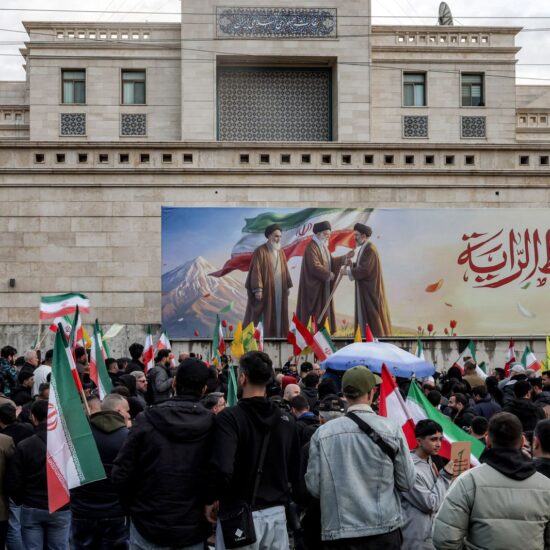
Because in Lebanon, the crisis is no longer hidden. It is not abstract, and it is not complicated. There is an armed organization that operates outside the authority of the state, that decides when Lebanon goes to war, and that answers, ultimately, not to Beirut but to Tehran. This is not a matter of interpretation. It is the central fact of Lebanese political life.
And yet, once again, it was treated as if it were unspeakable.
The president circled the issue. He gestured toward it. He hinted, carefully, cautiously, as if naming it would somehow make it more dangerous. But in doing so, he reproduced the very logic that has allowed this crisis to persist: the logic of avoidance.
In Lebanon, avoidance is not neutrality. It is complicity.
There is a growing tendency, one that increasingly shapes official discourse, to frame this avoidance as prudence. We are told that confronting Hezbollah risks civil war, that preserving “civil peace” requires ambiguity, that the state must move carefully, indirectly, patiently.
But this argument rests on a fundamental distortion.
What is being preserved is not peace. It is paralysis.
Hezbollah does not operate in ambiguity; it benefits from it. It thrives in a system where the state hesitates, where officials speak in half-sentences, where the obvious is left unspoken. Every time the state avoids naming the problem, it reinforces the idea that the problem is untouchable.
And once something becomes untouchable in Lebanon, it becomes permanent.
The most effective tool used to justify this paralysis is the specter of civil war. It is invoked reflexively, almost ritualistically, as if any assertion of state authority is a step toward internal conflict. But this is a misuse of history.
Lebanon today is not the Lebanon of 1975. What exists now is not a balance of militias but an imbalance of power—one armed actor operating beyond the state, not multiple factions competing within it. To equate the enforcement of state sovereignty with the outbreak of civil war is to accept, in advance, the collapse of the state.
A Lebanese soldier enforcing the law is not a sectarian act.
A state reclaiming its monopoly over arms is not a provocation.
A Lebanese soldier enforcing the law is not a sectarian act.
A state reclaiming its monopoly over arms is not a provocation.
It is the minimum requirement of existence.
This is where the president’s argument collapses under its own weight. Diplomacy, as he correctly stated, is necessary. But diplomacy without sovereignty is fiction. No country can negotiate seriously while the decision of war and peace lies elsewhere. No state can promise stability while its territory is functionally divided between official authority and parallel command.
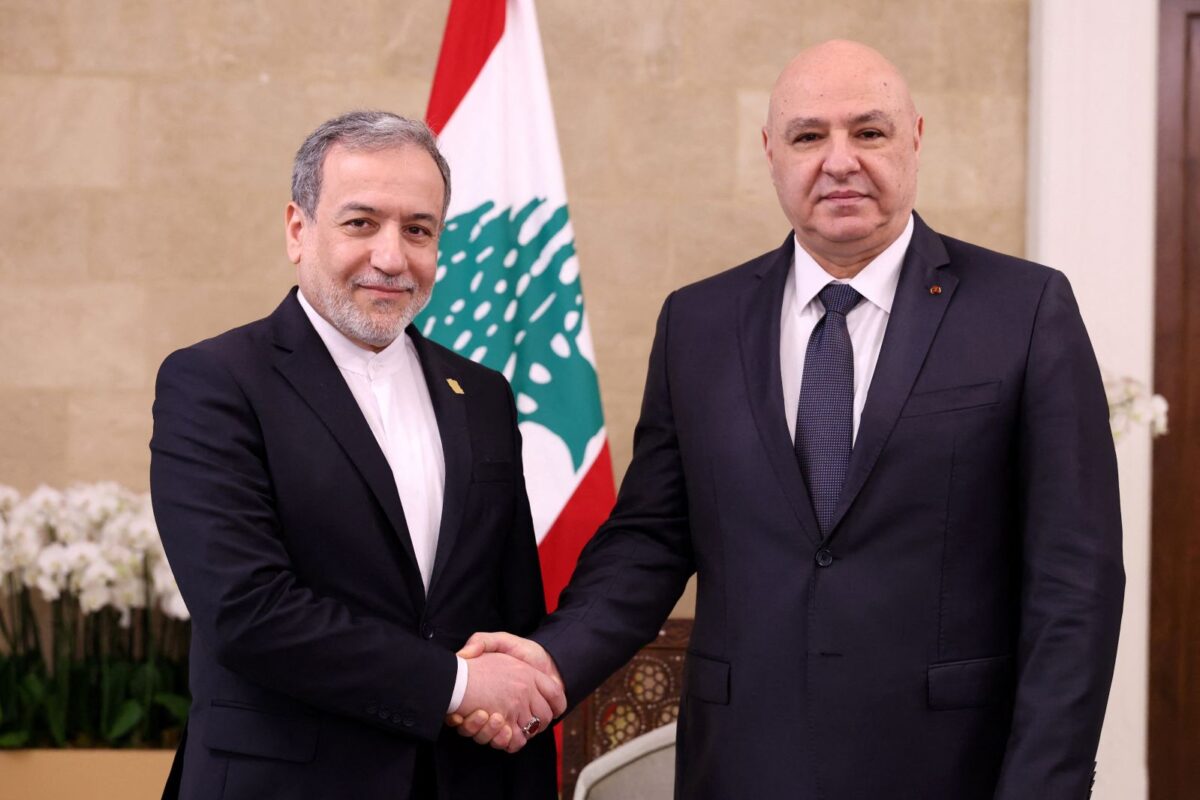
Because the question that precedes all diplomacy remains unanswered: who speaks for Lebanon?
This is why, despite the president’s openness to negotiations, there is little indication that such efforts will lead anywhere meaningful. Because the question that precedes all diplomacy remains unanswered: who speaks for Lebanon?
As long as that question has more than one answer, diplomacy becomes performance.
To understand why this persists, one must look beyond Lebanon itself. Hezbollah did not enter this war for Lebanon. It entered it as part of a regional calculation tied to Iran. Its priorities are not calibrated to Lebanese interests but to a broader strategic architecture that extends far beyond the country’s borders.
This is why appeals to its “Lebanese responsibility” repeatedly fail. They misunderstand the nature of the actor in question. One cannot domesticate what is structurally external.
And yet, the Lebanese state continues to behave as if this were a misunderstanding that can be resolved through careful language and incremental gestures.
It cannot.
What Lebanon lacks is not a roadmap. The principles are neither new nor controversial: the state must monopolize arms, the constitution must be enforced, and no actor can operate above the law. These are not radical demands. They are the baseline of any functioning state.
What is missing is the willingness to say them plainly, and to act accordingly.
Instead, we are offered a politics of suggestion, where the most important truths are implied but never stated, where everyone understands the reality but pretends otherwise. It is a politics that confuses restraint with wisdom and avoidance with strategy.
It is, in effect, a politics that ensures its own failure.
Easter is, ultimately, about the return of what was thought lost. It is about the reappearance of truth in a moment of doubt. President Aoun had, on this day of all days, an opportunity to signal such a moment for Lebanon—to speak with clarity, to name the problem, to assert, unequivocally, that the state must rise.
Easter is, ultimately, about the return of what was thought lost. It is about the reappearance of truth in a moment of doubt. President Aoun had, on this day of all days, an opportunity to signal such a moment for Lebanon—to speak with clarity, to name the problem, to assert, unequivocally, that the state must rise.
He chose not to.
And so the country remains suspended between what is said and what is known, between the language of diplomacy and the reality of power.
Christ has risen.
But the Lebanese state is still waiting.
Makram Rabah is the managing editor at Now Lebanon and an Assistant Professor at the American University of Beirut, Department of History. His book Conflict on Mount Lebanon: The Druze, the Maronites and Collective Memory (Edinburgh University Press) covers collective identities and the Lebanese Civil War. He tweets at @makramrabah