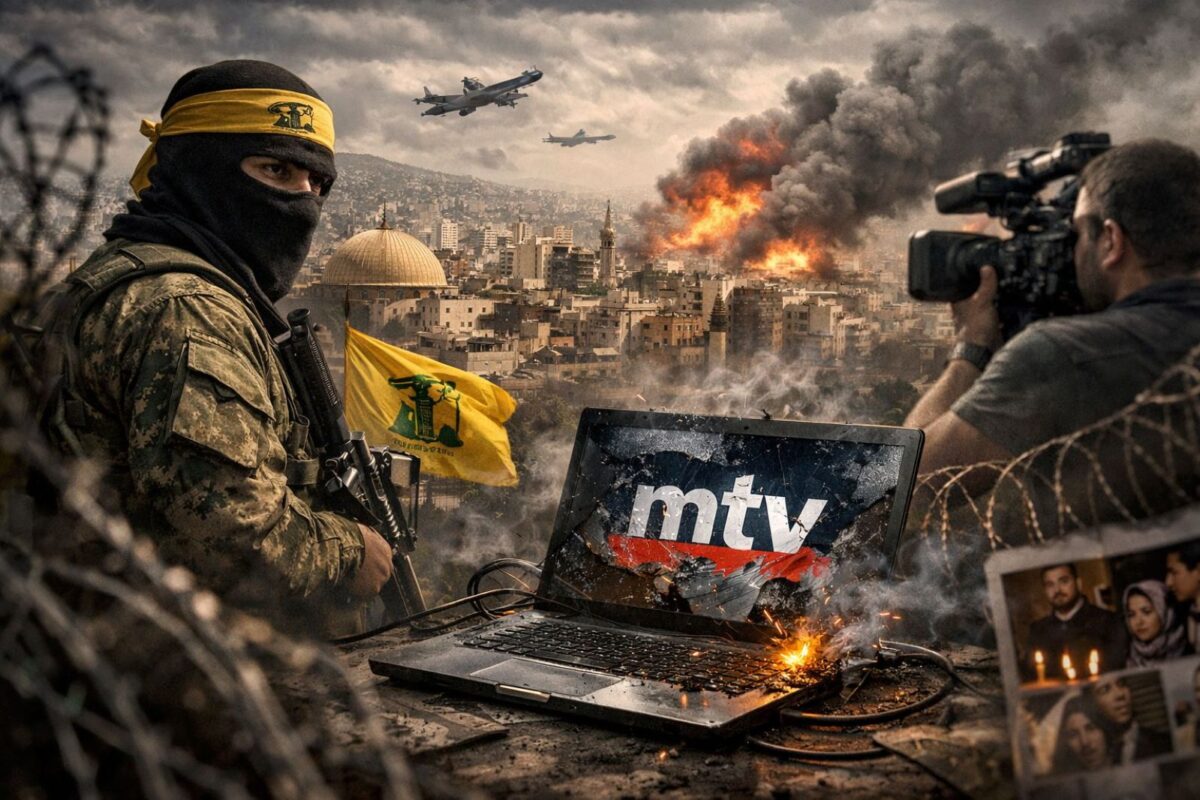
In a country where telling the truth has become a punishable offense, it is hardly surprising that MTV has come under a barrage of threats and cyberattacks simply for doing its job as a media institution: reporting facts accurately. After the channel aired a report exposing the existence of Hezbollah-run secret prisons in Beirut’s southern suburbs, the familiar machinery of intimidation went into overdrive. A chorus of accusations—petty in substance and absurd in logic—claimed that the channel was “providing coordinates to the Israeli army.”
This narrative is not only dishonest; it is insulting. The information presented in the report is neither classified intelligence nor some groundbreaking revelation. It is widely known, discussed openly by residents of the area, and documented in both local and international reporting. Much of it is common knowledge, including within Hezbollah’s own environment.
The problem, therefore, is not the information itself. The problem is Hezbollah’s constant need to manufacture an internal enemy.
Whenever it suffers a blow from Israel, Hezbollah refuses—indeed, it avoids—any serious self-reflection about why its positions are being targeted or why it has turned densely populated civilian areas into open military zones. Instead, it looks for a scapegoat: a journalist, a television station, a social media activist—anyone who dares to say what everyone already knows.
The cyberattack that targeted MTV’s website, claimed by the so-called “Fatemiyoun Cyber Team,” is not an isolated technical incident. It is part of a systematic campaign of intimidation designed to silence Lebanese media, suppress the truth, and deter anyone who might consider breaking the wall of fear.
And yet, what is both tragic and comical is the nature of the accusation itself.
For Hezbollah to accuse a Lebanese media outlet of being responsible for Israeli strikes is akin to a foolish drug addict walking into a police station to report that his stash of hashish has gone missing. That is the level of logic being imposed on the Lebanese.
A militia that has stockpiled rockets among residential buildings, transformed civilian neighborhoods into weapons depots, and built a full-fledged military infrastructure within urban areas now wants to convince us that the problem is not the rockets—but the journalist who spoke about them.
More ironically still, Hezbollah itself knows that this narrative convinces no one. Israel does not rely on Lebanese news bulletins to identify its targets. The region’s history is replete with examples of sophisticated intelligence penetration, surveillance technologies, and preemptive targeting capabilities. But admitting this would require acknowledging a far more uncomfortable truth: that Hezbollah is deeply infiltrated, structurally weakened, and far more fragile than it claims.
And so, as always, it resorts to the easiest escape—accusing the media.
But the issue goes far beyond a single report. Hezbollah is not merely an armed group operating outside the authority of the state; it is a state within the state. It runs its own prisons, detains Lebanese citizens outside any legal framework, and operates a parallel investigative apparatus. More dangerously, this parallel system sometimes seeps into official institutions, feeding files and “evidence” into the Lebanese judiciary—particularly the military courts—as if Hezbollah were a legitimate security agency.
In doing so, it does not only monopolize weapons; it attempts to monopolize justice itself.
In doing so, it does not only monopolize weapons; it attempts to monopolize justice itself.
The bitter irony is that this same organization—widely associated with the Captagon economy and cross-border smuggling networks—launches smear campaigns against anyone who dares to describe its reality. The moment a Lebanese citizen points to Hezbollah’s involvement in drug trafficking or recalls its history of political assassinations, they are immediately branded a “foreign agent,” a “Zionist,” a “traitor.”
Thus, agents of Iran accuse the Lebanese of treason. A militia tied to a regional project accuses those who demand state sovereignty of being foreign operatives.
This is not merely hypocrisy; it is political farce.
The truth Hezbollah seeks to obscure is far simpler. The strikes it suffers are not the result of a television report but of an exposed and overstretched military structure. The security breaches whispered about within its own ranks are not the work of journalists in Beirut but the product of a system rotting from within.
While it asks its supporters to prepare for existential wars, many of its leaders inhabit an entirely different reality—one of deals, parallel economies, smuggling networks, and lifestyles that bear little resemblance to the image of “resistance” they market to their base.
The campaign against MTV is therefore not really about MTV. It is about controlling Hezbollah’s own environment. It is about telling its audience: “You are under media attack.” It is the same narrative it has always used to deflect failure and prepare the ground for what comes next.
This strategy of intimidation is not directed at Israel—it is directed inward. Hezbollah knows that the coming phase will be difficult. It anticipates questions from within its own constituency—about losses, about war, about economic collapse, about weapons, and about an uncertain future.
And so, it preemptively constructs an internal enemy to carry the blame.
Once again, MTV is not the real target. The message is aimed at every Lebanese journalist:
If you speak the truth, we will threaten you.
If you raise your voice, we will accuse you.
If you persist, we will come after you.
The flaw in this strategy is that it rests on an outdated assumption—that the Lebanese are still afraid.
They are not.
Lebanese citizens know who hijacked their state, who turned their cities into battlegrounds, and who tethered their country to a regional project that has nothing to do with Lebanon’s national interest.
Defending MTV today is not about defending a television station. It is about defending a principle: that telling the truth is not an act of treason.
The real betrayal lies in a militia that has captured an entire country and then accuses its journalists of causing the catastrophe.
And the ultimate betrayal is that a weapon once justified as a means of defending Lebanon has been turned inward—to silence, intimidate, and suppress the very people it claims to protect.
As for the attempt to recast Lebanese media as the perpetrator, it is merely the latest act in an old and tired play: the victim that insists on being the executioner at the same time.
Hezbollah’s real crisis is that this theatrical performance no longer convinces anyone.
Makram Rabah is the managing editor at Now Lebanon and an Assistant Professor at the American University of Beirut, Department of History. His book Conflict on Mount Lebanon: The Druze, the Maronites and Collective Memory (Edinburgh University Press) covers collective identities and the Lebanese Civil War. He tweets at @makramrabah