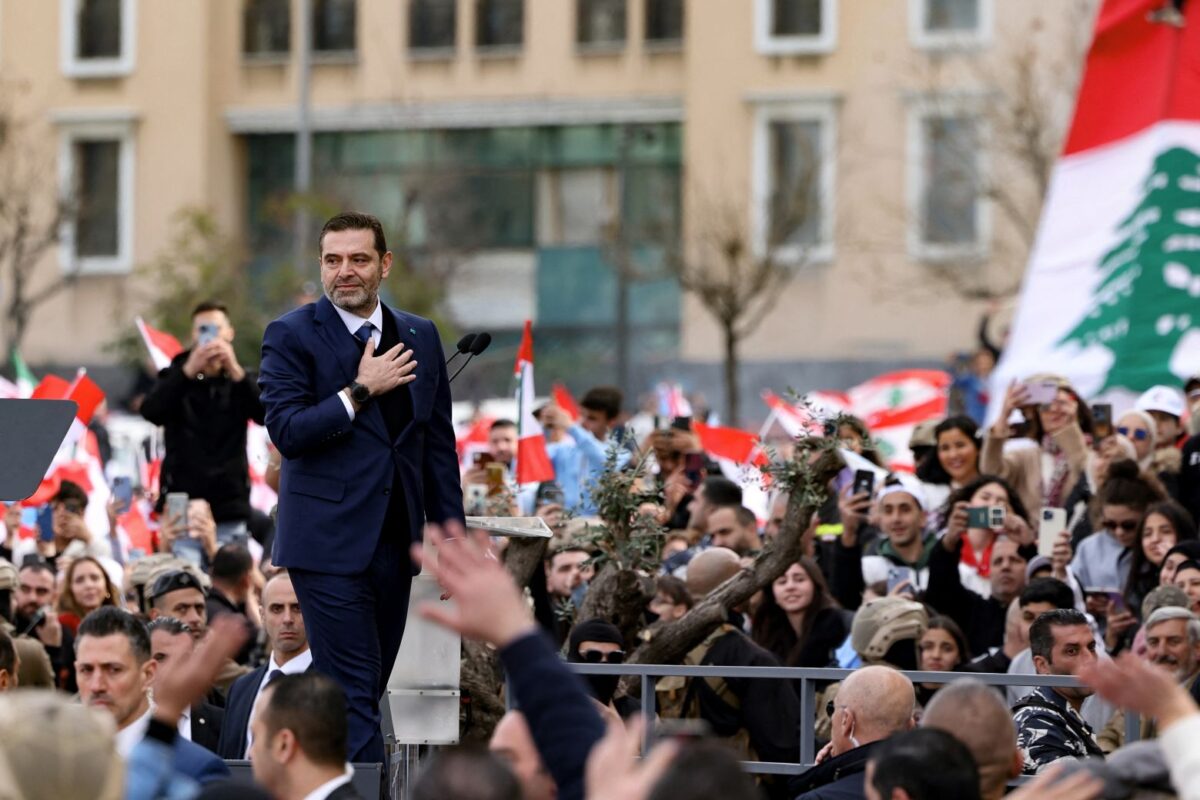
BEIRUT — Lebanon’s political scene is stirring again as former Prime Minister Saad Hariri returned to Beirut to mark the 21st anniversary of the assassination of his father, former Prime Minister Rafik Hariri.
Why it matters: The annual Feb. 14 commemoration has long served as more than a memorial. It is a barometer of Sunni political mobilization, a signal of Lebanon’s shifting alliances, and — this year — a possible turning point in whether Saad Hariri re-enters political life.
The scene in Beirut
- Hariri arrived at Beirut–Rafic Hariri International Airport on Thursday and proceeded to his residence at Bayt al-Wasat in central Beirut.
- The residence quickly became a hub of diplomatic and political meetings.
- Meanwhile, Martyrs’ Square is fully prepared to host large crowds expected for Friday’s commemoration.
At 12:55 p.m., supporters are scheduled to recite Al-Fatiha in memory of Rafik Hariri, followed by Saad Hariri’s annual address — a speech that often sets the tone for Lebanon’s political season.
Behind the scenes: A diplomatic flurry
On his first day back, Hariri met with:
- U.S. Ambassador Michel Issa
- U.N. Special Coordinator for Lebanon Jeanine Hennis-Plasschaert,
- French Ambassador Hervé Magro,
alongside senior aides and former MP Bahia Hariri.
The takeaway: The meetings underscore the enduring international interest in Sunni leadership and Lebanon’s political balance — particularly amid ongoing debates over state sovereignty, Hezbollah’s arms, and regional realignments.
What to watch in Saturday’s speech
Hariri’s annual Feb. 14 speech traditionally blends remembrance with political messaging. This year, observers expect a focus on:
- State monopoly over arms — reaffirming the principle of exclusive weapons control by the Lebanese state.
- Support for the Lebanese Armed Forces — positioning the army as the cornerstone of sovereignty.
- Domestic political shifts — including the fallout from the past year’s regional and internal developments.
- Electoral participation — the most anticipated question: Will Hariri formally return to politics and contest upcoming parliamentary elections?
There is, so far, no confirmed decision. But insiders suggest the contours of the speech are largely set, with signals likely — even if no final declaration is made.
The broader context
The Feb. 14 anniversary has historically mobilized large crowds and defined political alignments in Lebanon’s post-2005 era. Rafik Hariri’s assassination reshaped the country’s trajectory, triggering the Cedar Revolution and the withdrawal of Syrian troops.
Two decades on, the political terrain has shifted dramatically:
- Hezbollah remains a dominant force.
- Sunni leadership is fragmented.
- Lebanon’s economy is still in freefall.
- Regional dynamics — from Syria to Iran — continue to shape domestic calculations.
Hariri’s possible re-entry could consolidate parts of the Sunni electorate and recalibrate alliances ahead of parliamentary elections.
Bottom line
This year’s commemoration is less about ritual and more about direction.
If Saad Hariri signals a return, Lebanon’s electoral landscape could change overnight.
If he hesitates, the vacuum in Sunni politics may deepen.
Either way, Feb. 14 remains not just a date of remembrance — but a recurring test of Lebanon’s unfinished political reckoning.