
In Beirut’s political salons and private offices, where rumors often travel faster than facts, one conclusion has begun to take shape among diplomats and intelligence officials watching Lebanon’s slow drift toward another strategic turning point: the immediate obstacle to any credible peace negotiation is not Hezbollah itself. It is Nabih Berri.
Hezbollah, of course, remains the structural enemy of any peace arrangement with Israel. That much is obvious. But Hezbollah’s position has never been ambiguous. Berri’s has.
For months, the Speaker of Parliament has refused to openly engage with the idea of negotiations. Publicly, he speaks the language of resistance. Privately, according to several individuals familiar with recent discussions among Lebanese political leaders and foreign interlocutors, his position is more complicated.
Berri’s hesitation is rooted less in ideology than in calculation.
Berri’s hesitation is rooted less in ideology than in calculation.
The first concern is domestic. Hezbollah’s dominance within the Shiite political sphere leaves little room for dissent. An overt move by Berri toward negotiations could provoke a backlash not only from Hezbollah itself but also from factions within the Shiite community that view any departure from the “resistance line” as a form of communal betrayal. Berri has spent decades cultivating Amal as the political counterpart to Hezbollah. He is unlikely to risk watching that base fracture overnight.
There is also the matter of history—something Lebanese politicians tend to remember with unusual precision. Berri has not forgotten the fate of Kamel al-Asaad, the former Speaker who endorsed the 1983 May 17 Agreement with Israel. Asaad’s support for that treaty cost him his political career when President Amine Gemayel failed to stand by the agreement. In Lebanon, political leaders who gamble on peace without sufficient guarantees rarely get a second chance.
Then there is the constitutional question. For years Berri has quietly promoted the idea of institutionalizing a one-third power-sharing arrangement across the state’s key executive and administrative positions—a formula that would formalize Shiite participation in Lebanon’s governing architecture beyond its current informal arrangements. Those familiar with internal negotiations say that no such concessions have yet been offered.
And finally, there are the incentives. Lebanese politics has never operated in a vacuum of material considerations. Several sources in Beirut suggest that the political and economic guarantees that might accompany a historic repositioning have not yet reached a level that Berri considers sufficient.
But the strategic environment around him is changing faster than his calculations.
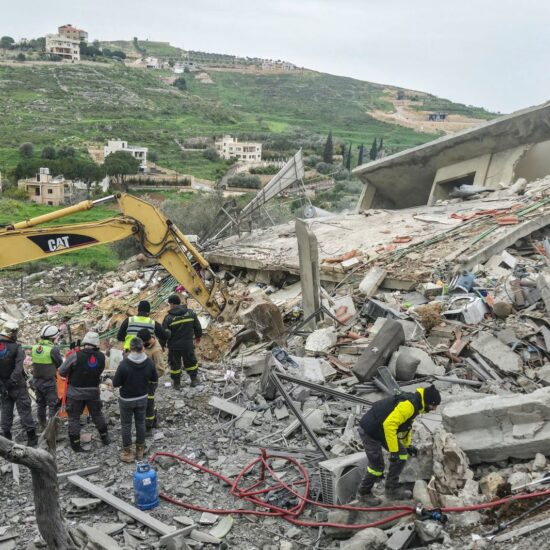
Israeli operations in southern Lebanon have intensified steadily in recent weeks, targeting villages and logistical nodes linked to Hezbollah’s infrastructure. Military analysts monitoring the campaign describe a deliberate attrition strategy: two or three targeted strikes per day, each designed to degrade the group’s operational capacity while avoiding full-scale escalation. At the same time, Iranian influence in the region—already weakened by economic pressure and internal instability—appears increasingly stretched.
The result is that the leverage Berri once believed he possessed is eroding.
Ironically, he has already extracted substantial political dividends from the current presidency. From the earliest days of the Aoun mandate, Berri positioned himself as the man capable—eventually—of delivering what many Western and regional actors have long demanded: a Hezbollah that would relinquish its weapons, or at least place them under state authority.
The reward was immediate. Amal secured the Ministry of Finance once again, along with a slate of appointments favorable to Berri’s political network at the Central Bank, in the Judiciary and even the security agencies.
But when the moment arrived to clearly distance himself from the strategic orbit of Tehran—and from the influence of the Islamic Revolutionary Guard Corps—Berri stepped back.
He is still stepping back.
Several Lebanese political observers describe his strategy in financial terms: Berri is behaving less like a traditional politician and more like a hedge-fund manager, hedging against two incompatible outcomes. If Israel ultimately degrades Hezbollah’s military capacity, Berri can present himself as the pragmatic Shiite leader who kept channels open. If Hezbollah survives, he can claim he never betrayed the resistance.
The difficulty with such strategies is that they rely on time—and time is precisely what Lebanon’s political system may be running out of.
The difficulty with such strategies is that they rely on time—and time is precisely what Lebanon’s political system may be running out of.
Within the presidential palace, according to officials familiar with the discussions, there is growing recognition that waiting for Berri to move first may no longer be viable. One option now circulating quietly among advisors is for the President, in coordination with the Prime Minister, to assemble a separate negotiating delegation and dispatch it discreetly to a neutral venue—Cyprus or Paris have both been mentioned in preliminary conversations.
The composition of such a delegation, several insiders note, is almost secondary. Whether it reflects Lebanon’s traditional confessional balance or not may no longer be the decisive issue. What matters is the message.
And that message, if Lebanon’s leadership were to articulate it openly, would represent a break with decades of political ambiguity.
It would require stating plainly that Hezbollah functions as a militant organization operating outside the authority of the Lebanese state and that its continued military autonomy is incompatible with Lebanese sovereignty.
It would require acknowledging that the current Iranian regime—whose influence has shaped Lebanon’s strategic landscape for more than two decades—cannot simultaneously claim to support Lebanese stability while sustaining an armed proxy within its borders.
It would require admitting a difficult reality about the Lebanese Armed Forces: that while widely respected, they do not possess the capacity to disarm Hezbollah on their own.
And it would require invoking the possibility of an international framework—potentially under Chapter VII of the United Nations Charter—that could deploy a multinational force to assist the Lebanese state in reasserting control over its territory.
None of these statements would come without consequences.
But they would clarify a question that has long hovered over Lebanon’s political life: whether the country intends to remain an arena for regional confrontation or finally reassert itself as a sovereign state.
The final step—perhaps the most controversial—would be acknowledging what many diplomats in Beirut privately concede has become inevitable: that Lebanon may ultimately need to pursue a formal peace arrangement with Israel, accompanied by a security partnership with the United States.
Such a declaration would overturn decades of political doctrine.
Yet for Lebanon’s exhausted population—whose savings have vanished, whose infrastructure has collapsed, and whose political class appears increasingly paralyzed—the larger question may no longer be ideological.
It may simply be whether the state still has the capacity to decide its own future before others decide it for them.
The views in this story reflect those of the author alone and do not necessarily reflect the beliefs of NOW.