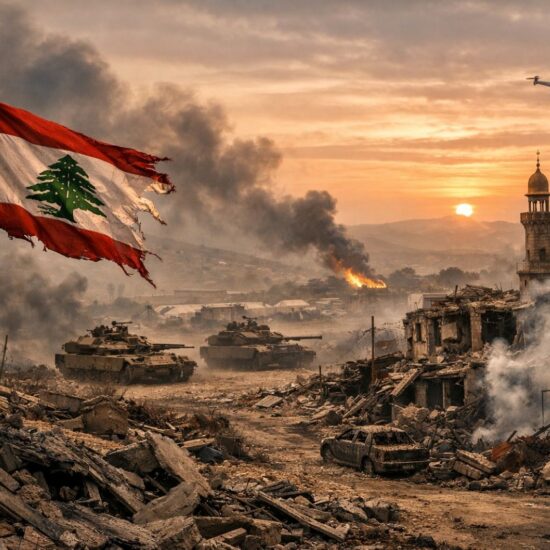
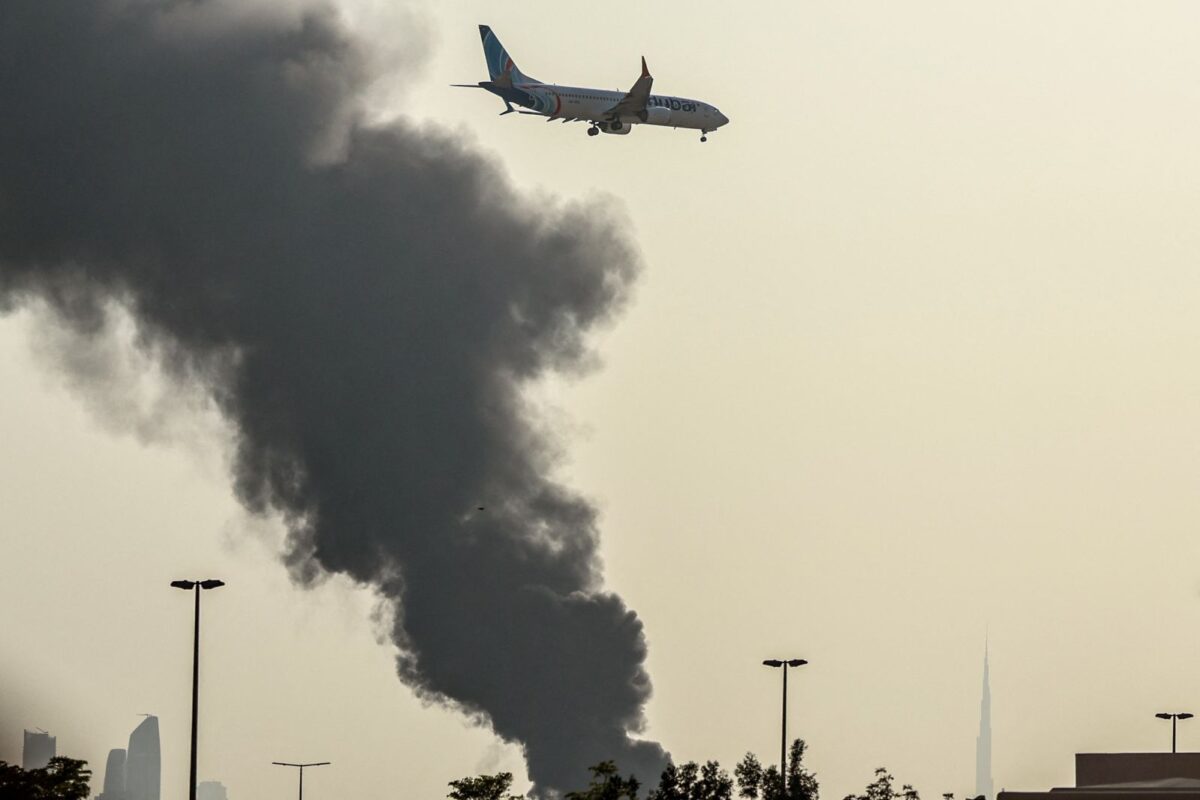
As the ongoing war pits the Islamic Republic of Iran against the United States and Israel, Tehran’s retaliation has extended well beyond Israeli territory and into the Arab Gulf. The latest official statements and field reporting indicate that Iranian missile and drone attacks have threatened or damaged airports, ports, refineries, energy facilities, water infrastructure, and even residential areas in the United Arab Emirates, Qatar, Bahrain, Kuwait, and Saudi Arabia. What began as a war centered on Iran and America – Israel has increasingly evolved into a regional crisis with direct consequences for the Persian Gulf states.
Official tallies released by Persian Gulf governments, even after accounting for a high interception rate by air-defense systems, suggest that Tehran’s objective is no longer limited to “sending a message.” The pattern of attacks points instead to a broader strategy: to impose sustained security attrition and economic disruption across the Gulf’s operational environment.
Why Is Iran Firing ?
At least four strategic calculations appear to be driving Tehran’s decision. First, Iran is attempting to impose direct costs on countries that host U.S. bases, military assets, or logistical infrastructure. Saudi officials have publicly indicated that Tehran had been warned against widening the war, and Iran explicitly framed some Persian Gulf states as legitimate targets because of their links to U.S. military power.
Second, Tehran appears intent on globalizing the economic cost of the war by targeting the Persian Gulf’s energy and logistics arteries. Attacks on or near energy hubs in Qatar, Saudi Arabia, the UAE, and Kuwait have heightened concerns about LNG supply, oil exports, shipping insurance, and maritime traffic through the Strait of Hormuz. Japan’s decision this week to tap joint oil stockpiles underscores how deeply the conflict is reverberating through global energy markets.
Third, strikes on critical or civilian-adjacent infrastructure reflect a logic of deterrence through destabilization: a message that continued military pressure on Iran will come at a price for the entire region, not only for Israel or the United States. Bahrain’s push at the U.N. Security Council for authorization to protect maritime navigation reflects the degree to which Persian Gulf governments now see Iranian actions as a broader regional threat rather than an extension of a bilateral war.
Fourth, at the domestic level, these attacks serve as a display of resilience and reciprocal force for Iran’s hardline security establishment, even at high diplomatic cost. This helps explain the contradiction in Tehran’s messaging. While President Masoud Pezeshkian has sought to reassure neighboring states and emphasize de-escalation, the Islamic Revolutionary Guard Corps (IRGC) has maintained a far more confrontational line. Ali Vaez of the International Crisis Group argued that, in wartime, rhetorical missteps by civilian officials are secondary because “the only voice that truly matters is the IRGC’s.” In other words, the real center of decision-making in this file appears to be military rather than diplomatic.
The Most Serious Consequences
The first major consequence has been the direct transfer of insecurity to critical Persian Gulf infrastructure. Bahrain said an Iranian drone strike damaged a desalination facility and injured three people, while Kuwaiti authorities said a drone attack targeted fuel tanks at the international airport and damaged civilian infrastructure. In another Bahraini incident, civilians were reportedly hurt when debris fell over a residential district, illustrating that even successful interceptions can generate secondary threats to noncombatants.
The second consequence is the threat to water and energy security, two pillars of social and economic stability in the Persian Gulf. Qatar formally condemned the March 18 strike on Ras Laffan, calling it a dangerous escalation and a direct threat to national security. Market analysts warned of serious implications for global gas supply if disruptions persist. This is no longer merely a security issue for the Gulf; it is a structural risk to Asian and European energy chains as well.
Third, the attacks have narrowed the space for caution and relative neutrality among Persian Gulf governments. A joint statement issued by the UAE alongside Qatar, Saudi Arabia, Bahrain, Jordan, Kuwait, and the United States described Iranian missile and drone attacks as reckless and unjustifiable, stressing that they violated sovereignty and endangered civilian populations and non-military infrastructure.
Fourth, the attacks are disrupting shipping and maritime trade at a time when the Strait of Hormuz remains central to global energy flows. Roughly one-fifth of the world’s oil trade passes through the strait, and any sustained instability there threatens not only Persian Gulf security but also the entire business model of the region’s export-driven economies, from energy and aviation to marine insurance and global logistics. Gulf governments increasingly view the war not simply as an Iran-Israel confrontation, but as a direct threat to their own vital interests.
Regional Responses Are Hardening
Saudi Arabia’s reaction has grown markedly sharper in recent days. Foreign Minister Prince Faisal bin Farhan said Riyadh has the right to take military action against Iran if necessary, adding that Tehran’s attacks are politically and morally backfiring. Following missile attacks on Riyadh, Saudi Arabia not only intensified its air defenses but also signaled that trust in Tehran had effectively collapsed. Saudi channels had earlier warned Iran that continued attacks on Saudi territory and energy infrastructure could trigger retaliation and even operational access for U.S. forces.
Qatar has focused its public response on sovereignty and regional stability. Doha condemned the strike on Ras Laffan as a blatant attack and a dangerous escalation, while Qatari officials argued in international forums that the attacks endangered not only security installations but also airports, energy facilities, and global supply chains. Qatar’s foreign ministry said this week that it supports all diplomatic efforts to halt the conflict, even while denying that it is directly mediating between Washington and Tehran.
In Bahrain and Kuwait, the official tone has centered on the targeting of vital civilian infrastructure. Bahrain described the incidents as Iranian aggression against civilian sites, while Kuwait characterized attacks on airport and fuel facilities as direct strikes on essential infrastructure. Both governments have repeatedly urged citizens to take shelter during air alerts, a sign that the war has moved beyond strategic concern and into the realm of daily public security.
The UAE has taken a similarly firm line, but in more explicitly legal language. Abu Dhabi said that Iran’s attacks constituted a clear violation of international law and the U.N. Charter, while stressing that the UAE had not entered the war but was acting in self-defense. In the joint statement issued earlier in March, the UAE and its partners framed Iranian strikes as dangerous, destabilizing actions against states that were not necessarily direct belligerents.
Who Is Setting the Rules of the War?
Among regional analysts, one of the clearest warnings came from Abdulaziz Sager, chairman of the Gulf Research Center. He said there is a growing sense across the Persian Gulf that Iran has crossed all red lines. Once Tehran began attacking Gulf states directly, he argued, it could no longer be treated merely as a difficult but manageable actor. His assessment suggests that Iranian attacks are shifting Persian Gulf calculations away from strategic caution and toward a harder policy of containment.
Ali Vaez’s assessment points in a related direction. By emphasizing the IRGC’s role in setting Iran’s real wartime line, he suggests that the cause of these attacks lies not only in classic state-to-state escalation but also in the structure of power inside Iran itself. When final decisions rest with a military-security institution, the logic of regional retaliation can override diplomatic restraint. From that perspective, firing at Persian Gulf states is not simply a reaction to the U.S. presence; it is also a reflection of the IRGC’s dominance in defining the rules of this war.
A Strategy Producing Regional Anger
Taken together, the latest official positions and reporting suggest that Iran’s missile and drone strikes on Persian Gulf states are serving multiple purposes at once: imposing costs on neighbors that host U.S. assets, threatening energy and transport corridors, signaling deterrence, and projecting continued strength inside Iran. Yet this strategy has also produced three clear negative outcomes for Tehran.
First, it has pushed Persian Gulf states away from caution and toward closer coordination against Iran. Second, it has increased Iran’s economic and legal exposure by placing civilian and critical infrastructure at the center of the conflict. Third, it has fueled regional anger to a level that may strengthen support for a tougher U.S.-Israeli effort to contain Iran militarily and economically. What was intended as an instrument of pressure is, at least for now, eroding rather than reinforcing the Islamic Republic’s regional position.
Armin Soleimani is a Middle East reporter.
The views in this story reflect those of the author alone and do not necessarily reflect the beliefs of NOW.