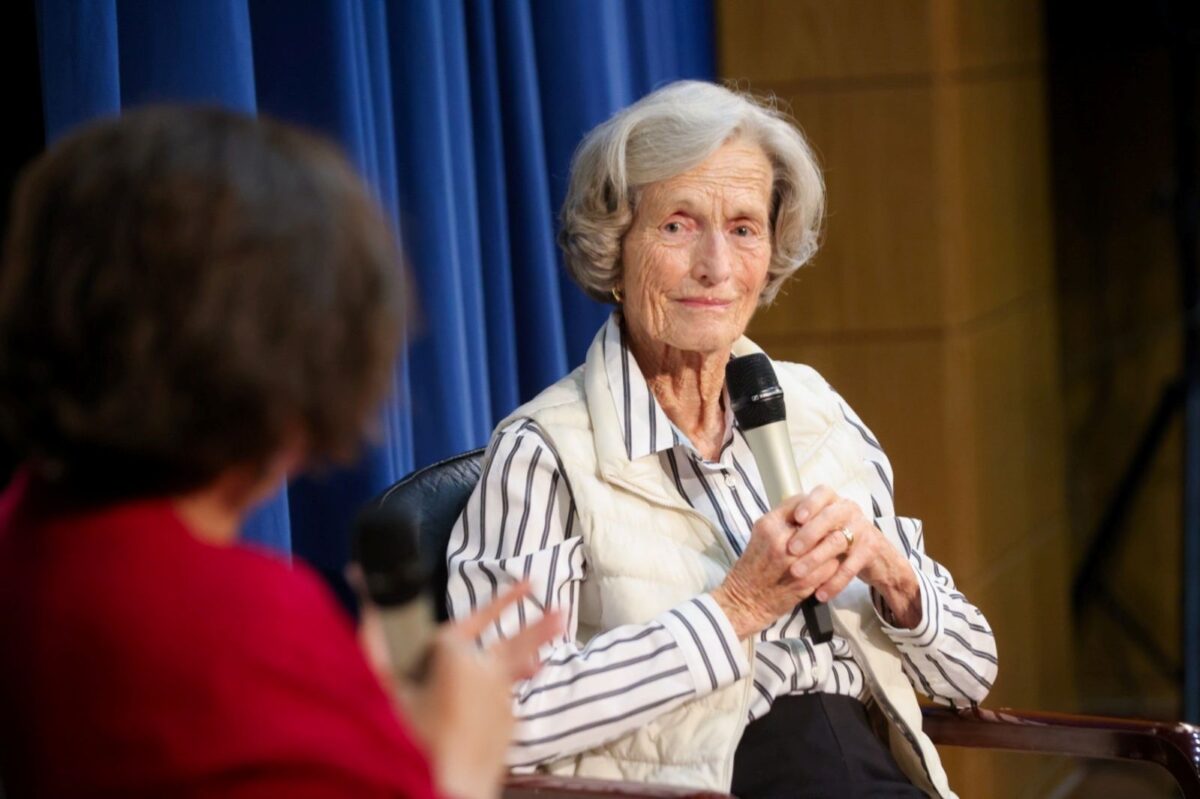
On February 19, 2026 in West Hall, the American University of Beirut did what it does best when it remembers itself: it turned an auditorium into a moral argument.
Ann Kerr walked onto that stage at ninety-one with the kind of calm that makes everything around her look noisy and small. She did not perform nostalgia; she carried it. She did not speak in slogans; she spoke in sentences shaped by decades of refusing to “turn her back” on Lebanon—even after Lebanon, in its darkest hour, took Malcolm Kerr from her.
In a country where people routinely confuse loyalty with amnesia, Ann Kerr is an inconvenient witness. Not because she is naïve—she is not. But because she is stubborn in the most radical way: she insists that love can be honest. That friendship can survive grief. That AUB is not a building, not a logo, not even a campus (though God knows the campus tries hard). AUB, in her telling, is an idea people have tried to intimidate, corrupt, and kill—and an idea that refuses to die.
Kim Ghattas, with the grace of someone who knows that a conversation can be both intimate and political, took us back to 1954: a young American woman on a ship, landing in Beirut, listening for the call to prayer, feeling romance and wonder and a kind of recognition—“the same sunshine, the same sky.” A Lebanese audience laughed at the idea of “tea dances” in the women’s hostel, then fell silent at the reminder of what happened next: a life built between Beirut and California, four children, decades of service, and then the gunshots on January 18, 1984.
We have grown used to discussing Malcolm Kerr as a martyr of an era, as an emblem of tragedy, as a name on scholarships and institutions. But listening to Ann Kerr speak, you remember that the assassination was not just a political event. It was a domestic one. A husband leaving home and not returning. A family forced to translate shock into survival. A university forced to translate fear into continuity.
And yet the most unsettling part of the evening—at least for me—was not the grief. It was the clarity that followed it.
When I asked Ann Kerr a question I have lived with for years, I asked it plainly: Malcolm Kerr was not a colonial caricature. He was born in Beirut. He spoke Arabic. He understood the region better than most American officials who presumed to “manage” it. He wrote with empathy about Arab politics and the Palestinian tragedy. In the jargon of Washington, he was the kind of “Arabist” that the Cold War and its afterlives tried to purge. Why, then, would those who claimed to fight America and champion Arab causes kill a man who, by every honest measure, was a friend of the Arabs?
Her answer was disarmingly direct: the killing had less to do with the Arab-Israeli conflict than with Hezbollah’s hostility to what AUB represented—“liberal, open-minded ideas.” In other words, the target was not Malcolm Kerr’s passport; it was his principles. Not his Americanness; his openness. Not his politics; the possibility he embodied.
This matters because Lebanon keeps trying to make political murder sound like a misunderstanding. As if assassinations are unfortunate glitches in an otherwise functional system. As if the killers were merely “sending messages” in a complicated region. But the message in 1984 was not complicated. It was brutally simple: there will be no neutral spaces. No free institutions. No universities that teach people to think instead of obey. No public life that is not subordinated to armed doctrine. Something which Hezbollah and its fellow travelers are still trying to do u until this day.
Hezbollah did not kill Malcolm Kerr because he was anti-Arab or pro-Israel or a “CIA man” or whatever lazy propaganda needed that week. The logic, as Ann Kerr articulated it, is more revealing—and more frightening: Malcolm Kerr was killed because AUB, at its best, produces citizens rather than subjects. It produces questions, not chants. It produces historians, not enforcers. And any militia that thrives on fear cannot tolerate a campus that makes fear look intellectually embarrassing.
That is why the assassination remains a wound that never becomes “history.” Because the impulse behind it—the desire to dominate public life by shrinking it—did not die in 1984. It simply changed costumes.
Ann Kerr’s presence last night was more than a tribute. It was a rebuke: a reminder that Lebanon’s tragedy is not that it is “too diverse” or “too complicated,” but that it keeps allowing armed movements to punish the country for imagining normal life. Her love for Lebanon is not sentimental. It is disciplined. It separates the place from the criminals who vandalized it. “It was not my friends who killed Malcolm,” she said. That sentence alone is a masterclass in moral precision.
And perhaps that is her “secret sauce,” as Kim joked—community, motion, one foot in front of the other. But I heard something else beneath it: defiance. The quiet kind. The kind that returns, and returns again, insisting that light is not a metaphor, it is a choice.
In West Hall last night, Ann Kerr did not just tell a story about Lebanon. She reminded us what Lebanon is supposed to be when it is not being held hostage: a place where friendship is possible, where education is a form of freedom, and where the killers do not get to define the meaning of the dead.
Makram Rabah is the managing editor at Now Lebanon and an Assistant Professor at the American University of Beirut, Department of History. His book Conflict on Mount Lebanon: The Druze, the Maronites and Collective Memory (Edinburgh University Press) covers collective identities and the Lebanese Civil War. He tweets at @makramrabah