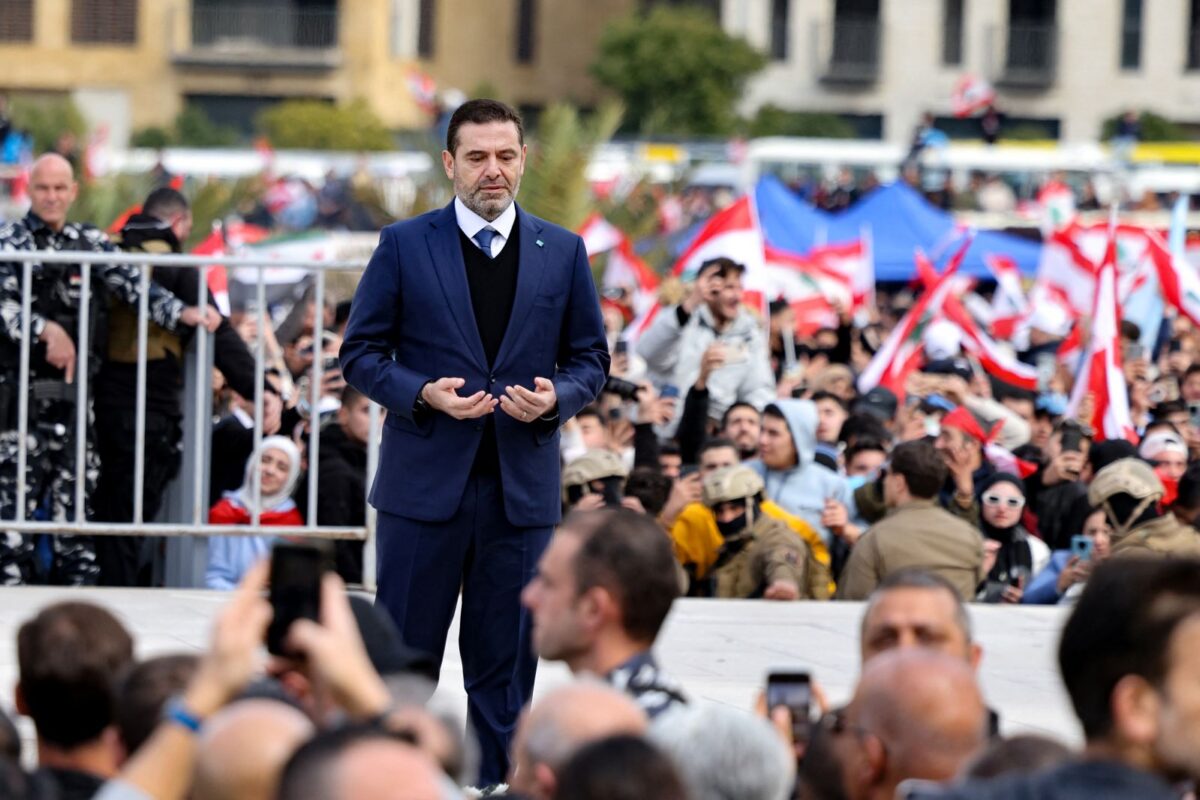
Saad Hariri’s speech on February 14 was framed as remembrance. But in Lebanon, remembrance is never neutral. The subtext was political: a carefully calibrated signal of return, not necessarily by Hariri himself, but by network, proxy, and parliamentary engineering.
This is not a heroic comeback narrative. It is something more cautious, and more revealing of how Lebanese leadership now operates within a shifting Gulf order. The question is no longer whether Hariri returns to politics, but how, and under whose regional logic.
From Patronage to Repositioning
For nearly two decades, Hariri’s political brand was structurally embedded in Saudi patronage. The relationship was never symmetrical: Riyadh saw Hariri as a Sunni anchor in Lebanon, useful insofar as he could deliver outcomes within a system that structurally resists delivery. The 2017 episode in Riyadh, when Hariri was forced into a resignation that appeared scripted, was not just a diplomatic incident. It was a rupture of political identity. It publicly exposed the limits of Hariri’s autonomy and the conditional nature of Saudi support.
Since then, Saudi Arabia’s approach to Lebanon has shifted. Riyadh today prioritizes regional bargaining over micromanaging Lebanese sectarian arenas. In that recalibration, Hariri became de-prioritized: not rejected outright, but no longer central to Saudi strategy. This is less about personal failure and more about structural mismatch. Lebanon’s political system did not allow any Sunni leader to “deliver” the kind of outcomes Riyadh demanded.
Enter Abu Dhabi. Hariri’s residency in the UAE is not merely logistical. It signals a different regional style of politics: one oriented toward stability, brokerage, and networked influence rather than overt ideological confrontation. The UAE’s soft power operates through relationships, media ecosystems, business elites, and symbolic moderation. In this architecture, Hariri fits more comfortably: internationally legible, non-populist, cautious in tone, and oriented toward managerial politics.
This is not a crude “switch of patrons.” It is a repositioning within a changing Gulf political economy of influence.
The Logic of a Return by Proxy
A direct, personal return to frontline politics would expose Hariri to multiple costs: Saudi expectations he may not be able to meet, domestic backlash against perceived external engineering, and the accumulated baggage of pre-2019 governance. A return by proxy is strategically cleaner.
A parliamentary bloc of 10-12 MPs is a realistic, high-impact target in Lebanon’s fragmented legislature. Such a bloc would not dominate parliament, but it would wield kingmaker leverage: influencing cabinet formation, presidential votes, and coalition arithmetic. This is precisely the scale of influence that matters in a system where blocking minorities shape outcomes.
Crucially, a proxy return allows Hariri to test political viability without becoming the face of the project. It is influence without exposure, leverage without overcommitment. This fits a soft power logic more than a patron-client logic: power exercised through networks, not personal heroics.
The Emirati Style of Sunni Politics
If Hariri’s re-entry is structured this way, it aligns more closely with Emirati preferences than Saudi ones. The UAE favors low-noise influence: stability discourse, non-escalation, and managerial politics that freeze conflicts rather than inflame them. A Hariri-aligned bloc that emphasizes sovereignty, institutions, and economic recovery, without maximalist confrontation, would carry Emirati soft power values into Lebanese Sunni politics.
This has consequences for the Sunni political field. A proxy bloc recentralizes Sunni representation without renewing leadership. It marginalizes emergent actors and reasserts an old truth of Lebanese politics: that Sunni parliamentary viability still depends on regional cover. In the short term, this stabilizes representation. In the long term, it risks freezing generational renewal.
The Saudi Dilemma
Riyadh may not object to Hariri’s symbolic presence, but it is unlikely to invest in a project that prioritizes ambiguity over confrontation. Saudi preferences today tilt toward clearer lines in the regional contest. Hariri’s tone, emphasizing unity, institutions, and non-escalation, is domestically resonant but strategically underpowered from Riyadh’s perspective.
This creates a paradox. Hariri’s repositioning may restore his regional viability through Abu Dhabi’s softer architecture of influence, but it weakens the old Saudi logic that once underwrote his Sunni legitimacy. The result is a leader who may return with regional cover but thinner symbolic authority within the Sunni imagination.
What This Signals for the Next Elections
Regardless of when the elections take place , if Hariri can engineer a bloc of 10-12 MPs, he proves continued relevance in Lebanon’s parliamentary mathematics. If he cannot, his return risks becoming symbolic rather than structural. The February 14 speech, then, reads less like a declaration and more like a trial balloon. A test of domestic appetite and regional tolerance.
This is not the politics of grand comebacks. It is the politics of networked return in a fragmented state, under shifting regional sponsorship. The real question is not whether Hariri comes back, but whether Lebanese politics can escape a cycle in which leadership is continually reconstituted through external architectures of influence.
In that sense, Hariri’s repositioning is not just about him. It is a mirror of Lebanon’s enduring condition: sovereignty rhetorically affirmed, politics structurally outsourced.
Ramzi Abou Ismail is a Political Psychologist and Senior Research Fellow at the Institute for Social Justice and Conflict Resolution at the Lebanese American University.
The views in this story reflect those of the author alone and do not necessarily reflect the beliefs of NOW.