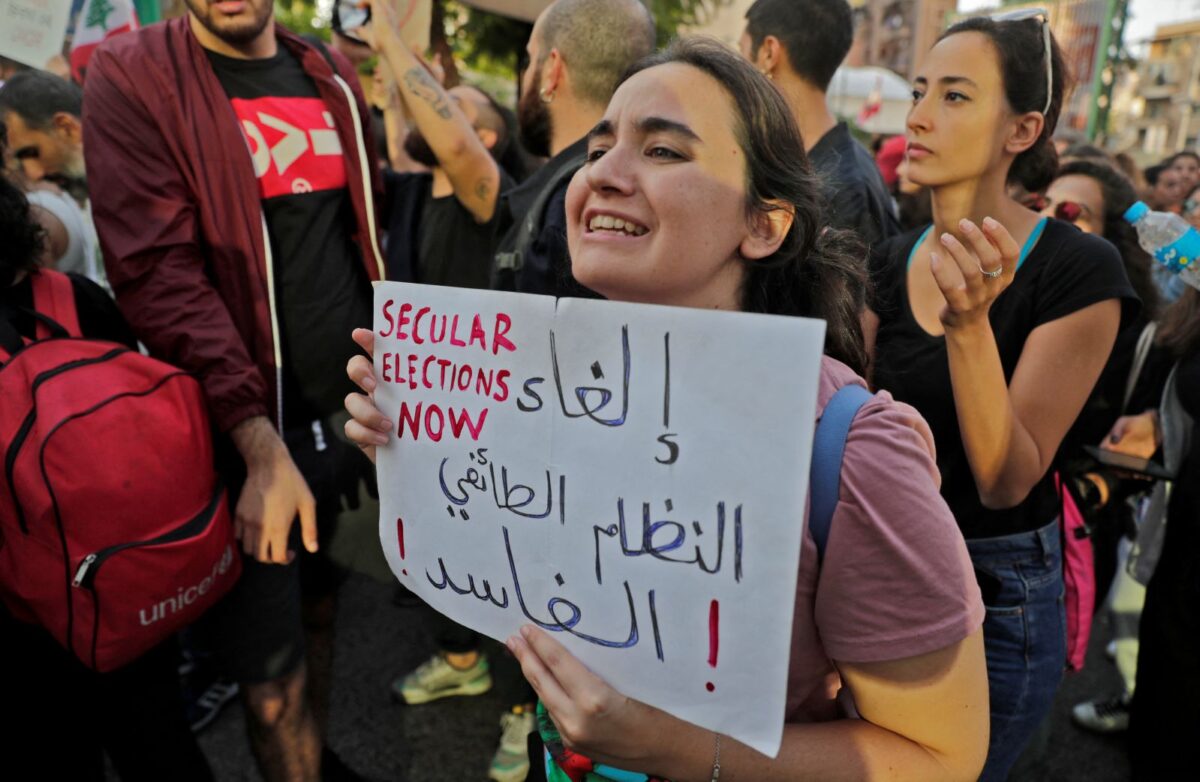
Every time the slogan “abolish political sectarianism” is revived in Lebanon, it is presented as a magical solution to the state’s chronic crises. Yet, at its core, this proposition ignores a foundational truth: pluralism is not an aberration within Lebanon’s political architecture, but an integral part of its historical and social fabric. Political sectarianism, however distorted it has become, was originally conceived as a mechanism to reassure communal groups and ensure their participation in governance, not as an end in itself.
This principle was enshrined constitutionally in the consensual frameworks established since independence, and later reaffirmed and developed in the Taif Agreement of 1989, which provided the post-war blueprint for reconstructing the state.
The real problem has never been pluralism itself, but the deviation in the implementation of the Taif Agreement. The system, initially intended to create a balance among Lebanon’s components, gradually morphed into a quota-based distribution of power among sectarian leaders, where accountability and competence were supplanted by political loyalty. Over time, clientelistic networks became entrenched, and authority intertwined with administration and public resources, rendering the state itself hostage to power balances rather than serving as a central reference.
Occasionally, proposals are made to implement Taif as written: elect a parliament free from sectarian quotas and establish a Senate in which the confessional communities are represented and whose powers are confined to existentially critical issues. This theoretical balance aims to shift the conflict from identity-based competition to programmatic politics, while preserving existential guarantees within an institutional framework. Yet, the challenge does not lie solely in constitutional design but in the locus of actual authority: who decides? Who administers the state? Who steers policy? Experience has shown that even the most precise legal texts lose their effectiveness if the distribution of power remains outside institutional channels.
Lebanese experience demonstrates that any imbalance in political influence directly affects resource management, from tax collection to budgetary allocation, even if constitutional guarantees remain formally intact. This is reflected in regional developmental disparities, the transformation of the national budget into a field of political contention, and the absence of long-term economic planning. In other words, the distribution of authority determines the allocation of opportunities and resources in practice, not the reverse.
Here, international comparison is instructive. Multi-identity states have successfully turned pluralism into a stabilizing factor rather than a source of fragmentation. In Switzerland, linguistic and religious diversity is managed through a federal system that grants cantons extensive authority and institutionalizes shared decision-making. In Belgium, the transition from a centralized state to a complex federal model distributes power among regions and linguistic communities to prevent domination. The common thread in both cases is not the erasure of particularities, but their structuring within institutions with clearly defined powers and resources. Crucially, these models rely on the state’s monopoly over force, judicial independence, and fiscal transparency, structural prerequisites without which any governance framework cannot succeed.
Put differently: what is required is not merely the protection of existence but the assurance of balanced partnership in decision-making and state administration. Symbolic representation cannot compensate for deficiencies in executive, fiscal, or security authority, nor does it prevent perceptions of marginalization or domination. Genuine partnership is measured by the capacity to influence national decision-making, not merely by presence within its formal structures.
This is why proposals for expanded decentralization, or even federalism, are revisited as potential mechanisms to reorganize authority and alleviate fears of domination, by distributing decision-making and resources rather than concentrating them in a paralyzed center. Such proposals should not necessarily be read as calls for partition, but rather as efforts to design a governance model that accommodates diversity within a single state framework, provided it is built on stringent fiscal and administrative rules, and anchored in a unified, indivisible sovereign authority.
The real debate, therefore, is not between “sectarianism” and a “civil state” as often portrayed, but between a centralized model that has lost its capacity to manage pluralism and an alternative model that seeks to reconcile recognition of social realities with equitable distribution of authority and resources. And this is the question that remains unresolved: should reform focus on altering constitutional identity, or on redistributing power within the state itself?
Elissa El Hachem is a journalist and political writer specializing in regional affairs and governance. Former Regional Media Advisor at the U.S. State Department’s Arabic Regional Media Hub, with broad experience in strategic communication across government and private sectors.
The views in this story reflect those of the author alone and do not necessarily reflect the beliefs of NOW.