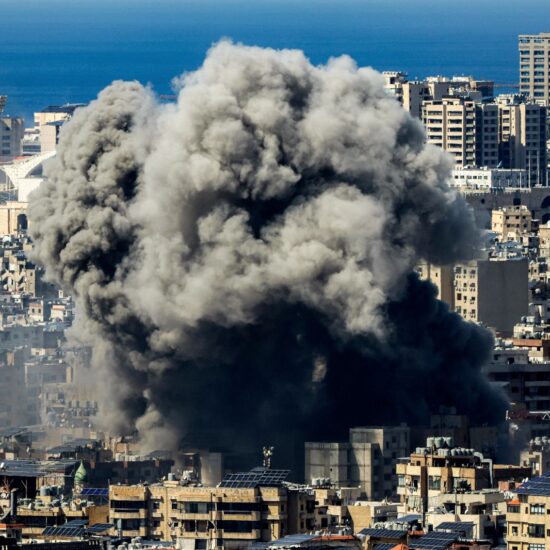
In Beirut—a city that exhausts itself yet refuses to die—there are those who come to resemble it. They carry its contradictions with grace, smile through its burdens, and sing precisely when silence feels easier. Ahmad Kaabour was not merely an artist. He was, in the truest sense, a son of this city—of its tiny streets and its sea, of its quiet resilience and its wounded dignity.
He belonged to Beirut not as an image, but as a presence.
Kaabour did not sing resistance as spectacle, nor as profession, nor as hollow performance. He sang it as an ethical act—as a deeply human stance. In his voice lived the longing of ordinary people who asked for nothing more than to live with dignity. That is what set his songs apart: they were unadorned, uncorrupted, and profoundly sincere.
When he sang “Unadikum,” he was not calling out to a party, nor to an axis, nor to a cause seeking validation. He was calling out to something far more fragile and enduring: our shared humanity.
And when he sang for Beirut, it was never for a place defined by borders, but for a city carried within—its sea, its streets, and the faces that shaped his memory and ours.
Even in his most political moments, there was a clarity that many lacked. When he sang for Rafik Hariri, he sang not for power, but for a project—imperfect, yes, but one that did not sanctify violence or elevate it into identity. And when he stood with the Syrian revolution, his voice did not waver:
“We ought not wait—let us rise and sing…”
It was not a pose. It was a choice. A declaration—for people, for freedom, for a land “with a great heart.”
Ahmad Kaabour did not conform. And perhaps that alone is enough to explain his place among us.
Ahmad Kaabour did not conform. And perhaps that alone is enough to explain his place among us.
At a time when music was conscripted into the service of violence, he refused to lend his voice to its justifications. When art became an extension of the gun, he stepped away from its echo. He did not bargain, did not equivocate, and never sought refuge in grand slogans to conceal a quieter surrender.
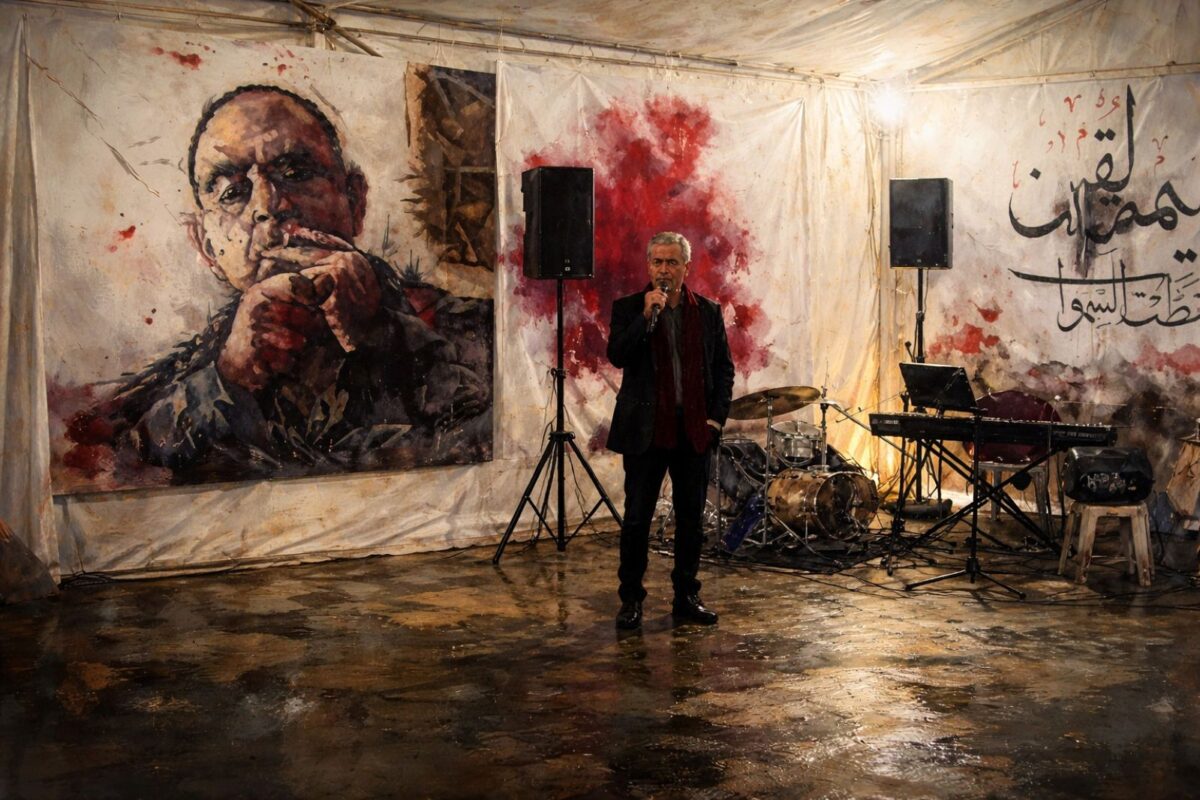
And then there was that moment—so telling, so unmistakably his—when he chose to sing in the tent of Lokman Slim, mere meters from the shattered remains of the Beirut port. There, where devastation still lingered in the air, he placed his voice where it belongs: in confrontation with violence, not in submission to it.
He sang for people. For the land. For its wounds and its possibilities.
He sang for Hamza al-Khatib—and for all those unnamed faces who give meaning to the word “life.”
Through it all, he remained what he had always been: a true son of Beirut.
You could encounter him in Hamra, walking quietly, almost anonymously, with that gentle, unassuming smile and eyes that carried a quiet, knowing light. There was no performance in him, no cultivated distance, none of that artifice that so often separates the artist from the people. He was of them—entirely, without condition—and perhaps his greatest grace was that he remained so until the very end.
In the language of Beirut, and in the moral imagination of its people, Ahmad Kaabour was simply “a decent man.”
In the language of Beirut, and in the moral imagination of its people, Ahmad Kaabour was simply “a decent man.”
And in a time when decency has become an exception rather than a norm, he stood—quietly, steadfastly—among the few who never relinquished it.
This is not only a farewell to an artist.
It is a farewell to a sensibility. To a way of being. Perhaps even to a fragment of Beirut itself.
Farewell, Ahmad Kaabour—
you who chose humanity, and sang for it, when so many chose otherwise.