Why it matters:
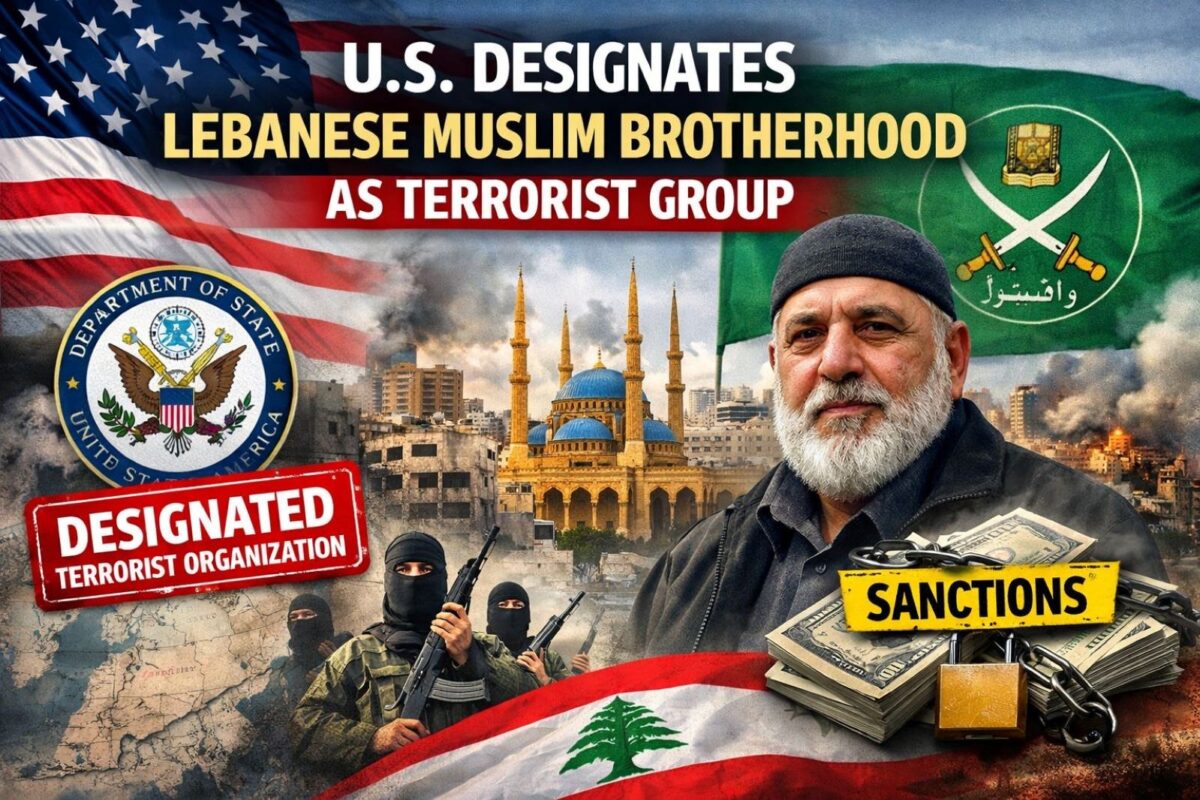
The United States has officially designated the Lebanese Muslim Brotherhood as a Foreign Terrorist Organization (FTO) and a Specially Designated Global Terrorist (SDGT), marking a major shift in Washington’s approach toward Islamist movements operating inside Lebanon. The move places the group alongside globally sanctioned organizations and will likely reverberate across Lebanon’s already fragile political and financial systems.
What happened:
In a statement released today, the U.S. government announced it is sanctioning the Lebanese, Egyptian, and Jordanian chapters of the Muslim Brotherhood as part of what it described as an “ongoing, sustained effort” to dismantle Brotherhood networks worldwide.
The Department of State designated the Lebanese Muslim Brotherhood as both an FTO and SDGT, while also sanctioning its leader, Muhammad Fawzi Taqqosh, individually. Simultaneously, the Department of the Treasury designated the Egyptian and Jordanian chapters as SDGTs for providing material support to Hamas.
The decision was framed as the first step in implementing President Trump’s Executive Order 14362, which targets Muslim Brotherhood-affiliated entities deemed to threaten U.S. national security.
Zoom in: Lebanon
Unlike other chapters, the Lebanese Muslim Brotherhood operates in a complex environment where armed non-state actors already dominate the political and security landscape. While Hezbollah has long monopolized the global terrorism label, the designation of a Sunni Islamist organization marks a notable broadening of Washington’s scope.
The U.S. decision signals that Washington is no longer willing to tolerate what it views as ideological or operational gray zones—where groups operate politically while allegedly maintaining militant or logistical ties to armed movements.
What’s new:
This is the first time a Lebanese Islamist organization outside Hezbollah’s orbit has been designated under such sweeping terrorism frameworks. The FTO label criminalizes material support, freezes assets, and exposes anyone dealing with the group to severe U.S. penalties.
Lebanese banks, NGOs, and political intermediaries will now be forced to conduct deeper compliance checks, potentially triggering another wave of financial de-risking.
Between the lines:
The move reflects a broader recalibration of U.S. Middle East policy, where Islamist movements—whether armed or politically embedded—are increasingly viewed as security threats rather than political actors.
It also puts pressure on the Lebanese state, which has historically avoided confronting Islamist groups so long as they remain outside the direct orbit of Hezbollah’s military activities.
What they’re saying:
The U.S. government said the designations aim to “deprive these Muslim Brotherhood chapters of the resources to engage in or support terrorism.”
What to watch:
- How Lebanese authorities respond—or don’t.
- Whether local political actors distance themselves publicly from the group.
- Potential ripple effects on Sunni Islamist networks operating through charities, mosques, and social institutions.
- The reaction of Hezbollah and its allies, who have long framed U.S. counterterrorism measures as selective and politicized.
Bottom line:
Washington is signaling that Lebanon’s status as a political exception zone is over. Islamist movements that once navigated between social activism and political engagement may now find themselves reclassified as security threats—raising the stakes in a country already struggling with the meaning of sovereignty