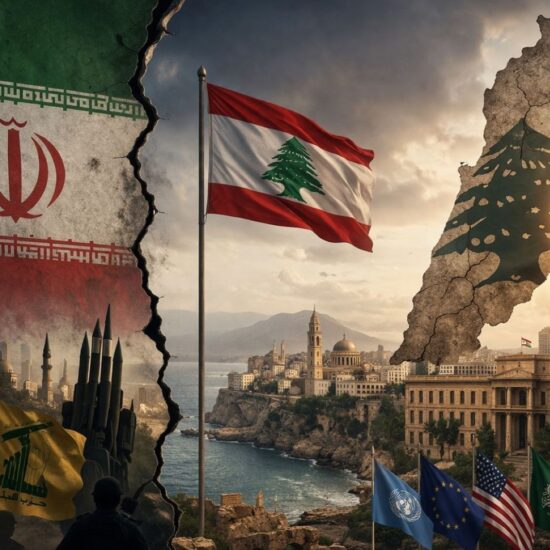
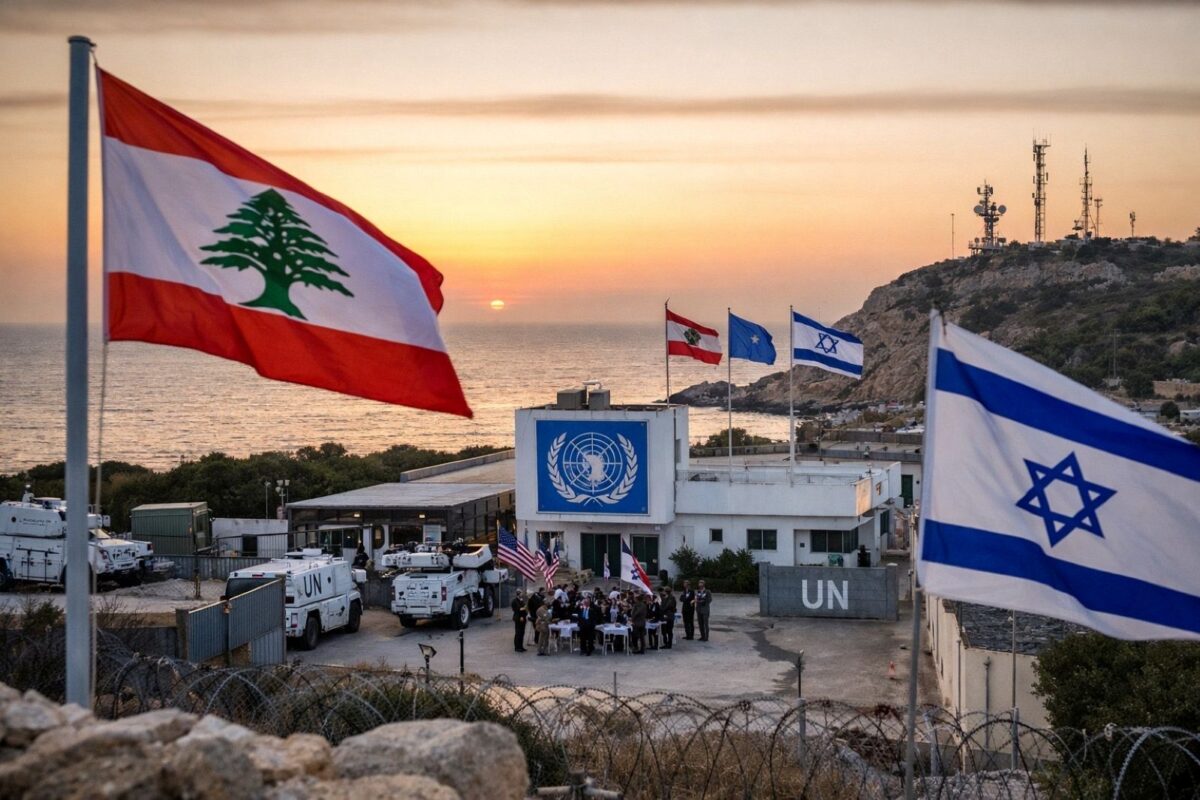
Lebanon’s engagement in Naqoura, location of the Lebanese-Israeli talks , represents more than a procedural recalibration of ceasefire mechanisms. It reflects an overdue effort to restore the state as the central authority in matters of war, peace, and national security—domains that have long been fragmented, militarized, and removed from institutional oversight. In a country where sovereignty has often been invoked rhetorically but rarely exercised in practice, this shift carries significance precisely because it challenges a deeply entrenched model of governance by exception.
For decades, Lebanon’s confrontation with Israel was treated as a special case, governed not by diplomacy but by security arrangements, intermediated frameworks, and opaque mechanisms that insulated decision-making from public accountability. This approach did not emerge accidentally. It evolved alongside the steady erosion of state authority and the elevation of non-state actors as de facto arbiters of national security. Political judgment was replaced by operational management, and strategic choices were reduced to technical necessities. The consequences were predictable: decisions of national consequence taken without national consent, recurrent escalations without clear objectives, and ceasefires that froze crises rather than resolved them.
The introduction of a civilian diplomatic figure into this process signals a return to basic international norms. States negotiate. Governments decide. Militaries implement. This hierarchy is not a procedural luxury; it is the foundation of sovereignty. When it collapses—when military logic supplants political authority—the state ceases to function as a governing institution and survives only as a symbolic shell. Lebanon’s recent history offers ample evidence of this erosion, where the absence of political ownership translated into perpetual instability.
This shift should not be misunderstood as a departure from Lebanon’s long-standing positions, nor as an embrace of normalization by default. Rather, it reflects a recognition that ceasefires generate political obligations whether states acknowledge them or not. Border demarcation, disputed points, security guarantees, civilian protection, and post-conflict reconstruction are not technical footnotes. They are inherently political questions that cannot be delegated indefinitely to military channels without hollowing out the state itself.
Israel’s framing of the issue as one of “disarming Hezbollah” is strategically revealing. It seeks to recast the conflict as an internal Lebanese matter, positioning Israel as a state actor responding to non-state provocation rather than engaging a sovereign counterpart. This narrative gains traction precisely when the Lebanese state is absent, fragmented, or silent. In such a context, responsibility becomes asymmetrical: Israel claims strategic necessity, while Lebanon appears structurally incapable of exercising control over its own territory.
By reasserting its role, Lebanon alters the framework of engagement. Responsibility becomes reciprocal. Political costs rise on both sides. This does not eliminate the power imbalance between the two states, nor does it neutralize Israel’s military superiority. But it does constrain the logic of unilateral escalation by restoring politics as a mediating force. Even limited diplomatic engagement imposes visibility, accountability, and a degree of restraint that purely militarized management does not.
Historical precedent underscores the stakes. The failure of earlier diplomatic efforts—most notably in the aftermath of the 1982 invasion—stemmed not from diplomacy itself, but from the absence of a unified and capable state able to sustain political commitments. Agreements collapsed because institutions were weak, divided, or overridden, not because negotiation was inherently futile. The lesson is not to retreat from diplomacy, but to anchor it in institutions strong enough to carry its burdens.
Economic incentives floated by Israel should be treated with caution, but also with realism. Stability has tangible dividends, particularly for border communities that have borne the brunt of repeated conflicts and prolonged displacement. Reconstruction, agriculture, mobility, and basic security are not ideological concessions; they are core components of human security. Recognizing this does not override national principles, nor does it substitute economic arrangements for political rights. It simply acknowledges that policymaking divorced from lived realities is unsustainable.
Ultimately, the question facing Lebanon is not whether diplomacy carries risks—it does—but whether continued reliance on militarized management has produced any viable alternative. The evidence suggests it has not. Cycles of escalation have neither deterred conflict nor strengthened the state. Instead, they have entrenched paralysis and normalized exceptionalism as a mode of governance.
The Naqoura process, limited and fragile as it may be, represents an attempt to reintroduce politics where force has failed. Its success will depend not on intentions alone, but on whether Lebanon’s institutions are allowed to function, assume responsibility, and withstand pressure. Sovereignty, in this sense, is not a posture or a slogan. It is the capacity to govern—and to decide—on behalf of the state.
Makram Rabah is the managing editor at Now Lebanon and an Assistant Professor at the American University of Beirut, Department of History. His book Conflict on Mount Lebanon: The Druze, the Maronites and Collective Memory (Edinburgh University Press) covers collective identities and the Lebanese Civil War. He tweets at @makramrabah