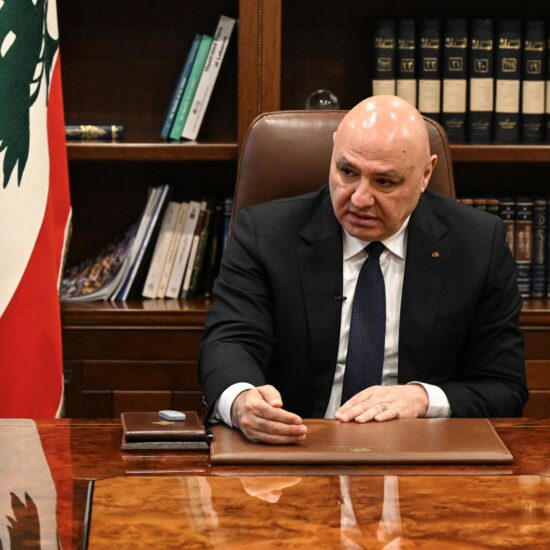
Ali Hijazi is not a significant political figure. He does not shape national debates, command a constituency, or represent an electoral force capable of altering outcomes. Like many marginal actors in Lebanese politics, his ambition is limited and familiar: to secure a place on an electoral list that might carry him to Parliament.
What makes his recent repositioning worth examining is not who he is, but what it reveals about a growing political reflex in Lebanon.
When asked about Bashar al-Assad and any potential role beyond Lebanon, Hijazi responded cautiously: “As of today, I am not part of anything related to anything outside Lebanon.” The phrasing mattered. It was neither a rupture nor a denial, but a temporary boundary. Disengagement without disavowal.
That message was reinforced visually. His newly rebranded party logo features the Lebanese cedar, a symbol long associated with sovereigntist politics and parties historically by pan-Arab and Baathist actors as isolationists. In Lebanon, symbols are not decorative. They are political declarations. And the cedar, in particular, signals a claim to local legitimacy.
This is not ideological conversion. It is political recalibration.
For decades, a class of political actors operated under the assumption that regional projects, transnational causes, or external alignments would eventually carry them into relevance. Lebanese politics, in this view, was a temporary arena; a waiting room rather than a destination. National symbols were mocked, sovereignty discourse dismissed, and local anxieties treated as provincial.
That assumption is collapsing.
As regional umbrellas weaken and external affiliations lose both credibility and utility, many actors who long imagined themselves as future players are confronting a harsher reality: relevance is no longer guaranteed by history, ideology, or alignment. It must be negotiated; locally, visibly, and immediately.
Hijazi’s repositioning reflects this moment of reckoning. What is striking is not the shift itself, but the willingness with which previously asserted beliefs are set aside. The rejection of Lebanese nationalism, the critique of isolationism, the insistence on larger causes, all appear negotiable when the alternative is political disappearance.
This is where the phenomenon becomes unsettling.
What we are witnessing is not a debate over ideas, but a competition over memory. Political actors who once spoke with certainty about history now behave as if survival in the present is the only remaining currency. Ideology becomes expendable; symbolism becomes transactional. The goal is no longer to convince, but to remain visible long enough to avoid erasure.
Hijazi’s case is particularly revealing because it is unconvincing. Without the political weight to anchor a credible transformation, the adaptation is exposed as what it is: an attempt to borrow legitimacy rather than earn it. But the impulse behind it is widely shared.
Lebanese politics is increasingly populated by figures who are not trying to build futures, but to avoid being forgotten. In that struggle, consistency is treated as a liability, and reinvention – however abrupt – as a necessity.
The risk, of course, is that symbols do not forget. A cedar does not rewrite a political biography; it confronts it. And voters, however disillusioned, remain acutely literate in the language of political opportunism.
Whether Ali Hijazi secures a seat is ultimately irrelevant. What matters is the signal his maneuver sends: a growing number of political actors are willing to abandon everything they once claimed to believe in for a chance at staying visible.
That is not an adaptation. It is an admission, that for some, relevance has replaced ideology, and memory has replaced meaning.
Ramzi Abou Ismail is a Political Psychologist and Senior Research Fellow at the Institute for Social Justice and Conflict Resolution at the Lebanese American University.
The views in this story reflect those of the author alone and do not necessarily reflect the beliefs of NOW