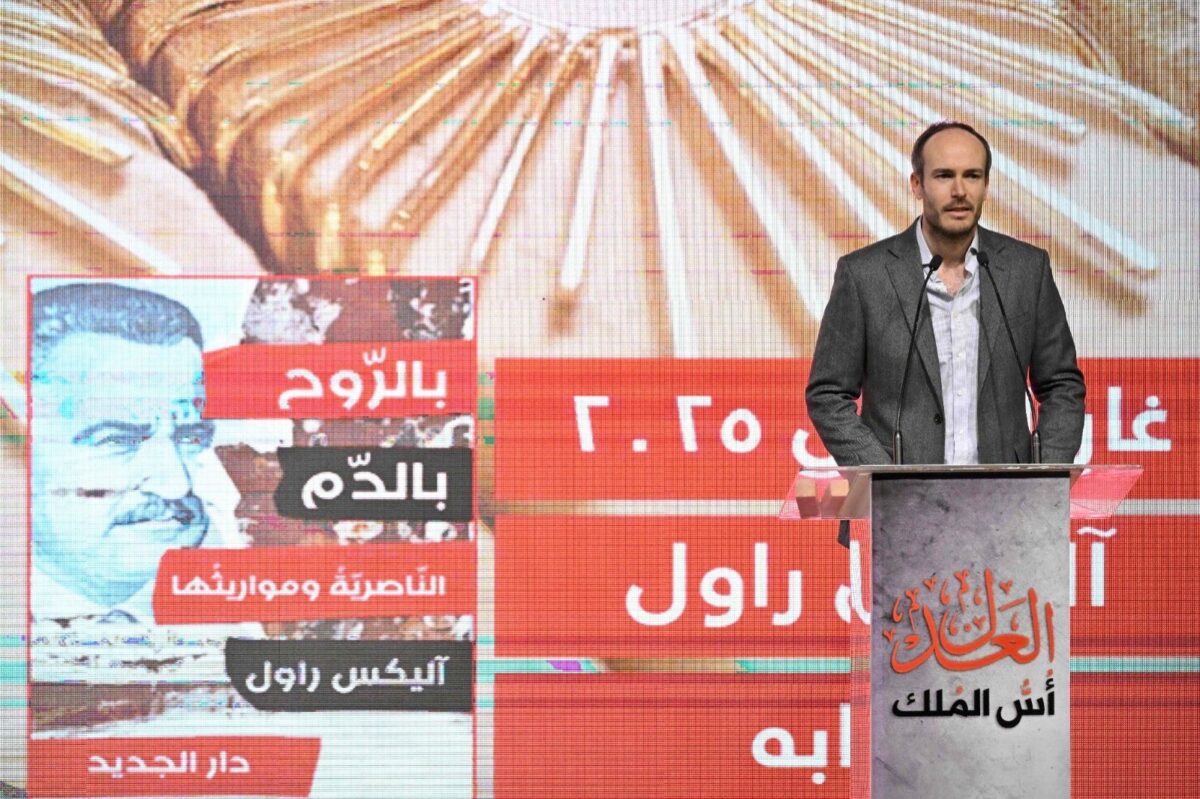
It did not take long for the author himself, Alex Rowell, to respond—exposing the central irony overlooked by Kamal Khalaf al-Tawil when he appointed himself guardian of “historical rigor” and “mastery of sources.” The reviewer who inundated readers with a list of forty-two alleged “historical errors” committed three glaring mistakes from the very first lines: he misidentified the author’s name, his nationality, and his place of residence—despite the fact that all three are clearly stated and easily verifiable.
This is not a personal or cosmetic matter. It is symptomatic. It reveals that what was presented as a scholarly review was, in fact, an apologetic text written to protect a preconceived narrative. Details were not mobilized in pursuit of truth, but deployed selectively to shield that narrative from scrutiny.
Rowell’s reply was calm, measured, and quietly devastating. He acknowledged only two genuine errors, then proceeded to demonstrate how the bulk of the accusations were either factually incorrect, the result of selective reading, the omission of key sources, or—most tellingly—political disagreements disguised as historical objections.
Yet the most striking element of Rowell’s response was not its technical rebuttal. It was his deliberate insistence on what al-Tawil’s review conspicuously avoided: the crimes themselves.
Here lies the farce.
The critic who claims to defend “historical accuracy” finds no urgency in confronting the Nasserist regime’s record of transnational political assassinations, the Yemen war that cost tens of thousands of lives, systematic torture in prisons, the militarization of state and society, and the entrenchment of a security model that would later become the norm across the Arab world.
All of this passes in silence.
Instead, disputes over Mohamed Fawzi’s military rank, the precise date of King Hussein’s arrival, or the institutional description of Nour al-Din Tarraf are elevated into existential issues—worthy of pages of outrage and indignation.
It is precisely here that Rowell’s book derives its historical value.
Not because it is flawless in every detail, but because it shifts the debate away from the worship of texts and leaders toward accountability of projects; away from numerical minutiae toward political substance; away from ideological passion toward historical consequence.
What makes this mode of critique especially hollow is that this same logic—justifying violence in the name of a “cause”—was later adopted wholesale by regimes and movements that see no problem in barrel bombs, mass killing, or political extermination, so long as they are framed as “resistance,” “steadfastness,” or “sovereignty.”
Barrel bombs did not appear over Syria by accident.
They are the product of an intellectual culture that places the leader above society, the army above politics, violence above ethics, and conspiracy above accountability.
When a critic speaking from this position demands “objectivity,” the real question is not how many executions occurred—but where his moral compass lies.
And when a book is attacked simply because it unsettles Nasserist memory, it is because that memory itself has never been fully awakened.
In closing, Rowell did not need lessons in the “art of historiography.” He asked for something far simpler—and far more demanding: that critics read what they condemn, name things for what they are, and acknowledge, even once, that the project they continue to defend did not produce renaissance, but an enduring legacy of ruin under which the region still labors today.
If there is a ghost that truly haunts them, it is not the ghost of Gamal Abdel Nasser, but the ghost of truth—once stripped from the corridors of myth.
And had Lokman Slim been with us today, he would have smiled his quiet, knowing smile—the kind that mocks tyrants without theatrics. He would have looked at Iskandar the tyrant slayer, who dared to pierce the myth, taken a slow drag from his cigarette, and said with his disarming simplicity:
“Hold your head high, my friend. The age of tyrants has passed.”
History, no matter how long it is obscured, does not forgive despots. It remembers only those who confronted them with truth. As for the age of tyrants—however much it disguises itself in the language of resistance and Arabism—it has ended. What remains is the free word, standing as witness against them.
This article originally appeared in Elaf
Makram Rabah is the managing editor at Now Lebanon and an Assistant Professor at the American University of Beirut, Department of History. His book Conflict on Mount Lebanon: The Druze, the Maronites and Collective Memory (Edinburgh University Press) covers collective identities and the Lebanese Civil War. He tweets at @makramrabah