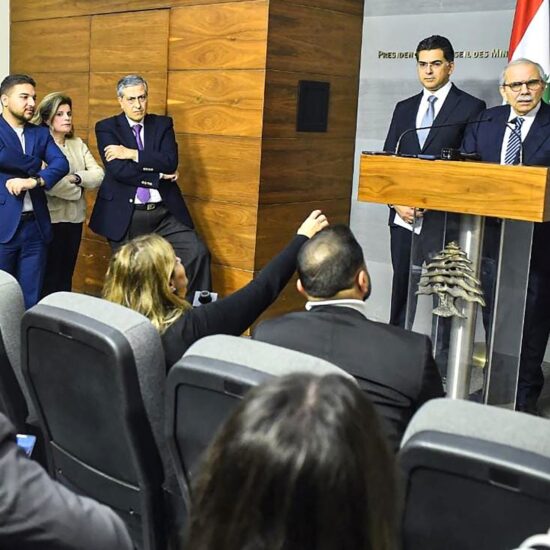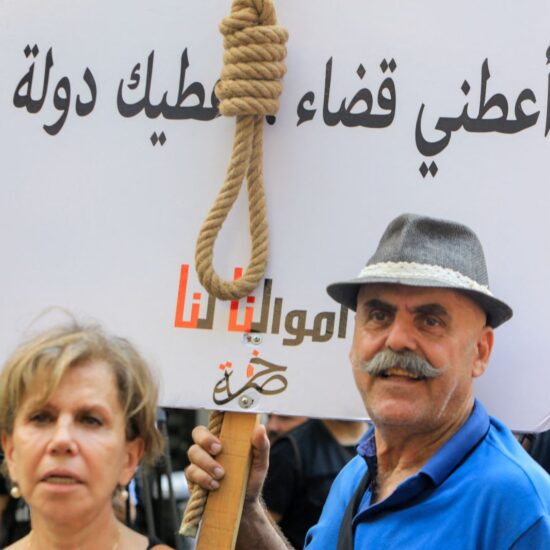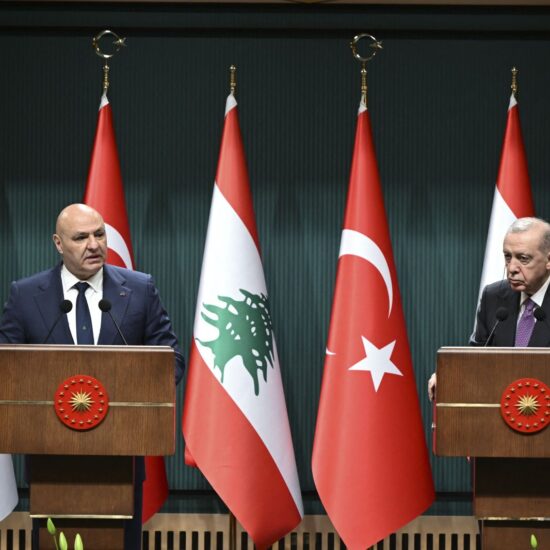
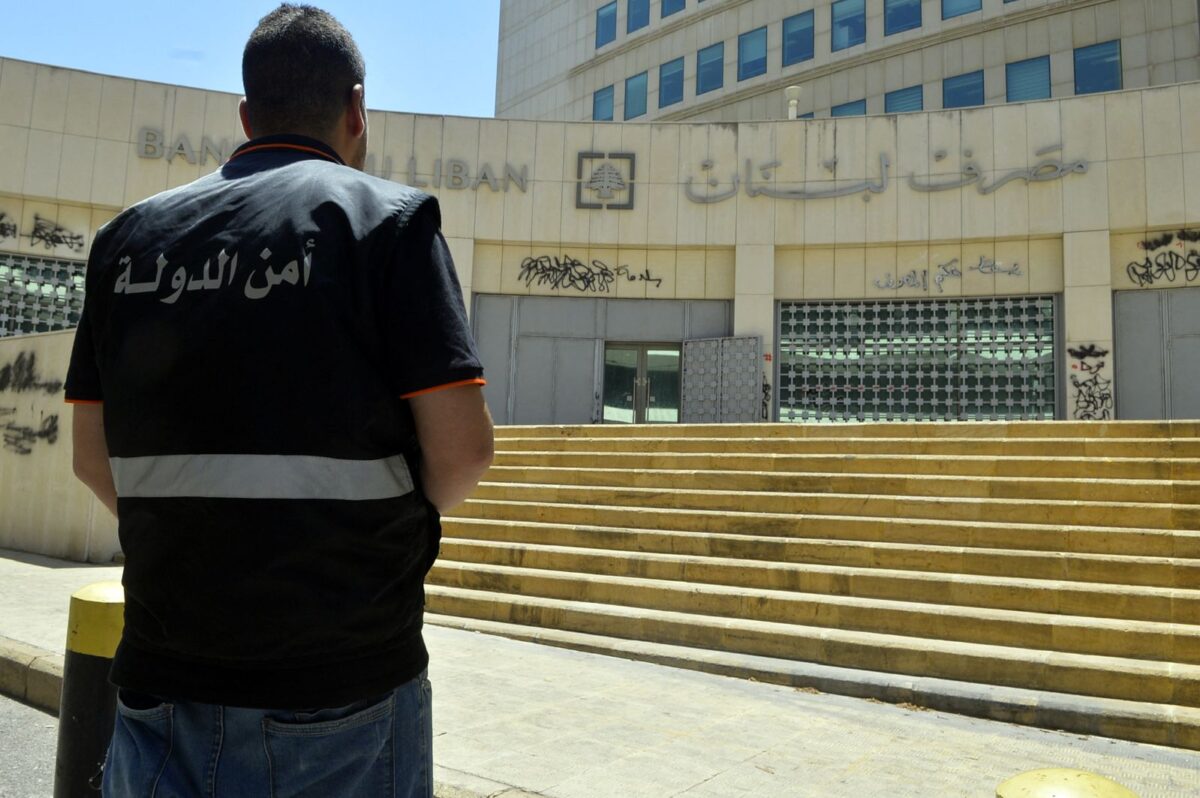
BEIRUT, LEBANON - JULY 19:Security forces raid the central bank in search of its governor Riad Salameh in the capital Beirut, Lebanon on July 19, 2022. The raid came upon a judicial order issued against the governor as part of investigation into accusations of illicit enrichment and money laundering. Houssam Shbaro / Anadolu Agency (Photo by Houssam Shbaro / ANADOLU AGENCY / Anadolu via AFP)
On the IMF’s Diagnostic of Governance and Corruption in Lebanon, and eighty years of identical diagnoses.
Alan Greenspan, the US Federal Reserve Chair who served for almost 19 years under four American presidents, passed away a few days ago at the age of 100. He is considered the second-longest-serving Fed Chair in US history, but his tenure is 11 years shorter than that of Riad Salameh, who served as Governor of the Banque du Liban (BdL) for 30 years.
During his tenure, Greenspan was hailed as the greatest central banker ever. However, just two years after his departure, the US found itself in a severe financial crisis, with accusations that the Fed Chair’s regulatory and monetary policies had helped trigger one of the worst financial crises in modern times.
Economic and financial crises are not like natural disasters. They are human-made, the result of bad policies and weak regulations. A financial crisis in the US in 1907 led to the establishment of the Federal Reserve. The Great Depression of 1929 led to the Glass-Steagall Banking Reform Act and sweeping stock market reforms. The 2008 crisis produced the Dodd-Frank Act and a global framework known as Basel III.
During his tenure, Riad Salameh was treated not only as a star but as a larger-than-life figure. He was a magician who, despite all odds, managed not only to shield the Lebanese economy but also to promote prosperity. The Lebanese are always drawn to the phoenix-rising-from-the-ashes narrative, and this worked well. Salameh was showered with awards, and the IMF praised his leadership in 2009 for steering clear of risky investments and avoiding the worst of the 2008 crisis. Since Lebanon’s great financial collapse, it has become ironic to revisit the risky investments the IMF once praised him for avoiding. But this article is not about Riad Salameh’s rise and fall. That story is for another time and cannot be told without the full context of Lebanon’s political economy, its regional geopolitical setting, and everything bound up with both.
Although the IMF praised Salameh in the past, much has changed since then. The relationship between the IMF and Lebanon today is best described as complicated, borrowing from social media relationship statuses. Lebanon has not signed an agreement with the IMF, not because the political elite is concerned about the impact of such an agreement on the poor and inequality, but because of diverging views on financial and sectoral reforms. Lebanon has succeeded where no other country has: it has managed to rebrand the IMF as part of a grand conspiracy to dismantle the private and banking sectors.
A Diagnostic Nobody Asked For
The IMF recently made public a 73-page Diagnostic of Governance and Corruption, with annexes, drafted jointly by its Legal, Fiscal Affairs, and Monetary and Capital Markets departments. The diagnostic is based on missions conducted from October 2022 to April 2023, which were stalled for two years due to a presidential vacancy and a caretaker government, and was finally completed in October 2025. This document can best be described as a granular map of where the governance deficit manifests across different state institutions. It is worth reading not only for what it contains, much of which anti-corruption experts and civil society activists have been saying for years, but also because it demonstrates that, despite all the past diagnostics, very little has actually changed.
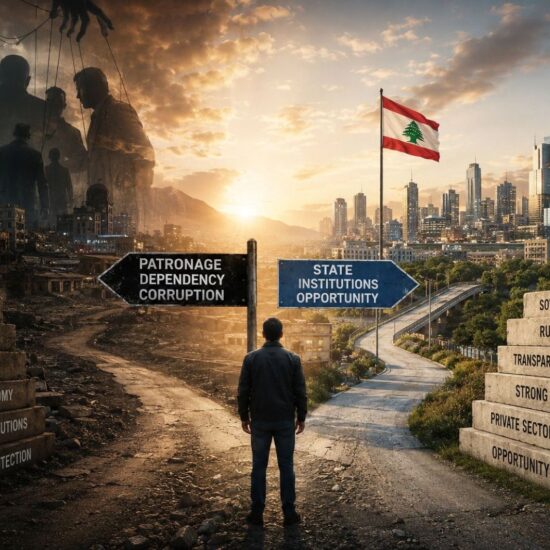
The report confirms what many of us have argued for years: grand structural reform in Lebanon is not currently achievable. It states plainly that structural reform requires “a stable political settlement with fully functional Parliament, President, and Council of Ministers in place.” So what can be done other than wait for that settlement? The report’s genuine contribution is proposing a smaller set of measures capable of creating “a sufficiently effective foundation” while Lebanon waits for Godot, in the form of a political agreement.
1966 and 2019: Two Crises, One Lesson
Of the five domains the report covers, the central bank and financial sector chapters carry the most weight, which should come as no surprise given the magnitude of the crisis. Here, an important analogy can be drawn with what Lebanon has done in the past.
In October 1966, Intra Bank, then the largest financial institution in the country, with roughly 15% of all bank deposits, and built by Yousef Beidas into an empire spanning Middle East Airlines, Casino du Liban, among others, suspended payments. The BdL itself was barely two and a half years old, having been created only in April 1964, and it moved very slowly to backstop Intra during the bank run. That decision has been debated for sixty years, giving rise to theories ranging from internal business rivalries to the political threat posed by a Palestinian-born outsider who had accumulated too much power.
Whatever the cause, the collapse triggered a genuine emergency, and the response was swift by any standard. Within roughly three months, the government and the bankers’ association agreed to a freeze on new bank licenses, a legal mechanism to seize and liquidate insolvent banks, a deposit-guarantee scheme, and two new oversight bodies, the Banking Control Commission and the Higher Banking Commission, all under legislation enacted in January 1967. Intra itself was restructured into Intra Investment Company.
The IMF’s own report notes, almost in passing, that the BDL still directly holds 35.22% of Intra Investment Company today, while the Lebanese state reportedly holds an additional 10%. For sixty years, neither the government nor the central bank considered it urgent to clean up their balance sheets by selling these assets.
Now consider what we face today. The 2019 collapse is not a 15%-of-deposits shock to a single overextended bank. It is the near-total loss of a currency, the wipeout of two decades of dollar savings, a sovereign default, and, as the report documents, a central bank that, for years, ran an opaque foreign exchange platform and unsupervised quasi-fiscal operations, all under the discretion of one governor. The liquidation mechanism, written in 1967, has been invoked exactly once since then, for Al-Madina Bank in 2004.
Sixty years ago, a crisis a fraction of this size produced three new institutions within ninety days. Seven years into one of the worst financial crises ever recorded, according to the World Bank, no new legislation is in place. This tells you something about how effectively Lebanon’s system has evolved since 1966 and in which direction.
The Clock Is Running
Lebanon was added to the FATF gray list in October 2024 and remains on it. The next FATF Plenary, scheduled for next October in Paris, will review Lebanon’s progress on its Anti-Money Laundering and Counter-Terrorist Financing commitments. The most likely outcome is that Lebanon will remain on the gray list until concrete reforms are implemented and sustained. The waiting game cannot continue indefinitely. Lebanon needs to act decisively; otherwise, the financial and reputational repercussions will become more severe.
History suggests that financial crises eventually produce regulatory responses. This happened in Lebanon once. The question today is how much optimism or faith we need in order to believe that reforms could happen again.
Khalil Gebara is an academic and researcher.
The views in this story reflect those of the author alone and do not necessarily reflect the beliefs of NOW.