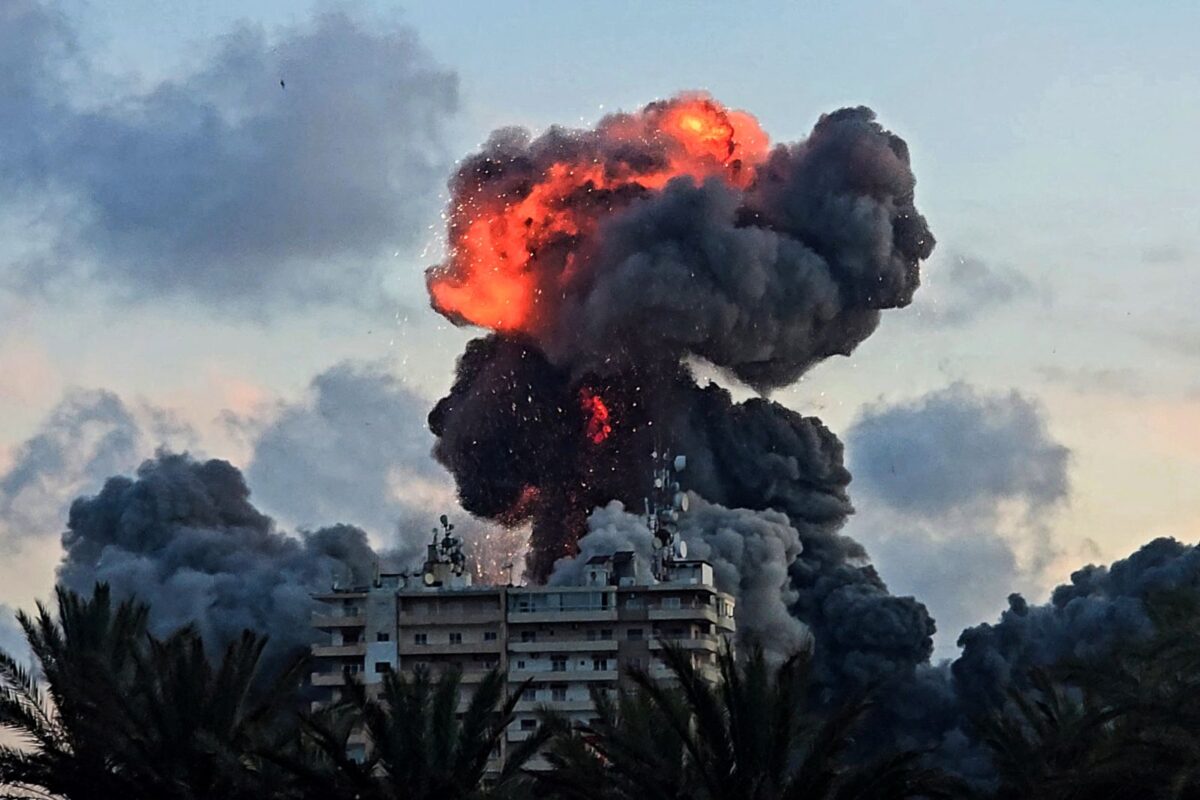
Photo by KAWANT HAJU / AFP. A fireball and smoke erupt from a building following an Israeli strike in Tyre, southern Lebanon, on May 28, 2026.
The Israeli military said on May 28 it had begun new strikes on Hezbollah infrastructure around the southern Lebanese city of Tyre after issuing an evacuation warning to its residents.
Lebanon’s next conflict will not be fought on battlefields, but within the structures that shape everyday life. While war may end with silence, the systems that sustained it often remain intact, continuing to influence how power is exercised, how loyalty is formed, and how dissent is managed. Nowhere is this more evident than in the entrenched reality of Hezbollah, whose influence extends far beyond its weapons. If Lebanon is to move beyond fragile ceasefires, it must confront not only an armed group, but an entire architecture of control.
When the guns fall silent in Lebanon, what often emerges is not peace in any substantive sense, but the illusion of it. While violence may recede from immediate view, the underlying structures of power do not disappear; instead, they reorganize, embed themselves more deeply, and continue to shape the conditions of everyday life in ways that are less visible, but ultimately more enduring.
To engage seriously with Lebanon’s future therefore requires confronting a reality that has too often been softened, deferred, or deliberately obscured: Hezbollah is not simply an armed actor operating within the state, but a system that has, over time, positioned itself as an alternative framework of authority, governance, and belonging.
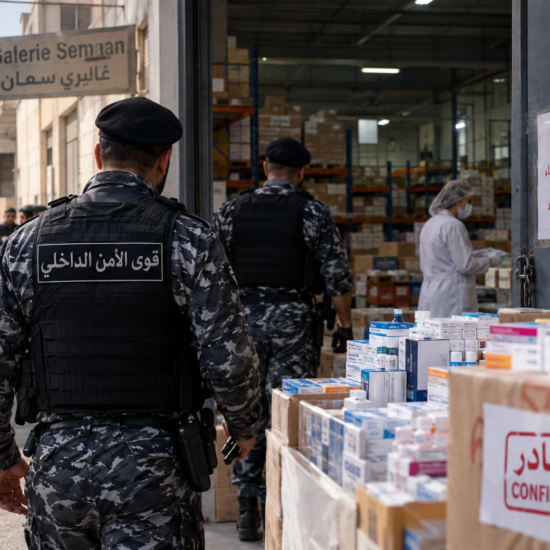
This system is neither accidental nor temporary. It is the outcome of a long-term and highly adaptive strategy through which Hezbollah has extended its reach across multiple domains of social existence. Its influence operates simultaneously through economic networks that generate dependency, educational institutions that shape identity and worldview, welfare structures that substitute for absent state services, and media platforms that frame reality and define the boundaries of acceptable discourse. Within this architecture, access to resources, opportunities, and protection is frequently mediated through proximity to aligned structures, creating a closed circuit in which power sustains itself.
At the level of everyday life, this translates into a reality in which access to work, education, or assistance is often not experienced as a guaranteed civic right, but as something informally mediated through networks of affiliation. In this sense, dependence is not incidental; it is structurally reproduced.
At the same time, this ecosystem is reinforced by a spectrum of coercive mechanisms that do not always rely on overt displays of force. Social pressure, reputational risk, economic exclusion, and implicit threats form a continuum that regulates behavior and narrows the space for dissent. In certain cases, even legal and judicial processes have functioned in ways that extend this pressure, as lawsuits, investigations, or other forms of legal exposure serve not only to adjudicate disputes, but to signal the personal risks of political opposition. Under such conditions, conformity is not simply a matter of agreement; it is often the product of calculated restraint.
What results from this convergence of influence and pressure is not merely support, but a structured environment in which alignment is systematically incentivized and deviation rendered costly. The appearance of cohesion, often interpreted as broad-based legitimacy, must therefore be understood in light of the conditions under which it is produced.
It is within this context that the question of disarmament must be reconsidered and clarified. While the presence of weapons outside state authority is undeniably central, reducing the issue to its military dimension alone risks misdiagnosing the problem. Hezbollah’s power does not rest solely on its capacity for armed force, but on a broader and more complex arsenal that includes economic leverage, institutional penetration, information control, and ideological mobilization. These are not secondary attributes; they are integral to the movement’s resilience and capacity to endure pressure.
In practice, disarmament would therefore require far more than the removal of weapons. It would involve limiting the role of parallel service networks, strengthening independent state institutions, ensuring media plurality, and reducing the economic dependencies that bind citizens to non-state actors. As long as these structures remain intact, the balance of power remains fundamentally unchanged, even in the absence of visible confrontation.
This reality has also been shaped by the role of Lebanon’s broader political class. For years, Hezbollah and the Amal movement have not operated in isolation, but within a wider system of alliances that spans sectarian and political divides. These alliances, both tacit and explicit, have enabled exchanges of political cover, access to state resources, and mutual reinforcement of influence. In this environment, the weakening of state institutions cannot be understood as mere failure. It reflects a set of political incentives that have aligned with the persistence of fragmented authority.
The cumulative effect has been the erosion of state capacity through patterns of patronage, corruption, and institutional capture. Public institutions have not only struggled; they have been hollowed out in ways that make their absence functional for those who benefit from parallel systems of governance. In this context, Hezbollah’s system has not merely coexisted with the state; it has expanded within the very conditions created by its fragmentation.
At the same time, any meaningful transformation must confront a persistent and consequential misrepresentation: the reduction of Lebanon’s Shia community to Hezbollah and the Amal movement. While it is important to acknowledge that both actors continue to enjoy substantial and, in many areas, deeply rooted support among Shia populations, this support is not formed in a vacuum. It is shaped by a combination of lived realities, including security concerns, economic dependency, and the long-standing absence of a reliable state alternative.
Yet this reality should not obscure a more complex and structured dynamic. Over time, Hezbollah and Amal have not only consolidated their influence within the community but have also, both directly and indirectly and often in coordination with broader political actors across Lebanon, contributed to the weakening of state institutions and the erosion of state presence. This process has created the conditions necessary for the expansion of their own systems of control.
Within such an environment, the political space available to the Shia community has become increasingly constrained. While opposition does exist, it rarely appears unified or highly visible, not because it is absent, but because it operates under sustained conditions of pressure. Over the years, dissenting voices have faced marginalization, intimidation, and, in some cases, lethal violence, creating a context in which silence often reflects risk rather than agreement.
To continue equating the Shia community solely with its dominant political actors is therefore not only analytically flawed; it actively obscures the mechanisms through which plurality has been restricted. Recognizing both the reality of existing support and the structures that have shaped it is essential for any serious effort to understand Lebanon’s political landscape and the challenges involved in reconstructing a more inclusive and accountable state.
Lebanon thus stands at a critical juncture, faced with a choice that it has, in various forms, encountered before: whether to continue managing a fragmented reality through temporary accommodations, or to undertake the more demanding process of reestablishing a unified and accountable order of authority.
Ultimately, the durability of peace will not be determined by the absence of armed confrontation alone, but by the extent to which the state succeeds in reclaiming its role as the primary locus of legitimacy, governance, and protection. This includes not only control over weapons in their traditional sense, but also over the economic, institutional, and informational structures that give those weapons their meaning.
The war may well end in a moment, but what follows is a far longer and more consequential process, one that will determine whether Lebanon remains a landscape of competing systems or begins, finally, to function as a state in which citizenship, rather than affiliation, defines the terms of belonging. Ultimately, the durability of peace will not be determined by the absence of armed confrontation alone, but by the extent to which the state succeeds in reclaiming its role as the primary locus of legitimacy, governance, and protection. Without such a shift, the country risks not only the persistence of instability, but the normalization of a fragmented sovereignty that will continue to shape both everyday life and future crises. Wars end. Systems endure. Unless Lebanon confronts the structures that reproduce power beyond the battlefield, it will not be choosing peace; instead, it will be postponing conflict under a different name.
Mostafa Geha is a Lebanese-Swedish school leader with roots in southern Lebanon. He writes on the role of education in preventing radicalization and strengthening long term social cohesion in post conflict societies. A member of the National Board of the Swedish School Leaders’ Union, he lectures widely on education, democratic resilience, and developments in Lebanon and the Middle East.
The views in this story reflect those of the author alone and do not necessarily reflect the beliefs of NOW.