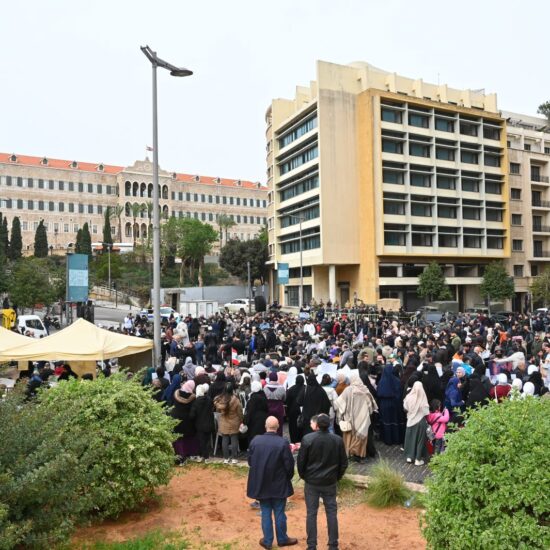
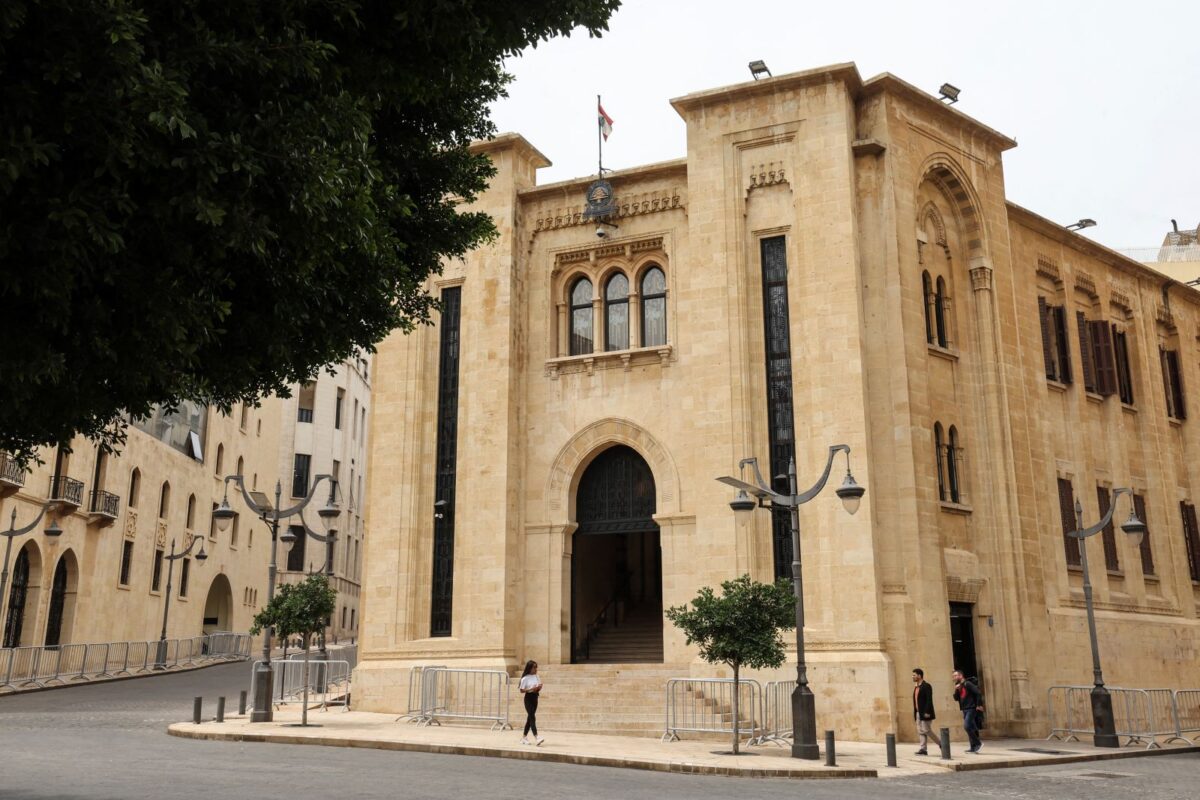
Photo by ANWAR AMRO / AFP. People walk past the Lebanese Parliament building in Beirut's Nejmeh Square on April 15, 2026.
Lebanon’s Parliament spent two days disproving one of the most convenient explanations in Lebanese politics: that the state is simply too weak to act. In forty-eight hours, Parliament voted to abolish the death penalty, adopted a media law debated for sixteen years, approved the first general amnesty since 1991 and amended legislation governing the restructuring of failed banks. A legislature that can alter the country’s criminal philosophy, decide the fate of thousands of prisoners, redraw the boundaries of speech and revise the architecture of banking power is capable of producing consequences. The uncomfortable question is how it chooses them.
The abolition of the death penalty is a genuine achievement. Lebanon had not carried out an execution since 2004, but courts continued to issue death sentences, leaving 85 people on death row at the beginning of this year. Parliament’s decision replaced an unstable moratorium with a legal commitment and made Lebanon the first abolitionist state in the Arab world.
This deserves to be celebrated. A state should not possess the power to kill in the name of justice, particularly when its courts are slow, uneven and vulnerable to political interference. The decision reflects years of work by Lebanese civil society and demonstrates that moral progress remains possible inside a dysfunctional political system. But the same session also revealed the boundaries of that progress.
The new media law modernizes an outdated framework, recognizes digital media and introduces protections for journalists. Yet Parliament retained Article 104, which criminalizes the intentional fabrication and publication of “false and malicious news.” The terms remain undefined, while the punishment can include imprisonment for between three months and three years. Parliament removed the state’s power to execute while preserving its power to imprison people under an ambiguous definition of falsehood. It expanded media protections while retaining an instrument that officials, prosecutors or political actors may eventually use to restrict them. This does not make the entire media law worthless. It shows how reform often works in Lebanon. Progress is permitted, but frequently only after the political system preserves a margin of discretion.
Each community arrived with its category of exception. Parliament moved when the bargain became distributable.
The general amnesty offers another example. The law may benefit up to one-third of Lebanon’s approximately 8,500 prisoners. It responds to real injustice: overcrowded prisons, excessive sentences and people spending years in pretrial detention. But it also emerged from a familiar sectarian exchange. Sunni politicians prioritized Islamist prisoners. Shia representatives sought provisions affecting drug-related offences. Christian parties pursued arrangements for Lebanese who fled to Israel after 2000. Each community arrived with its category of exception. Parliament moved when the bargain became distributable.
Lebanon can agree to empty part of its prisons without repairing the judicial system that filled them. It can reduce sentences without preventing prolonged detention before trial. It can distribute clemency more easily than it can produce equal justice.
The banking amendments complete the picture. Parliament revised the bank-resolution law after the International Monetary Fund identified deficiencies in the original legislation. Movement on financial reform is necessary, but institutional capacity again appeared when reform became connected to an external benchmark, international financing and the possibility of renewed negotiations with the IMF.
Taken together, these decisions make it difficult to describe the Lebanese state as uniformly absent. It acts when a cross-sectarian bargain can be assembled. It acts when external pressure attaches a reward to legislation. It acts when legal ambiguity allows reform to coexist with political discretion. It becomes weaker when action would identify responsibility, impose concentrated losses on powerful actors or remove privileges protecting the political system itself.
When consequences travel downward, the state often discovers its authority. When they travel upward, it discovers constitutional complexity.
This is why investigations slow when they approach political authority. It is why accountability for the financial collapse becomes trapped between technical plans and competing jurisdictions. When consequences travel downward, the state often discovers its authority. When they travel upward, it discovers constitutional complexity.
Selective capacity does not require a conspiracy. The Lebanese state is fragmented between institutions, sectarian interests and competing centers of influence. Where enough powerful actors benefit, institutions move. Where reform threatens a concentrated interest capable of blocking it, paralysis returns.
The narrative of permanent incapacity is useful because it transforms political choices into natural limitations. Officials do not have to admit that they refuse to act. They can say that the state cannot act. Responsibility disappears into the institution, and citizens are encouraged to lower their expectations.
Yet citizens experience a state that is remarkably present in certain moments. It can collect fees, prosecute minor offences, regulate speech and enforce procedures against those without protection. Its absence becomes most visible when people ask it to protect them from a bank, an official or an influential network. People therefore learn that institutional effectiveness depends on who is standing before the state and who is standing behind them.
None of this diminishes the reforms Parliament passed. Abolishing the death penalty matters. Modernizing media legislation matters, although Article 104 must be removed. Correcting unjust sentences and constructing a credible framework for resolving failed banks matter. Cynicism toward every achievement would only protect those who benefit from paralysis.
But this legislative burst has removed an excuse. The next test is no longer whether Lebanese institutions can act. It is what happens when their capacity stops distributing accommodation and begins distributing responsibility.
Ramzi Abou Ismail is a Political Psychologist, Researcher and Analyst.
The views in this story reflect those of the author alone and do not necessarily reflect the beliefs of NOW.