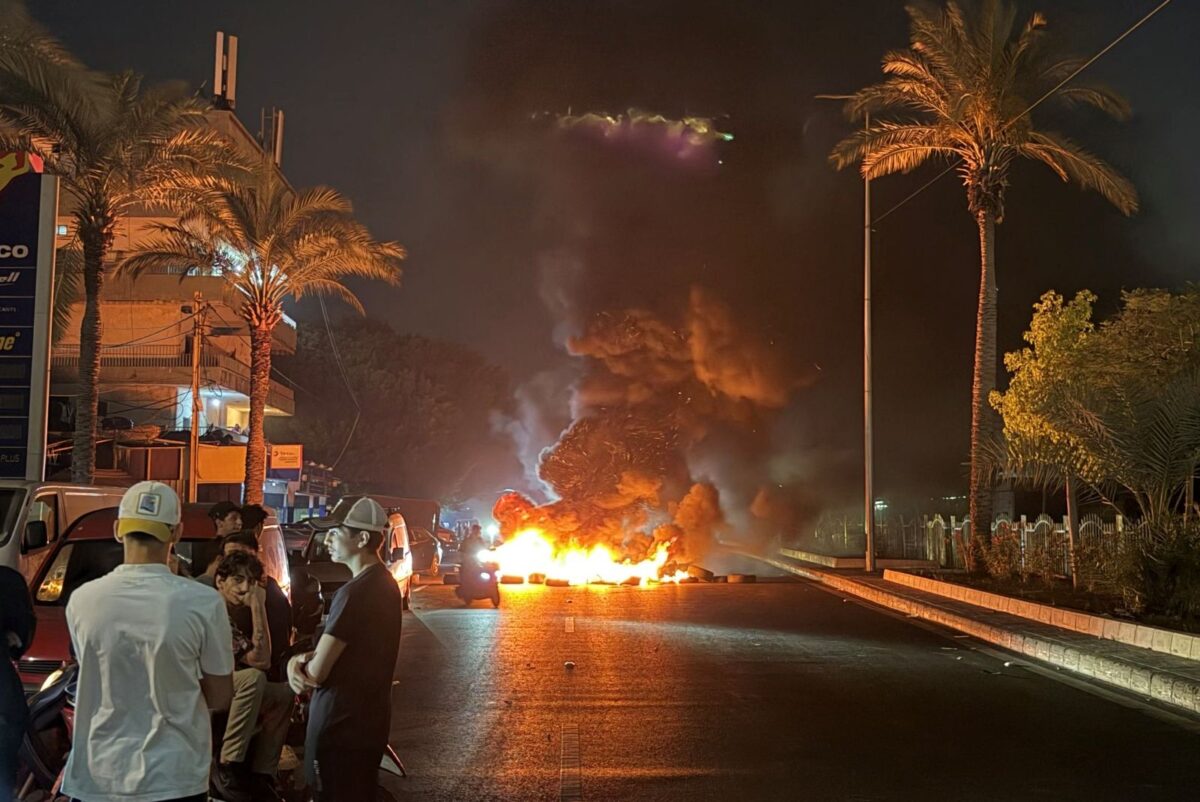
Hezbollah supporters block the old airport road in the southern suburbs of Beirut, with burning tires to protest against the trilateral agreement that was signed between the US, Israel and Lebanon on June 27, 2026. (Photo by Ibrahim AMRO / AFP)
The Lebanese government is losing the momentum to disarm Hezbollah, despite mounting domestic and international pressure to do so. After almost two years on the job, neither the President nor the Prime Minister have meaningfully advanced these efforts beyond entering talks with Israel after its destructive invasion of Lebanon. Beyond that, even the political parties that claim to oppose Hezbollah have failed, in turn, to push for any steps in that direction. As the war with Iran drags on and the Saudi-Houthi conflict proves more complicated than expected, disarming Hezbollah needs to take on a greater urgency than ever before.
Three moments mark turning points for Hezbollah and its strength: the November 2024 ceasefire agreement between Lebanon and Israel, the election of Joseph Aoun and Nawaf Salam as president and prime minister in early 2025, and Hezbollah’s decision to reenter war with Israel in March 2026, to great public outcry. At each of these moments, there was overwhelming public and political support which correctly identified Hezbollah as totally beholden to the IRGC which has caused tremendous damage to Lebanon. None of this was seized upon to initiate the long, complex process of disarmament, and it’s unlikely this is repeated soon.
When Hezbollah restarted the war with Israel in March 2026, the government declared that Beirut would be an “arms-free” city, a decision it also failed to follow through. Hezbollah grew bolder, which can explain why it felt it could drag the country into war and escape accountability twice in three years.
In August 2025, the cabinet tasked the army with limiting “militia arms”, a decision hailed as the beginning of a confrontation by critics of Hezbollah. However, this step was mired with grandiose threats of civil war and violence, and the government never followed through on its own decision. Similarly, when Hezbollah restarted the war with Israel in March 2026, the government declared that Beirut would be an “arms-free” city, a decision it also failed to follow through. Hezbollah grew bolder, which can explain why it felt it could drag the country into war and escape accountability twice in three years.
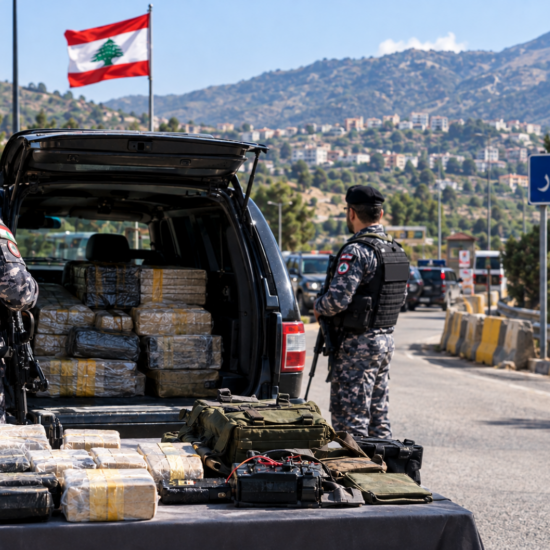
Reports of Hezbollah receiving financial aid from a war-stricken Iran and regrouping its forces further that perception. The party announced a new plan to compensate homeowners whose houses were destroyed by Israel, seemingly immune to the financial pressures of Operation Economic Fury. In addition, the party shows no signs of slowing its military efforts, reportedly preparing itself for a new round of fighting. Most dangerously, Hezbollah operatives were caught transporting explosives, a sign that Hezbollah was willing to resort to its old pattern of targeted assassination of politicians and critics, a tactic which helped entrench its power in the past.
Even the representatives of the state have not been spared, as a lawyer filed a complaint against our ambassador to Washington and lead negotiator, Nada Hamadeh Moawad, accusing her of “communicating with the enemy”, unaware that as a representative of the state, her duties provide her with legal immunity from the Boycott Law of 1955. That isn’t the point: the point is that the state which has allegedly committed itself to disarming Hezbollah and negotiating with Israel is unwilling or unable to go a step in the first direction or to protect those it has tasked with the second direction.
Hafez Assad, in the 1990s, decided to negotiate with Israel at the behest of the Clinton administration, knowing that such a step in the aftermath of the Cold War would grant him some concessions from Washington and the international community. Under the cover of these negotiations, Assad secured his son’s succession and Syria’s occupation of Lebanon, and subsequently international legitimacy. There may be some misguided people, specifically some affiliates of Amal and Hezbollah, who believe some cosmetic steps in negotiations and disarmament may pave the way for international acceptance of a kleptocratic, militia-riddled Lebanon even after the past three years.
Israel has given every indication that it intends to escalate its destructive war on Lebanon, and with the world’s attention occupied by the war in Iran and the closure of straits, it’s unlikely the Trump administration will devote time and effort to an endeavor it deems a failure
This is unlikely to be the case. Israel has given every indication that it intends to escalate its destructive war on Lebanon, and with the world’s attention occupied by the war in Iran and the closure of straits, it’s unlikely the Trump administration will devote time and effort to an endeavor it deems a failure. All this will cause is more Lebanese death and displacement by Israel, all with the absence of any accountability. Under such circumstances, Hezbollah is likely to entrench itself as a local armed gang, turning its weapons inward and weathering whichever “storm” that will engulf Lebanon.
Mohammad el-Sahily is a student and activist. He tweets @moesahily.
The views in this story reflect those of the author alone and do not necessarily reflect the beliefs of NOW.