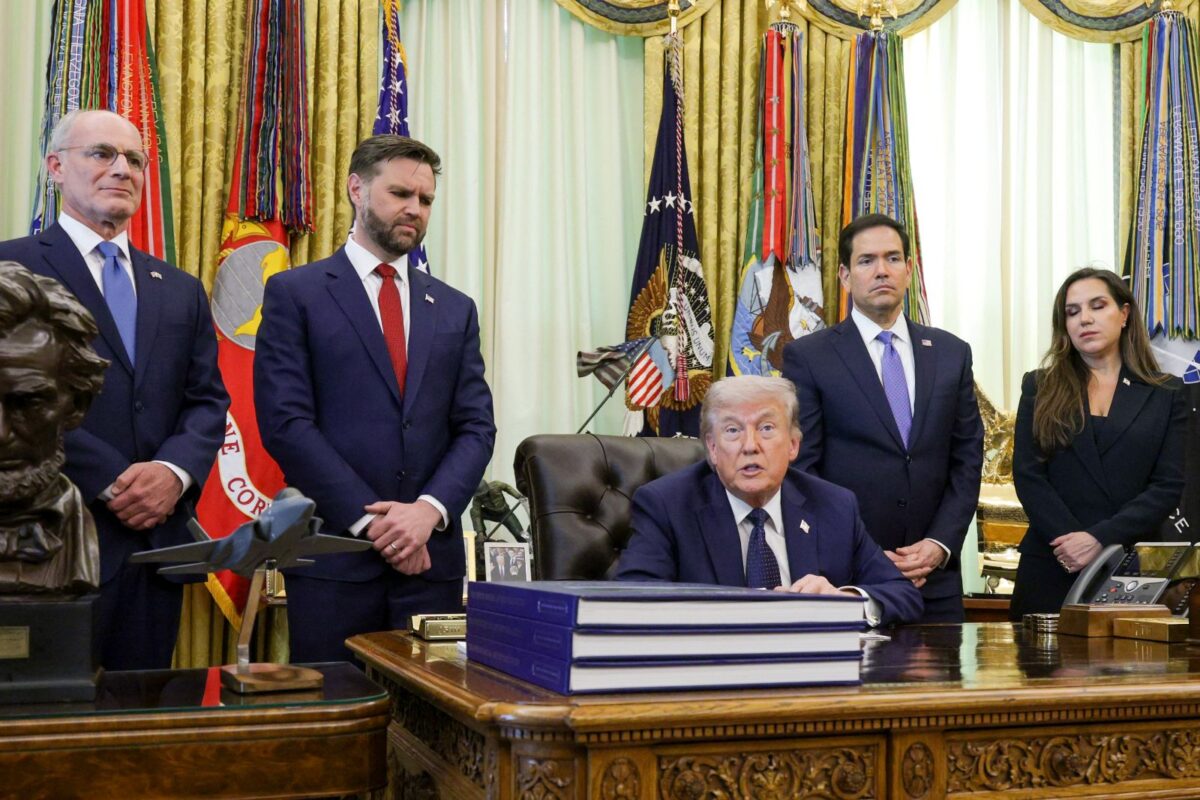
Photo by ALEX WONG / GETTY IMAGES NORTH AMERICA / GETTY IMAGES VIA AFP. U.S. President Donald Trump (C) speaks as (L-R) Israeli Ambassador to the U.S. Yechiel Leiter, U.S. Vice President JD Vance, U.S. Secretary of State Marco Rubio and Lebanese Ambassador to the U.S. Nada Hamadeh Moawad look on during a meeting in the Oval Office of the White House on April 23, 2026 in Washington, DC.
For nearly half a century, the Arab world has had two models of peace with Israel sitting side by side, and most people in this region have never bothered to notice they are not the same thing. Egypt signed its treaty in 1979. Jordan signed its treaty in 1994. Both ended wars, both remain formally in force, and both are, to this day, cold. Governments exchanged ambassadors; societies never exchanged much of anything. Surveys of Egyptian and Jordanian public opinion still show some of the widest anti-normalization sentiment in the region, decades after the ink dried. Peace, in both cases, stayed a fact about states. It never became a fact about people.
The Abraham Accords, signed in 2020 between Israel and the UAE and Bahrain, then Morocco and Sudan, were built differently, and the difference explains why they have taken root where the older treaties did not. The Gulf states that signed were never at war with Israel. They carried no battlefield trauma, no lists of the dead, no generation raised to see the other side only through a gunsight. That absence of shared trauma is not incidental to the Accords’ success, it is the reason business delegations, tourists, students, and artists move between Abu Dhabi and Tel Aviv today in a way they never moved between Cairo and Tel Aviv, or Amman and Jerusalem. Trade between Israel and its Accords partners, alongside Egypt and Jordan, grew by well over a hundred percent between 2021 and 2024. That is not a diplomatic statistic. It is what actual normalization looks like when it is allowed to happen.
This is where the demonization problem has to be named directly, because it is the real obstacle standing between Lebanon and any version of this path, and it works in both directions. Decades of state media, school curricula, and political rhetoric across the region have trained generations to see “the Israeli” as an abstraction: a uniform, a settlement, an airstrike, never a person with a family, a job, a disagreement with his own government. The same demonization runs the other way, flattening Arabs and Lebanese into threats rather than neighbors. Peace treaties signed by leaders and never sold to publics leave that machinery fully intact, which is exactly what happened after Camp David and after Wadi Araba. The Abraham Accords, by contrast, invested from day one in the unglamorous work of people actually meeting each other, joint ventures, university exchanges, tourism campaigns, interfaith projects, because Gulf leaders understood that a treaty nobody’s public believes in is a treaty that can be reversed by the next crisis. Humanizing the other side is not a soft add-on to peace. It is the only thing that makes peace durable once the politicians who signed it are gone.
Lebanon has watched all of this from the outside, at a considerable cost. It remains technically at war with a state it has not fought directly in years, held in that position not by its own strategic interest but by the veto of an armed faction answering to Tehran rather than Beirut. That arrangement has not protected Lebanon. It has impoverished it, isolated it from Gulf capital, and turned the south into a permanent front line for a fight most Lebanese never chose. The question worth asking is not whether Lebanon could one day sign something resembling the Abraham Accords, that is a conversation for another day, and a fraught one. The question worth asking now is simpler: what would it cost Lebanon to at least stop being demonized as a threat, and to stop demonizing its way out of every opportunity placed in front of it?
Because the Gulf states that signed the Accords did not simply make peace with Israel. They made a strategic bet on their own people’s future, on jobs, on investment, on a generation that would grow up trading and studying and building rather than inheriting someone else’s war. Lebanon has been offered fragments of that same bet over the past two years: Emirati capital returning, travel restrictions lifted, a real prospect of becoming a regional investment hub if the state can get its house in order. None of that requires Lebanon to sign anything with Israel tomorrow. It requires something arguably harder, a Lebanese state willing to reclaim its own sovereignty from the faction that has spent decades selling Lebanese blood and Lebanese future for someone else’s regional ambitions.
The lesson of the Abraham Accords for Lebanon is not really about Israel at all. It is about what happens to a country that lets its foreign policy be dictated by grievance and proxy war versus one that decides, deliberately, to build something for its own people. Egypt and Jordan proved that peace signed only at the top never survives contact with a public raised on demonization.
The Gulf states proved the opposite: that peace built on economic interest, mutual benefit, and the simple, patient work of letting people see each other as people can outlast the leaders who started it. Lebanon does not have to choose normalization to learn from that lesson. It only has to admit that the demonization it has been fed for forty years, of Israelis, and by the same rotten logic, of the very idea of an independent, sovereign, prosperous Lebanon, has cost it everything it might have otherwise built.
Elissa E Hachem is a journalist and political writer specializing in regional affairs and governance. Former Regional Media Advisor at the U.S. State Department’s Arabic Regional Media Hub, with broad experience in strategic communication across government and private sectors.
The views in this story reflect those of the author alone and do not necessarily reflect the beliefs of NOW.