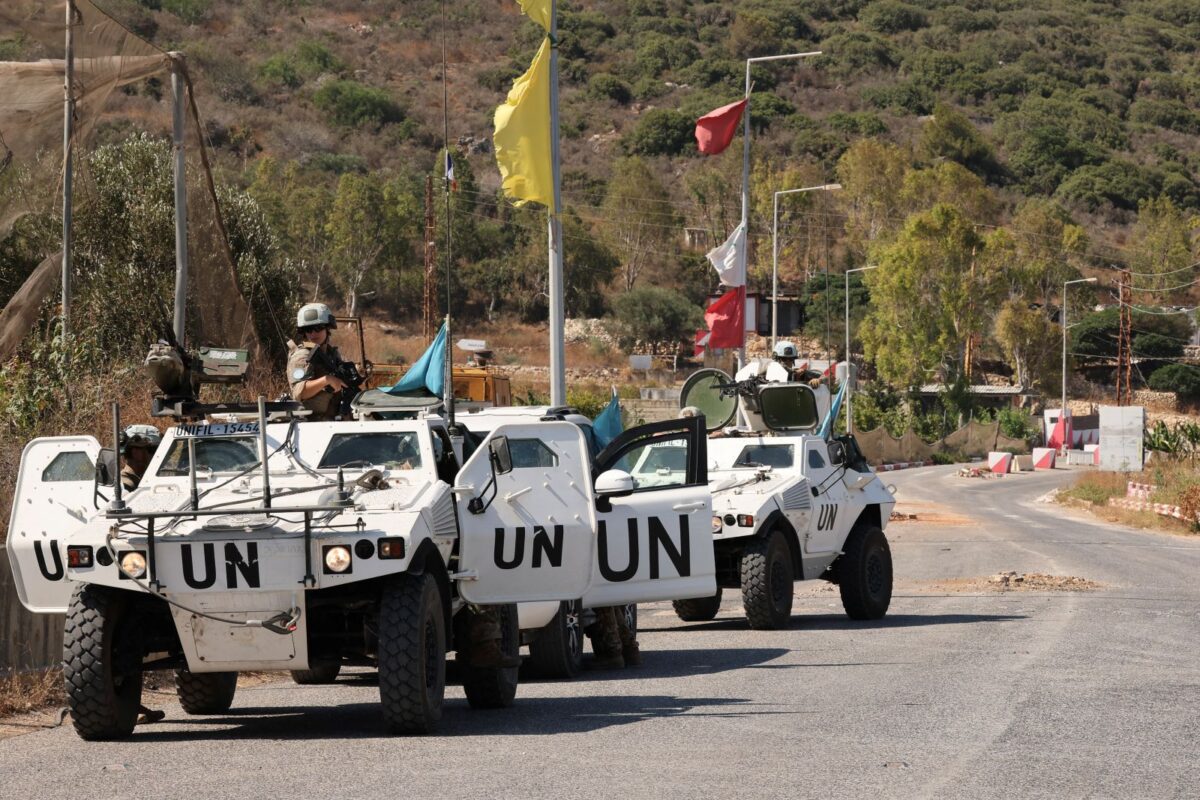
Photo by ANWAR AMRO / AFP. A photograph taken during a media tour organized by the French Catholic charity L'Oeuvre d'Orient shows peacekeepers with the United Nations Interim Force In Lebanon (UNIFIL) patrolling near the southern Lebanese village Biout es Sayed on July 20, 2026.
Lebanon is once again asking the international community to keep an international military presence in the South. President Joseph Aoun has said extending the mandate of the United Nations Interim Force in Lebanon (UNIFIL), which expires at the end of 2026, is Lebanon’s “first option.” If that fails, Lebanon would seek an alternative legal framework allowing international forces to remain alongside and in coordination with the Lebanese Army.
The debate, however, goes beyond whether UNIFIL should remain. It raises a more fundamental question: can an international force help Lebanon restore sovereignty if the Lebanese state itself is unwilling or unable to enforce its authority?
Supporters of a transition argue that continued international spending on UNIFIL risks creating a costly parallel security structure, while greater investment in the Lebanese Armed Forces could help build a sustainable, state-led security presence. The debate comes as Lebanon considers the future of the international mission and seeks to assume greater responsibility for security across the South.
For Middle East geopolitical security analyst Riad Kahwaji, the starting point is clear: sovereignty requires the state to have a monopoly over the use of force and weapons.
“First and foremost, sovereignty means full monopoly on use of violence, on possession of weapons, and no armed militias,” Kahwaji told NOW.
He argued that the Lebanese authorities must demonstrate greater seriousness in implementing their decisions to disarm Hezbollah, saying that so far there had been statements but little action on the ground.
Kahwaji said that establishing genuine state control would be essential not only to restoring Lebanese sovereignty, but also to facilitating an Israeli withdrawal and allowing international peacekeepers to operate effectively.
“The Lebanese authorities have to show seriousness and courageous moves in disarming Hezbollah,” he said. “So far it has been just words, statements, but no real action.”
His argument places the responsibility for the effectiveness of any international force primarily on the Lebanese state. In his view, UNIFIL’s shortcomings cannot be separated from the failure of Lebanese authorities to enforce the terms of Resolution 1701.
UNIFEL’S record
“The problem with UNIFIL was twofold,” Kahwaji said. “One, the Lebanese government was not doing its part in enforcing its sovereignty.”
He argued that reports of Hezbollah activity should have prompted action from the Lebanese Army under the existing international framework.
“All reports made about Hezbollah’s activities, the Lebanese Army should have moved to stop as per the mandate of the Security Council,” he said. “Lebanese authorities did not do anything.”
Kahwaji also placed responsibility on the countries contributing troops to UNIFIL, arguing that international forces should be more transparent about what they observe in their areas of operation.
Kahwaji also placed responsibility on the countries contributing troops to UNIFIL, arguing that international forces should be more transparent about what they observe in their areas of operation.
He accused contributing countries of failing to adequately report Hezbollah’s continued weapons trafficking and the construction of military infrastructure, including tunnels.
“We need countries that dispatch troops, international forces or troops for UN missions to be transparent about the activities down there in the areas of operation,” he said.
For Kahwaji, however, changing the name or structure of the international presence would not by itself solve the problem. The crucial issue is the mandate given to the force and, more importantly, whether the Lebanese government is prepared to act.
“It doesn’t matter whether we have international forces or UN forces,” he said. “It all depends on the mandate.”
Any future international force, he argued, would need sufficient authority to act against Hezbollah or any other armed group operating illegally in the South.
But while Kahwaji sees the Lebanese state’s political will as the central missing ingredient, Lebanese political writer Marwan El Amine takes a considerably more critical view of UNIFIL itself.
For El Amine, the UN mission has already exhausted its usefulness and failed to achieve its fundamental objectives.
“I believe the UNIFIL phase is completely over and has proven its failure,” El Amine told NOW Lebanon.
He argued that UNIFIL had failed to prevent successive Lebanese-Israeli wars, prevent the presence of militias on Lebanese territory, or strengthen the Lebanese state’s exclusive authority over the country, particularly following the 2006 war and the adoption of Resolution 1701.
“I believe the UNIFIL phase is completely over and has proven its failure,” El Amine told NOW Lebanon.
He argued that UNIFIL had failed to prevent successive Lebanese-Israeli wars, prevent the presence of militias on Lebanese territory, or strengthen the Lebanese state’s exclusive authority over the country, particularly following the 2006 war and the adoption of Resolution 1701.
A UN cover
Although the Lebanese Army deployed to the South alongside the expanded UNIFIL presence, El Amine argued that both institutions effectively turned a blind eye to Hezbollah’s military activity.
“The two sides were turning a blind eye to all of Hezbollah’s military activity and did nothing to prevent Hezbollah from building its military infrastructure,” he said.
He pointed specifically to the discovery of tunnels close to UNIFIL positions as evidence, in his view, that the mission failed to fulfil its responsibilities.
“We saw tunnels being built 50 meters from UNIFIL positions,” he said. “What was UNIFIL doing there if they were really carrying out their role and assuming their responsibilities?”
El Amine went further, arguing that UNIFIL’s presence ultimately contributed to Hezbollah’s ability to consolidate its military infrastructure in southern Lebanon.
“If we don’t consider it politically a cover for Hezbollah’s military activity in southern Lebanon, then the more accurate definition would be a UN cover,” he said.
He also argued that UNIFIL could have played a more consequential role even without directly confronting Hezbollah militarily: by publicly documenting violations of Resolution 1701.
“If UNIFIL was not under Chapter VII to carry out actions against Hezbollah and prevent it from carrying out military activities, it could at least have said every time it saw military activity by Hezbollah south of the Litani that this constituted a violation of 1701,” he said.
Instead, El Amine argued, the absence of such reporting contributed to the erosion of state authority.
“UNIFIL, by failing on this issue, was contributing to strengthening Hezbollah’s authority in the South at the expense of the authority of the Lebanese state,” he said.
That leaves Lebanon facing a difficult contradiction. Aoun’s government is seeking to preserve an international security presence precisely because the South remains unstable and the Lebanese state is still attempting to consolidate its authority. But the very need for an international force raises questions about whether that authority has actually been established.
The issue is therefore not simply whether UNIFIL stays or leaves. It is what happens to the Lebanese state if it stays, and what happens to the South if it does not.
Political will
For El Amine, redirecting UNIFIL’s funding toward the Lebanese Army could be useful, but only if it is accompanied by political will to impose state authority.
“Funding allocated to UNIFIL could go to the Lebanese Army,” he said. “But this must also be conditional on there being a will among the political authority and the Army command and all the security agencies to extend their authority on the ground in the South.”
He argued that the state cannot rely indefinitely on monitoring or reporting violations. It must eventually be prepared to confront armed groups that challenge its authority.
“Authority does not come through begging,” he said. “Prestige does not come through begging.”
El Amine also argued that Lebanon would first need to address what he described as Hezbollah’s influence inside state institutions before expecting the Army and security agencies to confront the group.
“There must be a campaign to clean all state institutions of officials, officers, personnel and leadership who coordinate with Hezbollah and work for Hezbollah,” he said.
The sovereignty gap
For Kahwaji, a stronger and better-mandated international presence can only work if the Lebanese government is serious about disarming Hezbollah and exercising state authority. For El Amine, UNIFIL’s record demonstrates that an international presence without enforcement and political will has failed to produce that outcome.
Lebanon therefore faces a sovereignty paradox. It wants an international force to help secure the South and strengthen the state, but the stated end goal of the international mission is precisely for the Lebanese state to become capable of securing the South on its own.