
Photo by HANDOUT / LEBANESE GOVERNMENT PRESS OFFICE / AFP. A photograph released by the Lebanese Government Press Office on December 26, 2025, show Lebanon's Prime Minister Nawaf Salam speaking during a press conference after a cabinet session in Beirut on December 26, 2025.
Lebanon has started reforming its banking sector which collapsed during the 2019 financial crisis, but still has to decide how to repay depositors their losses.
In mid-August, Lebanon’s parliament passed the long-awaited amendments to the Banking Resolution Law. After the 2019 financial crisis left the Lebanese economy in shambles, the government is hoping to reform the banking sector.
“But it does not solve the banking crisis by itself,” Samad added.
“The law is an important and necessary step, because Lebanon finally has a framework for resolving insolvent banks,” Ziad Abdel Samad, the executive director of the Arab NGO network for development (ANND) told Now. “But it does not solve the banking crisis by itself,” Samad added.
The law has been changed and adapted several times. Parliament first presented a draft last year, which in parts did not meet the international standards. In May 2026, Lebanon’s government submitted a different version, which was discussed and altered in the parliamentary process. In mid-August parliament approved the text, which is considered to be aligned with the IMF demands. Under the new law, the Higher Banking Commission (HBC) will have the power to identify, restructure and liquidate private banks.
The U.S. Embassy in Beirut endorsed the new law and urged the government to advance with the country’s Gap Law. The IMF’s representative to Lebanon, Federico Lima, called the Banking Resolution Law a “major step”, while urging Lebanon’s government to push for the “effective implementation”.
But the Banking Resolution Law “is facing non-enforcement until further notice”, the Chief Economist at Byblos Bank, Nassib Ghobril told Now. Its implementation depends on the Financial Stability and Deposit Recovery Act, which is commonly referred to as the “Gap Law”. This law is supposed to determine who will pay for the $70–73 billion losses from the financial crisis and how much each party will be asked to pay.
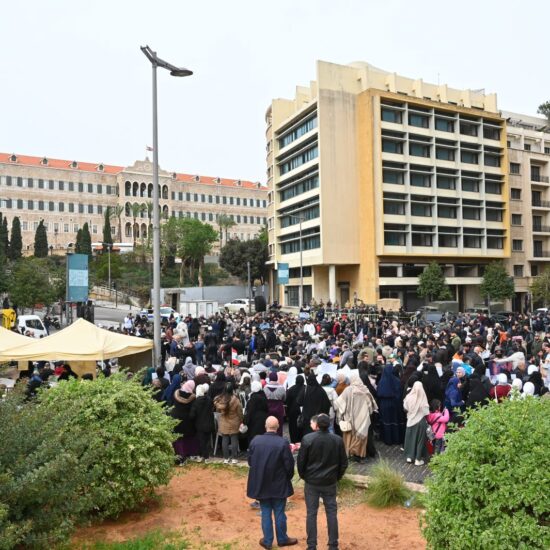
In the 2019 financial crisis, banks banned money withdrawals and transfers. As a consequence depositors could not access their money, which over time lost its value due to inflation. After the crisis, depositors stored their savings at home rather than giving it to the banks. Lebanon’s economy is currently mostly cash-based. In 2022, the cash economy amounted to about $9.9 billion — which was about half of the country’s GDP. “The cash economy is ultimately a symptom of the collapse of trust,” Samad said. “But people will not put their money back into banks simply because a law has been passed,” he added.
“The structural problem of the Lebanese commercial banks and banking sector lies in the lack of confidence, not just in the banking sector, but in the proper functioning of public institutions,”
“The structural problem of the Lebanese commercial banks and banking sector lies in the lack of confidence, not just in the banking sector, but in the proper functioning of public institutions,” Ghobril said. Solving Lebanon’s trust problem is therefore at the heart of any reform process. The depositors must trust the banks, while investors need to rely on the functioning institutions.
Corruption is a major problem in building trust. In 2025, Lebanon scored 153rd of 182 countries in the Corruption Perceptions Index. “If people believe that politically connected individuals or powerful networks can protect their interests while ordinary depositors bear the losses, confidence will not return,” Samad warned.
Cash flows to Lebanon are also restricted due to the risk associated in doing business in the country. Lebanon is currently on the gray list of the Financial Action Task Force against money laundering and terrorism financing and on the EU’s list of high-risk jurisdictions regarding money laundering. Banks need to increasingly monitor and verify their work in Lebanon, while foreign firms might be hesitant to invest in the country. Ultimately, “the goal is to remove Lebanon from these two lists,” Ghobril said. Realistically, it might take some years to achieve this.
The country is also facing a deep, multidimensional crisis — not simply a banking crisis, said Samad. “It is simultaneously an economic, financial, institutional, political and governance crisis, compounded by the consequences of war.” Eventually, Lebanon has to overhaul most of its institutions to win the people’s trust back.