With the U.S.-enforced regime change in Venezuela, the Trump administration sends a warning signal directed at Iran and it’s proxy Hezbollah. The new American foreign policy prioritizes its own interests over sovereign borders.
The U.S. abduction of Venezuelan President Nicolás Maduro has sent a strong message to the world. The rules of sovereignty and international law no longer constrain Washington from pursuing its interests, regardless of territorial borders.
In recent days, analysts have drawn parallels between the American intervention in Venezuela and those in Iraq, Libya, and Afghanistan. However, U.S. Secretary of State Marco Rubio has insisted that this intervention differs from previous ones. “This is not the Middle East, and our mission here is very different,” he said on Sunday.
But the message is clear: the intervention is a warning to the anti-American axis of the world — including Iran and its ally Hezbollah. The attack comes at a time when Iran is facing mounting pressure at home, with people flooding the streets to protest against inflation and rising prices.
Donald Trump warned Iran against violently repressing these protests — threatening US intervention. According to a rights group, 16 people have already died amid the violent clashes. “We are locked and loaded and ready to go,” Trump said last Friday on Truth Social. After the attack on Venezuela this message might resonate even louder in Tehran.
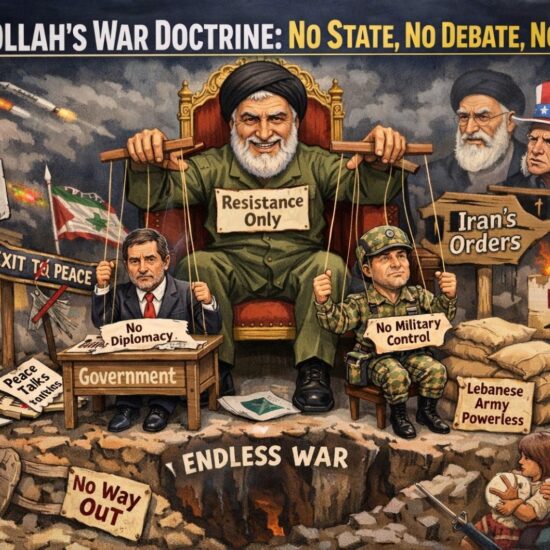
Hezbollah, which has longstanding ties to Tehran and Caracas, has meanwhile kept a low profile. During Saturday’s speech, Hezbollah Secretary-General Naim Qassem avoided talking about Venezuela or the protests in Iran. Instead, he called for a stronger Lebanese army and sovereignty across the country. Iran, he argued, had supported Hezbollah without expecting anything in return.
Both Iran and Hezbollah have benefited from Maduro’s regime in Venezuela. In December, the US seized a tanker off the Venezuelan coast. The ship had previously been sanctioned by the US for alleged smuggling in connection with Iran’s Islamic Revolutionary Guard Corps and Hezbollah.
American sources told Hezbollah before the attack that the old world order was gone and that “the game is over”. Another Lebanese-American source who met with Hezbollah officials in Beirut a few weeks ago, said they were aware of the impending attack on Venezuela and warned that Iran would face similar consequences if it did not negotiate.
Lebanese officials are allegedly traveling abroad to discuss with regional and international powers how a political settlement with Hezbollah could look. Regardless, the abduction of Maduro signals that sovereignty and international law can be bent to geopolitical interests.
In Lebanon
Prime Minister Nawaf Salam’s 2026 priorities: He said that his focus is on political reforms, the disarmament of Hezbollah and establishing the state’s monopoly on weapons. Salam said he was not concerned about internal clashes within the country, but wanted to stop the continued Israeli strikes. Regarding the financial gap law, he promised that depositors with less than $100,000 would receive their money within four years. Solving the country’s electricity problem would require patience, he insisted.
Raids against alleged pro-Assad loyalists in Tripoli: On Saturday, the Lebanese army raided shelters and camps in Tripoli and in the Akkar region, but did not arrest anyone. The raid came after a media report which claimed that several Assad loyalists — some based in Lebanon — were plotting to destabilize Syria.
New Israeli airstrike in Bint Jbeil district: Two people were killed on Sunday evening after an Israeli drone strike on a car — a passenger and a passerby. Incendiary bombs were also dropped close to Blida, while several loud explosions were heard across the South.
In The Region
Syria and Kurds held talks: On Sunday, the Syrian Democratic Forces (SDF) discussed the plan to merge its army into the Syrian army. In March last year, Syrian President Ahmed al-Sharaa negotiated a deal with the SDF — which was followed by disagreement about its implementation. Syrian state media reported that no “tangible results” came out of the meeting in Damascus.
Britain and France fly attacks against Syria: The UK and France have bombed an IS arms bunker north of Palmyra, the British Defense Ministry said on Sunday. The cache was located underground and is believed to have been successfully targeted, but success of the operation is still being assessed. In December, the U.S. had launched severe airstrikes against IS in Syria, after two of its soldiers and a translator had been killed in an attack.
Yemen in turmoil: The Saudi-backed Yemeni government has reclaimed key cities in southern Yemen, such as Mukalla and parts of Hadramaut. Previously the UAE-backed Southern Transitional Council (STC) seized oil-rich territories there. The Saudis conceived this as a security threat and bombed UAE arms deliveries to the STC — they also demanded that the UAE withdraw its military from Yemen, a demand with which it complied with.
Gaza: United Nations Secretary-General António Guterres has expressed concern over Israel’s ban on NGOs operating in Gaza and the West Bank. He warned that these moves will worsen the humanitarian crisis and urged Israel to lift the ban.
What We’re Reading
Lebanon was not the headline at Mar-a-Lago. That was precisely the point: Now’s managing editor Makram Rabah argues that Lebanon was largely sidelined in last week’s talks between Trump and Netanyahu. Trump described Lebanon as “disadvantaged” and unable to control Hezbollah, framing the U.S. and Israel as the main actors. This narrative makes the U.S. and Israel the main actors, and Lebanon as both dependent on outside powers and constrained by Hezbollah, which it cannot fully manage. Rabah warns that unless Lebanon asserts its sovereignty over militias like Hezbollah, it risks being treated as a territory subject to external enforcement rather than a state deserving diplomatic investment.
Lebanon in 2025: A Year of Political Change, Economic Challenges, and Security Uncertainty: In 2025, Lebanon ended years of political paralysis with the election of president Joseph Aoun, Now’s author Rodayna Raydan reports. The country’s government also sought ties with neighboring countries and regional powers, like Syria and Saudi Arabia, while slowly building ties with Israel. Despite symbolic moments like the pope’s visit, deep public anger persists over financial losses and slow recovery. Last year showed slow but important progress, while underlining the long-standing crises and regional instability that have shaped Lebanon for ages.
A State, a Strait, and a Shockwave: Somaliland and the New Regional Order. Elissa El Hachem argues that Israel’s recognition of Somaliland is a sign of the new regional order that is emerging in the Middle East and splitting the region into two blocs. According to her, Israel’s move is more than diplomacy. It highlights Somaliland’s strategic geography, transforming it into a geopolitical asset due to its core maritime chokepoints.