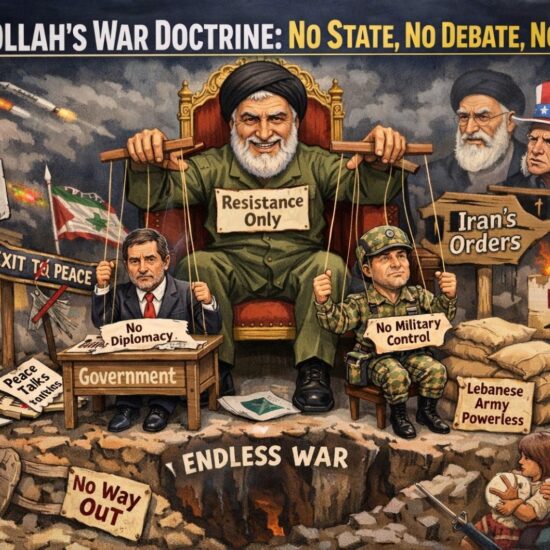
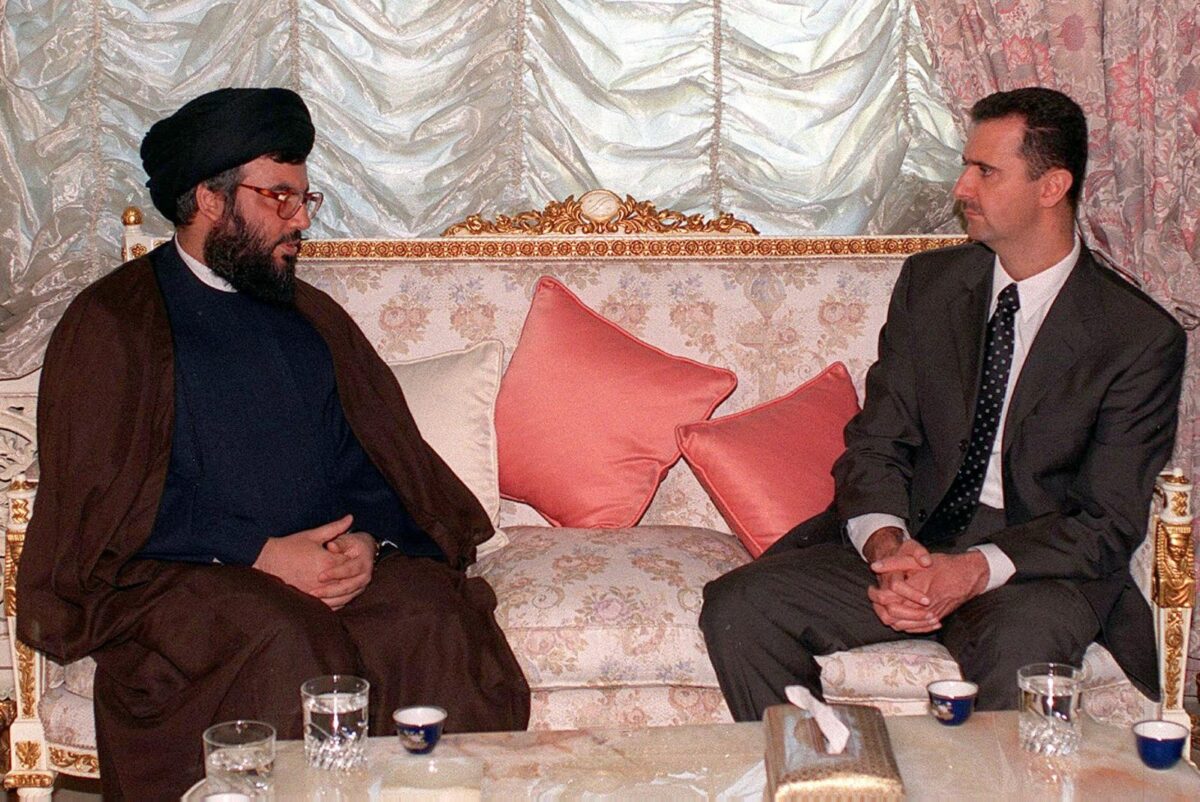
One year after Bashar al-Assad’s fall, a series of leaked recordings surfaced — not as mere scandal fodder or delayed archival curiosities, but as full political and moral indictments. They expose, with chilling clarity, the true character of the man who ruled Syria by fire and fear. More importantly for Lebanon, they unveil the real nature of the “axis” that sustained him — and the deception at its core.
The most striking revelation is not Assad’s contempt for his own people, army, or country — Syrians and Lebanese have long known that disdain. What is newly revealed, and far more damning, is his unfiltered mockery of his closest ally: Hezbollah. The man who claimed to lead an “axis of resistance” is heard deriding that very axis with the same sneer he reserved for his victims. His adviser, Luna al-Shibl, openly ridicules Hezbollah’s supposed “street fighters,” noting with dry sarcasm that “their voices have disappeared.” Assad does not object or offer even token praise. Instead, he joins the contempt, confirming what many suspected all along: this was never a partnership of equals but a utilitarian arrangement fated to end in neglect and disregard.
This is not casual personal derision. In the recordings, Hezbollah appears precisely as Assad viewed it — a disposable instrument. The thousands of fighters who crossed into Syria under banners of “protecting holy shrines” or “defending the resistance” become fleeting figures in bitter jokes, expendable noise that faded once their use expired. To Assad, they were not ideological “martyrs,” but cheap fuel for the war that kept him in power.
If Assad mocked Hezbollah behind closed doors, Hassan Nasrallah mirrored that mockery in public — masked in soaring rhetoric. He perfected the art of speeches that narcotize rather than awaken, glorifying death without accounting for it. While he boasted of “victories,” he sent young men from the South, the Bekaa, and the suburbs of Beirut into a war that had nothing to do with Lebanon’s security or national interest. Promised paradise, they were buried instead in Syrian soil for the sake of a dictator whose only skill is survival amid ruins. Their bodies became statistics in party records, while their leader tallied metaphors rather than the dead, selling illusion in the name of a “resistance” that now resists nothing except the truth.
Here lies Lebanon’s real tragedy. Hezbollah did not fight in Syria to defend Lebanon, protect religious sites, or confront Israel. It fought to prove loyalty to a brutal regime and to serve a regional patron in Tehran that treated Assad as a puppet worth preserving. The cost was staggering: hundreds of field commanders killed, thousands of fighters returned home in coffins draped in yellow flags, and a community trapped in rituals of glorification that concealed a reality now documented in the ally’s own voice.
That community is today called to confront an unbearable truth: their sons did not die for a national cause. They were sacrificed to an alliance built on calculation and contempt, not honor or loyalty. Assad never regarded the “axis” as anything more than a pool of tools to be burned and replaced. Anyone who wagered on it was wagering — knowingly or not — on a project that discards its partners the moment their usefulness expires.
On the anniversary of Assad’s fall, there is no need to recount his crimes or catalogue the mass graves. The recordings suffice. They capture the voice of a man mocking the country he destroyed, the people he slaughtered, and the allies he exploited before coldly discarding them. This is the “axis of resistance” exposed from within: an axis of political squalor driven by moral rot, wrapped in hollow slogans that conceal a single, brutal truth — everyone is used, and everyone is disposable once the need is gone.
This article originally appeared in Elaf
Makram Rabah is the managing editor at Now Lebanon and an Assistant Professor at the American University of Beirut, Department of History. His book Conflict on Mount Lebanon: The Druze, the Maronites and Collective Memory (Edinburgh University Press) covers collective identities and the Lebanese Civil War. He tweets at @makramrabah