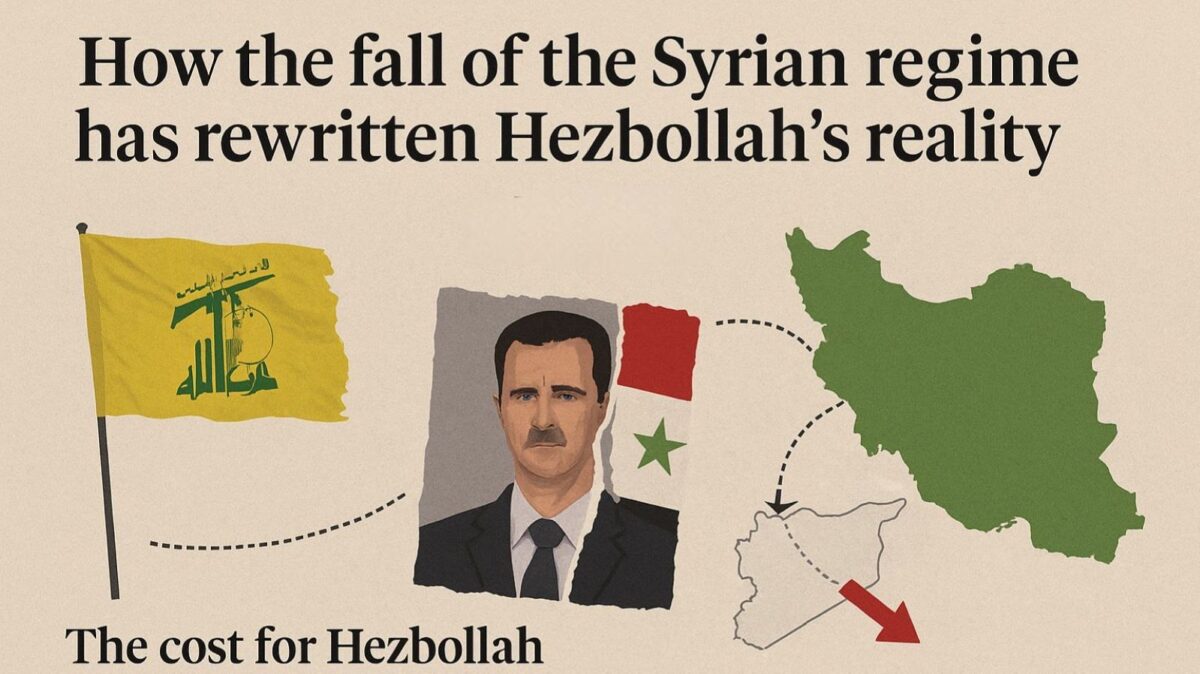
A year after the fall of Bashar al-Assad’s regime, an anniversary now celebrated across parts of the region, the impact on Hezbollah is clearer than ever. Assad’s collapse robbed the group, and Iran, of a crucial ally and cut off the reliable Syrian corridor that once sustained its military supply lines.
Over the past year, Hezbollah has found its regional reach shrinking and its room to maneuver increasingly limited. It’s isolation has deepened, and the party is now under growing pressure, both locally and internationally, to reassess its weapons, scale back its cross-border activities, and adapt to a political landscape no longer anchored in Damascus.
The cost for Hezbollah
Hezbollah has always relied on Syria as a crucial link in Iran’s so-called axis of resistance, providing a corridor for weapons and support.
The implications go beyond military supply routes. Syria also served as a key transit point for illicit trade, from goods to narcotics that helped fund Hezbollah’s parallel economy.
The regime’s fall has disrupted these networks, tightening financial pressure on the group at a moment when its regional support structure is already weakening.
Hezbollah has been pushed out of a battlefield it once treated as its own, losing the ground routes it depended on to exchange fighters, weapons, ammunition, and logistical support with the Syrian regime.
The Syrian uprising in 2011 led to Hezbollah sending thousands of fighters to support the crimes of Bashar al Assad’s regime.
One year after the Syrian regime’s collapse, Hezbollah emerges as one of the biggest losers. Assad’s fall comes on top of the setbacks the group suffered during its confrontation with Israel and the subsequent agreement forcing it 30 kilometers back from the border.
With Syria no longer providing strategic depth, Hezbollah has lost both its vital extension into Syrian territory and its grip over much of the Lebanese-Syrian frontier.
Lebanese journalist Omar Harkous told NOW that one year after the collapse of Bashar al-Assad’s regime, an event that unfolded in parallel with the end of the Lebanon–Israel war, Hezbollah’s real position within the so-called “axis of resistance” has been exposed. The party’s power, he noted, was never self-generated; it was built on the strength of its regional allies.
With Assad gone, Hamas weakened, Iraqi factions fractured, and the Houthis consumed by their own battles, the engine that once sustained the axis no longer exists. Hezbollah cannot play the same regional role without that structure around it.
Today, Hezbollah is struggling to define a new purpose or, more likely, Iran is struggling to find one for it, according to Harkous.
The Assad regime in Syria has been Irans ally since the 1979 revolution and Tehran has seen the survival of the Syrian government as being crucial to its interests since Syria provides a vital thoroughfare to Hezbollah in Lebanon.
The fall of the Assad regime show a remarkable shift in this longstanding relationship. One year after Assad’s collapse, the Sharaa government and Hezbollah are navigating a tense and mutually distrustful relationship.
According to Abdulrahman Al-Haj, an academic and researcher specializing in Islamic movements, Hezbollah’s long-standing role as Iran’s forward arm in the region has fundamentally shifted. With its defeat in Syria and the pressure of the ongoing conflict in Lebanon, the party is now fighting for its own survival. Al-Haj explains that Hezbollah is trying to adapt by redefining its function within the region’s changing power dynamics, yet there is little indication that it is prepared to seriously reassess its dependency on Iran.
No longer a passageway
Syria was a crucial passageway for Iran to supply Hezbollah with money, weapons, training, and political and logistical support which is no longer the case. Iran also deployed commanders and troops to Syria in 2012 at the start of the anti-government uprising.
Harkous told NOW “The collapse of the Assad regime disrupted the land corridor that once linked Iran to Lebanon through Iraq and Syria.
Iran is now forced to rely on more costly, indirect routes to deliver money, weapons, and trainers to Hezbollah at a time when Tehran is already struggling economically under heavy sanctions, he said.
Air routes have also become riskier, especially through Beirut airport, making transfers more difficult, he added.
With Assad removed from power, Hezbollah began facing growing challenges as this was no longer the case.
In one of his speeches post the fall of the Assad regime, Naim Qassem, Hezbollah’s secretary General said: “ Yes Hezbollah has lost the military supply route through Syria at this stage but this loss is a detail in the resistance work. A new regime could come and this route could return to normal and we could look for other ways.”
The collapse of Assads government signaled a potential upheaval in Lebanon’s already fragile political balance.
Today, more Lebanese are placing their trust in the Lebanese Army, while Syrian opposition factions have repeatedly affirmed that they respect Lebanon’s sovereignty and have no intention of attacking Lebanese territory.
What changed
After October 7,2023, Israel attacked Hamas’ allies everywhere, including in Syria which weakened Hezbollah and the Iranian militias that were there.
This affected their military capabilities and maneuverability inside Syria.
The Iranian, Russian troops and Hezbollah fighters left Syria in a panic within a few days. The only loyal gesture towards their former ally was Moscow’s willingness to grant exile to be fleeing Assad family. The rebel coalition took control of the country and the depths of the Assad regime were revealed to the world and to Syrians themselves.
One year after Assad’s fall, Hezbollah is facing mounting pressure on the disarmament question from every major international actor.
Alongside the European Union, Gulf states, and UN Security Council members, the United States has renewed its calls for Lebanon to curb Hezbollah’s military activities, framing the group’s weapons as a primary obstacle to stability and to any future security arrangements along the southern border.
The collapse of its closest strategic ally didn’t just remove a political partner, it dissolved a lifeline. With that corridor gone, Iran can no longer move weapons across Syrian territory with the ease it once did, leaving Hezbollah increasingly exposed and isolated within Lebanon.
Harkous explained that Hezbollah also lost its positions across Syria, from Qusayr to Hama, Idlib’s outskirts, Aleppo, Homs, and Eastern Ghouta along with the captagon factories it once operated with Syrian traffickers. This has dealt the group a major financial blow, sharply reducing the production and smuggling networks it depended on for revenue.
The captagon drug industry funded Assad’s war on his people and helped sustain his survival.
A dark legacy:
Syrians, Al-Haj explained, felt deceived by a group that once won regional admiration under the banner of “resistance,” only to later turn its weapons against them. What emerged was a force driven by an Iranian agenda and sectarian impulses.
Al-Haj recalled the shock of seeing Hezbollah’s involvement in atrocities including documented participation by senior commanders in the 2012 barrel-bomb campaign.
The group’s downfall in Syria, he said, brings a mix of pride for dismantling a force that tried to crush their struggle for freedom, and bitterness that Hezbollah chose to defend a hated dictator against a national uprising.