Photo by LENIN NOLLY / NURPHOTO / NURPHOTO VIA AFP
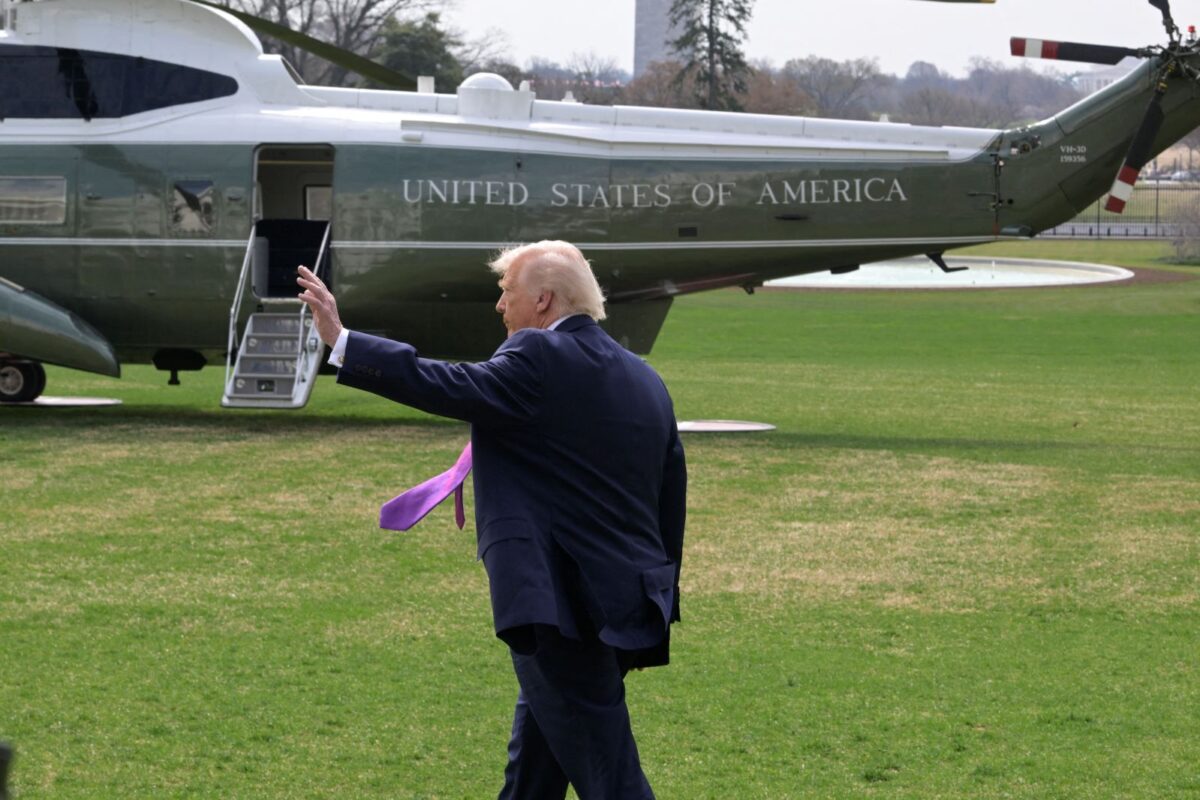
US President Donald Trump talks with reporters about Lebanon, Iran, and Spain before departing Washington, D.C., en route to Hebron, Kentucky, on March 11, 2026, at South Lawn/White House in Washington, D.C., USA. (Photo by Lenin Nolly/NurPhoto) (Photo by Lenin Nolly / NurPhoto / NurPhoto via AFP)
The debate surrounding the newly signed U.S.–Iran agreement has been dominated by a deceptively simple question: Is Lebanon part of the deal? The answer increasingly appears to be yes. Iran says so. Hezbollah says so. Even many officials and analysts in Washington now acknowledge that Lebanon forms part of the broader regional understanding that accompanied the agreement.
Yet despite this apparent consensus, a deeper disagreement remains unresolved. The real question is not whether Lebanon was included. The real question is: who included it? At first glance, the answer appears straightforward. Iranian officials have repeatedly insisted that no regional settlement could ignore Lebanon. Hezbollah has similarly presented the agreement as proof that Lebanon remains an integral component of Iran’s regional security architecture. From this perspective, Lebanon’s inclusion represents a strategic success for the so-called axis of resistance. But that interpretation becomes more complicated when one examines the details emerging from Washington.
Over the past week, American officials and diplomats have increasingly described the Lebanon component of the agreement in terms that closely resemble the understandings reached during the recent direct Lebanese-Israeli negotiations. The proposed mechanism is strikingly familiar: Israeli withdrawal from specific areas, deployment of the Lebanese Armed Forces, phased implementation, verification mechanisms, and the gradual transfer of security responsibilities to the Lebanese state. This is not the language of a regional proxy arrangement. It is the language of state-to-state conflict management. The distinction matters.
For years, the dominant assumption across the region was that any discussion of Lebanon’s security future would inevitably pass-through Tehran. Lebanon was viewed less as an independent actor and more as an arena through which larger regional powers negotiated their differences. What makes the current moment different is that the Lebanon file appears to have developed its own momentum. Long before the U.S.–Iran agreement was finalized; Washington had already opened a direct channel focused on Lebanese-Israeli security arrangements. Lebanese officials repeatedly emphasized that Lebanon’s future would not be negotiated by Iran but by the Lebanese state itself. President Joseph Aoun and senior Lebanese officials consistently framed the issue as one of restoring state authority rather than managing a balance between competing regional actors.
Seen from this perspective, the U.S.–Iran agreement did not create a Lebanon file. It attached itself to one that already existed. This helps explain the seemingly contradictory statements emerging from different capitals. Iran says Lebanon is included because it genuinely believes the agreement protects Lebanese stability and prevents renewed escalation. Hezbollah says Lebanon is included because any Israeli withdrawal and any reduction in military tensions can be presented as evidence that resistance achieved its objectives. Washington says Lebanon is included because the agreement reinforces a process already underway between Lebanon, Israel, and the United States.
Israel says it is not bound by the U.S.-Iran agreement because it rejects the notion that Tehran can determine the rules governing Israeli security policy.
These positions appear contradictory only if one assumes the parties are discussing the same thing. They are not. Each side is describing the same outcome through a different political narrative. This is not constructive ambiguity. It is competitive ownership. Every actor wants to claim authorship of the outcome. Iran wants to demonstrate that regional pressure produced concessions. Hezbollah wants to demonstrate that resistance remains relevant. Israel wants to demonstrate that its security freedom remains intact. Washington wants to demonstrate that diplomacy and direct engagement with states can succeed.
Meanwhile, Lebanon faces a unique opportunity. For perhaps the first time in years, the country’s future is not being discussed solely through the lens of regional confrontation. Instead, the emerging framework places the Lebanese state, the Lebanese Army, and Lebanese institutions at the center of implementation.
That does not mean success is guaranteed. The real test lies ahead. If Israeli forces withdraw from pilot zones and the Lebanese Army assumes effective control, then the balance of evidence will suggest that the Lebanon file has gradually shifted from a regional proxy issue to a state-building issue. If implementation stalls, ambiguity will once again replace progress. But one lesson is already becoming clear. The significance of the U.S.-Iran agreement is not that Lebanon was included. The significance is that, for the first time in a long time, Lebanon may be included through its state rather than through those who have traditionally claimed to speak on its behalf.
Ramzi Abou Ismail is a Political Psychologist, Researcher and Analyst.
The views in this story reflect those of the author alone and do not necessarily reflect the beliefs of NOW.