Five years after Lokman Slim’s killing, a Beirut exhibition turns photography into a collective demand for memory, justice, and an end to Lebanon’s culture of impunity.
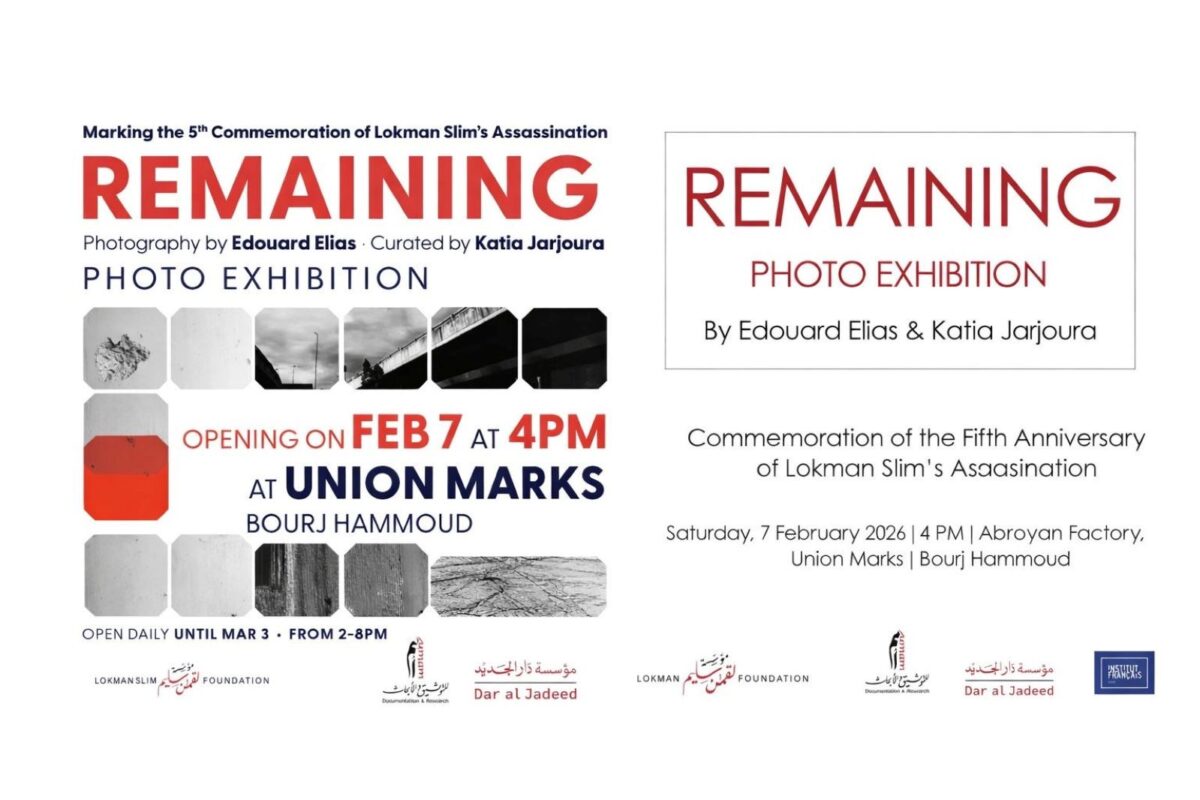
Five years after the assassination of Lebanese intellectual, publisher, and activist Lokman Slim, the photo exhibition Remaining opens in Beirut as a collective act of remembrance and a refusal to allow political violence to fade into silence. Organized by UMAM Documentation & Research, Dar Al-Jadeed, and the Lokman Slim Foundation, the exhibition documents political assassinations in Lebanon since 2005, centering victims, their families, and the enduring traces of violence left behind by crimes that remain largely unresolved.
Opening on February 7 at Union Marks in Bourj Hammoud, Remaining brings together photographs by Edouard Elias, curated by Canadian-Lebanese filmmaker and journalist Katia Jarjoura. Through portraits of victims’ families, personal objects entrusted by loved ones, and images of crime scenes, the exhibition traces how political assassinations continue to shape Lebanon’s public and private lives long after the killings themselves.
“For me, it’s unbelievable that it’s already been five years,” Monica Borgmann, Lokman Slim’s widow and co-founder of UMAM D&R, told NOW Lebanon. “It feels like yesterday. And at the same time, we’ve lost so much time.”
Memory against erasure
Through photography, the exhibition documents not only the acts of violence themselves, but their long afterlives — the grief, absence, and unresolved questions that remain. By returning to crime scenes and engaging directly with survivors, “Remaining” challenges the systematic erasure of political killings from Lebanon’s public record and confronts the normalization of impunity.
“Political assassinations are not only about death,” Borgmann told NOW. “They’re also about who controls the narrative.”
In Lebanon, political violence has long been managed through delay and silence. Investigations stall, files are closed and reopened, and assassinations gradually become part of the background noise of public life. Over time, impunity becomes normalized.
Remaining challenges that normalization by insisting on presence, on what, and who, remains.
A shared history, a shared responsibility
For curator Katia Jarjoura, the exhibition is rooted in a long personal and professional relationship with Borgmann and Slim. She first met them in 2002, shortly after arriving in Lebanon from Canada, when UMAM was still taking shape.
“They were just building UMAM at the time,” Jarjoura told NOW Lebanon. “We became very close — personally and professionally. UMAM wasn’t just an institution, it was a community.”
Jarjoura collaborated closely with Slim over the years, including on her 2004 documentary The Road to Karbala, filmed in Iraq after the fall of Saddam Hussein. Slim translated hours of footage and followed the project closely. “He was also a political analyst,” she said. “He often appeared in my films and in others’ work. He had a rare clarity about what was happening in Lebanon and the region.”
On February 3, 2021, Jarjoura was in Paris when she received the call informing her that Slim had been killed. “I immediately called Monica,” she said. “We spoke for a long time.”
She remembers making a promise. “I told her I would be there,” Jarjoura said. “I didn’t know what form that would take yet, but I knew we had to do something.”
From one assassination to a broader pattern
That promise became the starting point for Remaining. In the months following Slim’s murder, Borgmann founded the Lokman Slim Foundation, with a mandate that extended beyond her husband’s case.
“Of course I’m fighting for justice for Lokman,” Borgmann told NOW. “But at the same time, the foundation is fighting for justice for all political assassinations.”
Jarjoura said the goal was clear early on. “We wanted to go beyond the individual case,” she explained. “To speak about political assassination as a phenomenon and to bring families together, to tell them they’re not alone.”
Photography emerged as the most effective medium. “It’s direct, accessible, and lasting,” Jarjoura said. “Photography freezes time. It preserves memory.”
Why 2005 became the starting point
One of the exhibition’s central editorial decisions was to focus on political assassinations from 2005 onward , beginning with the killing of former Prime Minister Rafik Hariri.
“That was a huge discussion for us,” Jarjoura told NOW. “There are more than 200 political assassinations in Lebanon’s history. We didn’t want to start too big or too ambitious.”
The period following Hariri’s assassination marked a turning point. “It was a moment when political killings were deliberately used to repress dissent and dictate Lebanon’s political landscape,” she said.
Journalists, politicians, security officials, and public intellectuals calling for a sovereign Lebanon — free from Syrian domination and armed non-state power — were systematically targeted. “It wasn’t random,” Jarjoura said. “It was a sustained climate of fear.”
The exhibition presents 21 cases, including figures such as Samir Kassir, Gebran Tueni, Pierre Amine Gemayel, Walid Eido, Antoine Ghanem, Mohammad Chatah, and Elias Hasrouni, as well as survivors of assassination attempts including Marwan Hamadeh and May Chidiac. A special dedication is made to Lokman Slim.
Working amid fear and silence
Research for “Remaining” began in 2023, as Lebanon entered yet another period of political and military uncertainty. “When we started, people were afraid to talk,” Jarjoura said. “This was before October 7, but fear was already everywhere.”
As war and regional shifts followed, hesitation deepened. Families weighed memory against risk. Some refused to participate; others delayed for months.
Yet once doors opened, the need to speak was overwhelming. “For many families, it was as if the assassination had happened yesterday,” Jarjoura said. “They remembered every detail. Most of them cried.”
Borgmann described the pain as shared and unrelieved by time. “Time is not helping,” she told NOW. “It’s only together that we can fight this culture of impunity.”
Justice still deferred
Five years after Slim’s assassination, accountability remains elusive. “Nobody has been imprisoned. Nobody has been directly accused,” Borgmann said. “We still don’t have names.”
She did not hide her frustration with earlier investigations. “With the previous judges, it was just a loss of time,” she said.
Recent developments, however, have offered cautious hope. Following the reopening of the case and the appointment of Judge Rola Sfeir, Borgmann said she finally feels a shift. “For the first time, I feel we have a judge who is really searching with us for justice,” she told NOW.
Still, hope remains fragile. “We are not giving up the fight,” Borgmann said. “And this exhibition is part of that fight.”
Memory as a political act
For Jarjoura, Remaining is not a conclusion but a beginning. “This exhibition is not a final point,” she said. “It’s a starting point — an urgent call.”
By gathering families, preserving memory, and insisting on public visibility, the exhibition challenges Lebanon’s culture of waiting and waiting for justice, waiting for truth, waiting for closure that rarely comes.
In a country where political assassinations are routinely absorbed into silence, “Remaining” refuses closure. It insists that memory, when made public and collective, is itself a political act. Five years after Lokman Slim’s killing, the exhibition does not ask for sympathy alone. It asks a harder question: how many more lives must be documented before justice is no longer deferred?