Every time Lebanese officials are asked what the state actually means, the answer comes from outside the script: silence, evasion, or complicity. Not because the risks are unknown, but because the mentality governing official decision-making decided that “buying time” is easier than assuming the burdens of sovereignty.
Lebanon is now paying the price for that illusion. Through deliberate negligence, it has become an exposed zone—used as a base and an operational hub for military and security activities targeting Syria, involving networks linked to Hezbollah and remnants of the former Syrian regime. All of this is happening under the watch of Lebanese state institutions—if not under their quiet protection.
The problem is not the so-called “complexity” of the file, nor its “regional sensitivity.” The problem is the state’s intentional abdication of its most basic duty: protecting Lebanon and its interests. When authorities refuse to take preventive steps—legally, politically, and morally—they are not preserving “stability.” They are accumulating the conditions of its collapse.
What logic justifies hosting individuals accused of crimes against humanity, while leaving the country exposed to escalation, sanctions, and international isolation?
Neutrality, yes, is a legitimate and existential necessity for Lebanon. But neutrality does not mean blindness. It does not mean governing with the tools of the past. And it does not mean pretending that the world has not changed.
A significant part of Lebanon’s security apparatus still operates with a 1990s mindset: managing balances instead of managing risks, waiting instead of acting, reacting instead of preventing. The catastrophe must always come first—only then do we ask, “How did this happen?”
That logic no longer exists in the real world.
Nothing is granted for free today—neither protection, nor political cover, nor even patience. States are judged not only by what they do, but by what they refuse to do. And refusal here is not neutrality. It is abdication.
The role of the state—especially its security institutions—is not to coexist with danger, or manage it tactically, but to eliminate it before it metastasizes. Stability is not the absence of action; it is the product of it.
No leaked documents are needed to understand that Lebanon has become a logistical and political anchor point for networks connected to Syria’s internal war economy. Entire areas have turned into politically protected safe havens. What used to be whispered in diplomatic corridors is now becoming explicit pressure—because the other side sees, correctly, that Lebanon’s inaction provides justification: If Beirut refuses to protect itself, why should Damascus be blamed for claiming it must protect its own security?
What is most dangerous is that the Lebanese state still refuses to recognize that inaction is itself a form of action. When names are submitted, files are handed over, and months pass without a single procedural step, this is not prudence. It is a political decision to paralyze.
That paralysis can only be explained by a hostage mentality: hostage to internal balances, hostage to weapons outside the state, hostage to the illusion that others will continue paying the price of Lebanese dysfunction indefinitely.
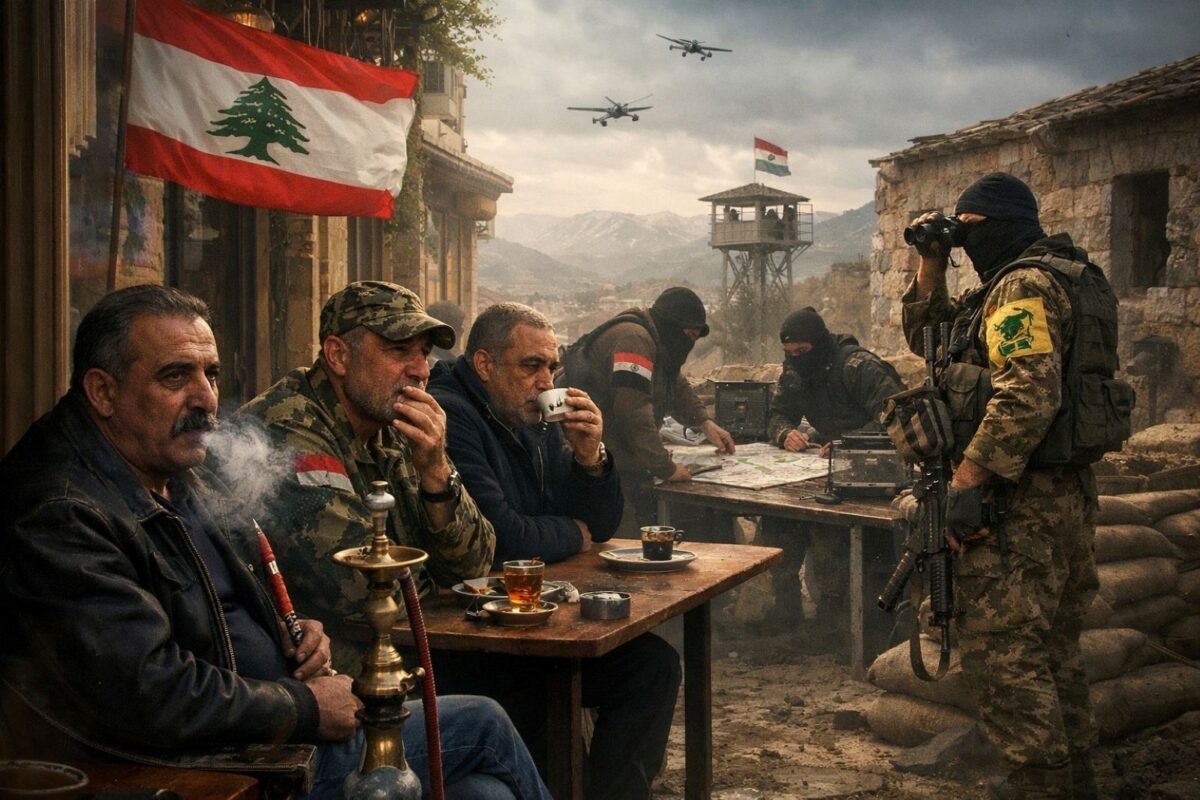
It is unacceptable for Lebanon to become a soft territory where remnants of a regime accused of crimes against humanity live openly—smoking shisha in cafés—while others run military and security operations in the eastern Bekaa under the banners of “sensitive conditions” and “political protection.”
This is not neutrality. It is slow-motion suicide.
It is not restraint. It is the strategic relocation of danger from one moment to the next until it finally explodes.
Lebanon had another option. It could have chosen the path of statehood—one that protects itself morally before it protects itself tactically. Handing over individuals accused of crimes against humanity would not have weakened Lebanon. It would have redefined it: a country aligned with international law, protecting itself through legitimacy rather than gray-zone bargains.
That choice would have sent a clear message: Lebanon is not a warehouse for fugitives, not a platform for proxy wars, and not a back alley for regional power games.
Instead, the authorities chose denial.
And denial does not erase facts—it accumulates them.
As facts accumulate, pressure escalates: from diplomatic tension, to border measures, to economic sanctions, and finally to the suffocation of a country already suffering from systemic fragility.
All of this could have been avoided with one decision: to act like a state.
True neutrality is not built through statements. It is built through actions. It is built when a state declares that its territory is not a safe haven for wanted men, not a launchpad for foreign conflicts, and not a battlefield by proxy.
It is built when security institutions understand that their role is no longer “managing internal rhythm,” but protecting national interest in a world that does not tolerate gray zones—and does not indulge states that confuse sovereignty with appeasement.
Lebanon is not being asked to choose sides. It is being asked to behave like a state.
And behaving like a state means initiative, not excuses; prevention, not delay; and the sober recognition that yesterday’s mentality no longer protects anyone.
The cost of indecision has now become far greater than the cost of decision.
This article originally appeared in Elaf
Makram Rabah is the managing editor at Now Lebanon and an Assistant Professor at the American University of Beirut, Department of History. His book Conflict on Mount Lebanon: The Druze, the Maronites and Collective Memory (Edinburgh University Press) covers collective identities and the Lebanese Civil War. He tweets at @makramrabah