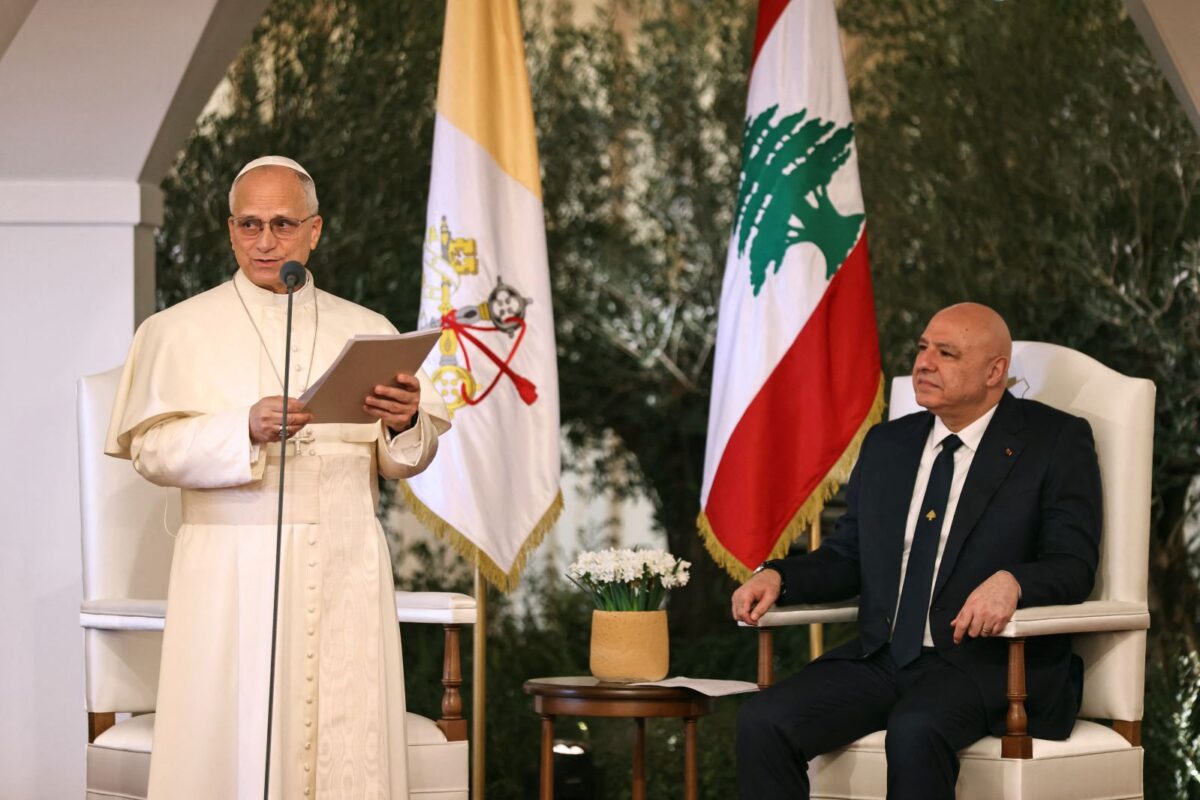
During Pope Leo’s visit to Lebanon, many assumed the central spectacle would be in the images and protocol. Instead, the real moment revealed itself in the speeches—the message of President Joseph Aoun on one hand, and that of the Pope on the other. Two addresses delivered at the same ceremony under the same biblical banner—“Blessed are the peacemakers”—laid bare a fundamental truth: Lebanon’s problem is not a shortage of eloquent rhetoric, but a chronic refusal to read the moment it inhabits.
President Aoun offered a carefully polished speech steeped in familiar national symbolism. Lebanon was described as a “Canaanite land longing for healing,” a “country of freedom and dignity,” a “land of saints,” a “message” and a “model of coexistence” whose collapse would leave “no alternative on earth.” His words echoed decades of political catechism: Pope John Paul II’s celebrated formula—“Lebanon is more than a country, it is a message”—the demographic balancing act between Muslims and Christians, the warning that the fall of any communal pillar would mean the collapse of moderation and justice itself.
This is the kind of speech perfectly suited for an interfaith dialogue conference or a Ministry of Tourism promotional campaign. What it is profoundly unsuited for is Lebanon’s present political reality. The Lebanon being addressed today is not the Lebanon of the 1990s, nor even the Lebanon of the pre-collapse era. It is a country of dismantled institutions, eroded sovereignty, hollowed-out governance, and ongoing demographic hemorrhage. Yet the official discourse prefers to present Lebanon as an abstraction—as an icon mounted on a wall—rather than as a fractured political entity in urgent need of honest diagnosis.
More troubling still, this lyrical narrative of a “beautiful Lebanon” stands far removed from the core purpose of a visit titled “Blessed are the peacemakers.” The most relevant political question went studiously unasked: Who is obstructing peace in Lebanon?
While the president elevated the country to the level of “testimony,” “message,” and “sacred land,” he avoided naming the forces that have transformed Lebanon into a battlefield by proxy—an open arena for foreign axes, illegal arms, and mafia-style economies. Peace was framed as a moral or spiritual aspiration rather than as a political task requiring accountability, authority, and the courage to confront facts.
In sharp contrast, the Pope punctured this rhetorical veil. His language, while spiritual in expression, carried far greater political gravity. He defined peace as “a desire and a calling, a gift and an ongoing task”—not a metaphysical state, but a process dependent on institutions, decisions, and responsibility. He reminded officials that their role is not to preserve slogans but to place “the goal of peace above everything else,” urging the use of a “language of hope” capable of countering economies of violence, polarization, and the pervasive sense of paralysis now gripping Lebanese society.
The dissonance between the two messages was striking. One affirmed Lebanon’s permanence because it is “a message.” The other asked where society draws the energy to sustain hope—and answered by pointing directly to civil society, youth, women, collective institutions, and shared civic responsibility. The president restated a worn mythology: if Christians fall, the national formula fails; if Muslims falter, moderation collapses. The Pope went further. He insisted that truth cannot be monopolized by any group—that reconciliation and peace depend on mutual recognition and on prioritizing the common good over sectarian and partisan calculus.
President Aoun framed Lebanon as an eternal equation to be preserved simply because “there is no alternative.” The Pope suggested something more unsettling: that Lebanon’s survival will not come from sanctifying the political formula but reforming it. Youth emigration, he argued implicitly, is not a betrayal of the Lebanese “message”; it is the expected response to poverty, violence, and institutional decay. The solution, he urged, lies in creating the political conditions that allow Lebanese not to search for peace elsewhere, but to become peacemakers at home.
The paradox was unmistakable. The discourse closest to theology came from the Vatican’s emissary, yet it was rooted firmly in political reality. The “official” political address, by contrast, resembled an extended liturgical homily—shielding itself behind icons of saints and sacred landscapes to avoid confronting a darkening present. This is more than a matter of style. It reflects a governing mentality incapable of grasping that the Lebanon it celebrates as a “message” is fast becoming, in the eyes of its citizens, a warning.
The Lebanese whom the Pope addressed are not merely “children of freedom.” They are casualties of state collapse, of a sectarian system that has become a tool of armed power and financial predation. When the Pope called on them to show “the courage to remain and return,” he did what official discourse dared not do: he touched the open wound. This country will not be rebuilt through declarations that “what unites Lebanon cannot be found elsewhere.” It will be rebuilt only through naming the realities of domination over war and peace, borders and economies—and through reasserting the state’s exclusive authority without exception.
The president is entitled to celebrate Lebanon’s spiritual heritage. Yet his primary duty is to seize the moment presented by the Pope’s clarity: there can be no peace without reconciliation, no reconciliation without truth and justice, and no justice without a sovereign state acting for its citizens’ interests alone. The Pope articulated this with diplomatic restraint. Lebanon’s official rhetoric, meanwhile, retreated once again into the comforting abstractions of “the message” and “the model.”
The papal visit will not transform Lebanon overnight. But it may change how Lebanese read themselves. The country now oscillates between two languages: one continues the liturgy of “Lebanon the message” while the ship takes on water from every side; the other insists that peace is a daily, grueling labor that begins not by sanctifying wounds, but by acknowledging them.
If Lebanon truly seeks to live up to the call of “Blessed are the peacemakers,” then peace-making must begin not with speeches that escape politics, but with courageous politics that name realities plainly—and finally act upon them
This article originally appeared in Elaf
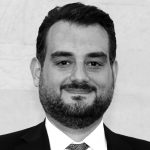
Makram Rabah is the managing editor at Now Lebanon and an Assistant Professor at the American University of Beirut, Department of History. His book Conflict on Mount Lebanon: The Druze, the Maronites and Collective Memory (Edinburgh University Press) covers collective identities and the Lebanese Civil War. He tweets at @makramrabah