In 1953, Iskandar Riachi, one of Lebanon’s most candid and sharp-tongued journalists, published his memoirs under the title Before and After (1). In chapter fifteen, “George Lotfallah: Candidate for the Throne of Lebanon!”, he narrated the story of a figure largely forgotten by Lebanese, Levantine, and Egyptian historiography alike. George Lotfallah was an Egyptian/Lebanese/Syrian millionaire who in 1929 decided to run for president of the young Lebanese Republic as a calculated stepping stone toward being proclaimed king.
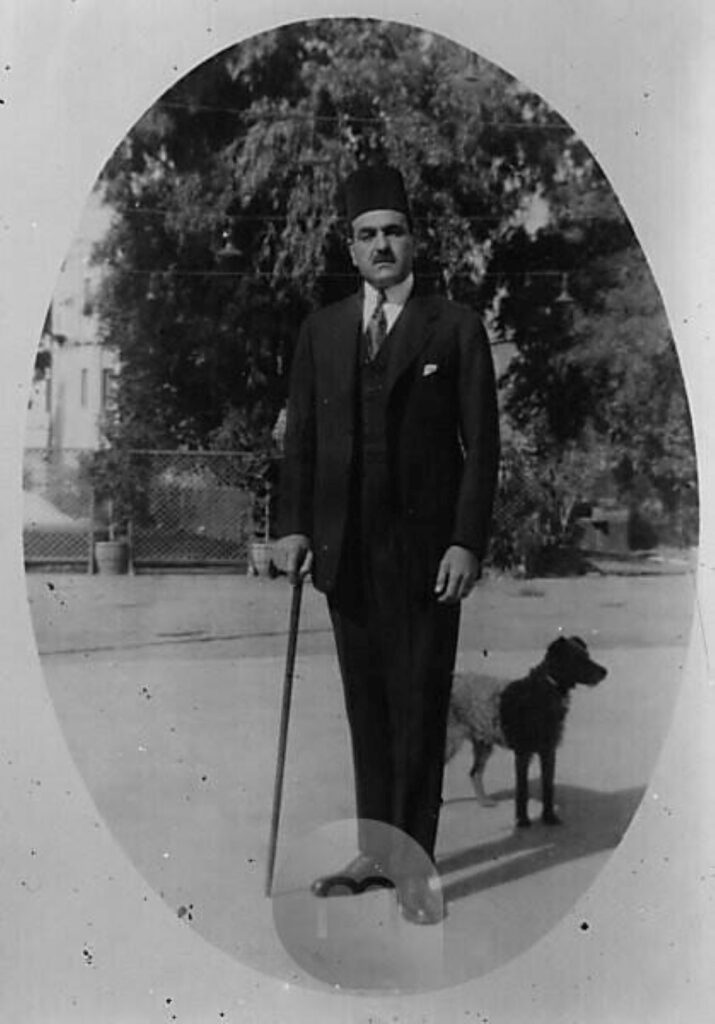
Portrait of George Lotfallah in Cairo, 1928 (2).
According to a book by Lebanese author Selim Sarkis, published in Cairo in 1924 and funded by the Lotfallah family themselves, under the expansive title The Emirs of the Lotfallah Dynasty (3), the family originally hailed from a Greek Orthodox household in Tripoli. In the eighteenth century, they relocated to Latakia, and then to Beirut, where Habib was born in 1826. In 1842, he moved to Egypt, as many Levantines did, drawn by the considerable opportunities that the country offered to emigrant Christians from Bilad al-Sham, known in Cairo as Shwam. He worked in cotton, built an immense fortune, acquired extensive landholdings, and invested in banking. He grew close to Khedive Abbas Hilmi II (4), who conferred upon him the title of Pasha in 1910. As a testament to his standing in Cairo, Habib purchased the Gezira Palace, originally constructed by the Khedives to receive Empress Eugénie of France, who had traveled to Egypt for the inauguration of the Suez Canal in 1869. With the establishment of the Kingdom of Hijaz in 1916, Habib became a financial and political advisor to Sharif Husayn and helped fund the Arab Revolt. In recognition of these services, he was awarded the hereditary title of Emir in 1920. In 1925, shortly before the fall of the Kingdom of Hijaz, his sons established the National Bank of Hejaz, and his namesake and son Habib served as the ambassador of the kingdom in Italy.
It was in one of the majestic dining rooms of the Gezira Palace that Emir Georges, son of Habib Lotfallah, first entertained the idea of becoming king of Lebanon in 1929. As Riachi narrates it, George harbored a pronounced weakness for flattery and, in his chronicler’s frank assessment, a streak of megalomania. During a dinner at the palace, Antoine Gemayel, the eminent journalist and editor-in-chief of Al-Ahram, and one of the leading figures of the Lebanese community in Cairo, improvised, as Riachi tells it, a leading question: “Why does no one in our country speak of a throne and a king in Lebanon? We have had for centuries a throne and an emir…”
Knowing the Emir’s enthusiastic temperament, typically expressed through lavish generosity toward those who pleased him, the guests began amplifying the project’s feasibility. George promptly presented himself as the natural candidate. By the time the dinner ended, Riachi writes, it was as though Lebanon had already become a monarchy. George even commissioned his entourage to gather examples of crowns and thrones from existing monarchies so that a new one might be designed for Lebanon.
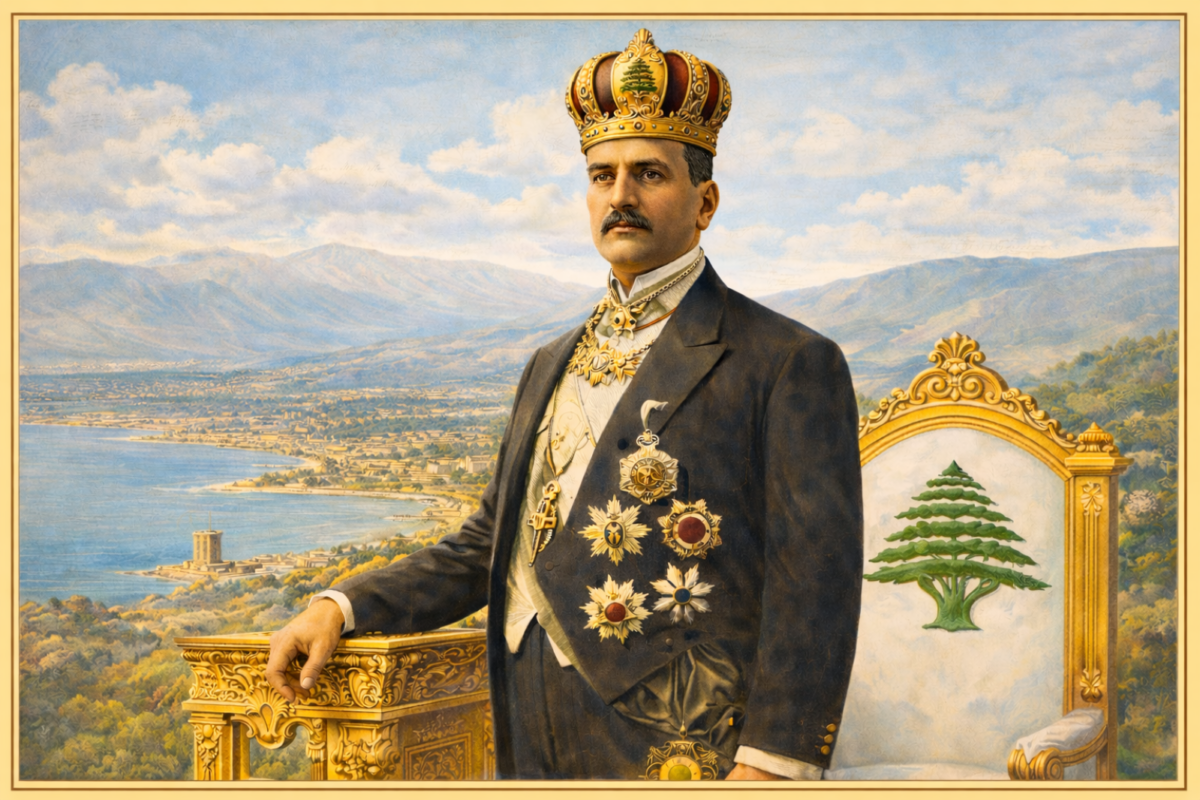
The historical context is important. Greater Lebanon, established under French Mandate in 1920, had become a republic following the adoption of its constitution in 1926. The Orthodox notable from Beirut, Charles Debbas (5), had been elected president for a three-year term, as the constitution then stipulated. George had already attempted to secure his candidacy in 1927 through the Sursock family. He was the son of Helene Sursok (6) and had married Loris Sursok, the daughter of the influential Nicolas Sursock. Through the Sursocks, he was introduced to High Commissioner Ponsot (7). His candidacy, however, did not receive approval. His family maintained close ties to Arab nationalist circles; his brother Michel, who had previously founded the Syrian Union Party, financed by George, had been actively involved in the Great Syrian Revolt of 1925. One illustration of this effort survives in the archives of Al-Irfan (8), the principal Shiite reformist periodical since 1909, where a portrait of George appeared, decorated with his various honorifics, presumably to convey a sense of formal gravitas, accompanied by a caption noting the services the Lotfallah family had rendered to the Arab cause, his candidacy for the Lebanese presidency, and his economic projects for the country.
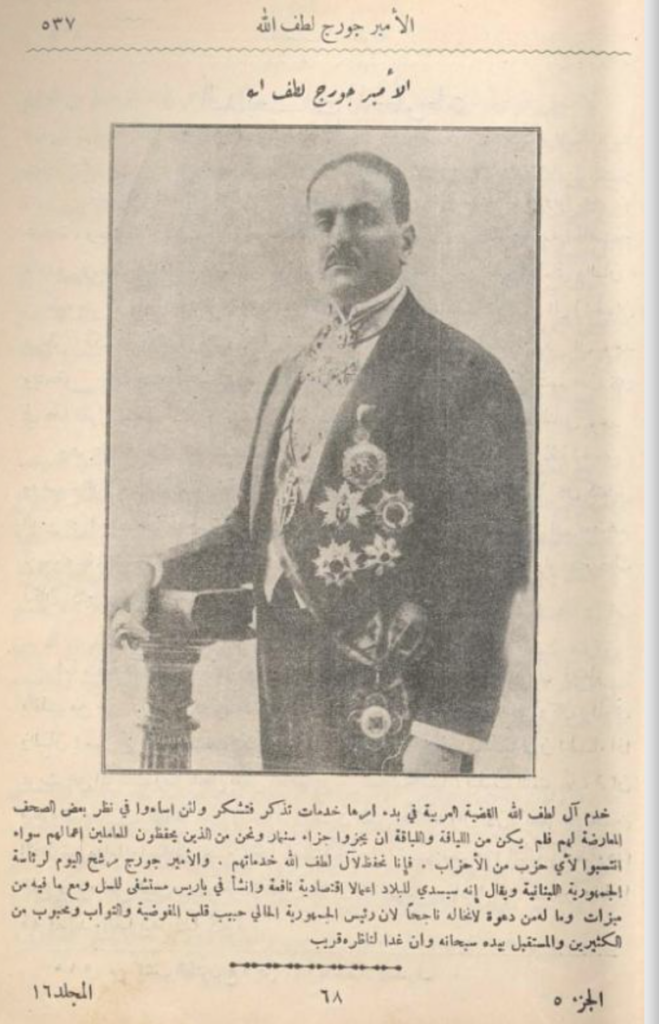
Portrait of Emir Georges Lotfallah, published in Al-Irfan, vol. 16, part 4, p. 538, December 1928, as part of his pre-campaign public relations effort ahead of his 1929 bid for the Lebanese presidency. (9)
George’s monarchical ambition did not emerge in a complete vacuum. The idea of a Lebanese monarchy had circulated, during this period, on a very minor scale. Habib Boustani, an author, established the “Royalist Party” to advance this cause, one in which he served simultaneously as founder, president, vice president, and only member, as Riachi drily notes. He called for a foreign prince to be proclaimed king of Lebanon, a model that echoed the Mutasarrifiyya arrangement of a non-Lebanese governor. However, George’s scheme was more calculating: taking Napoleon III as his point of reference, he envisioned winning the presidency of the republic first, and converting it into a throne from within.
The lobbying campaign that followed is narrated by Riachi in his most beautifully sarcastic register. George traveled to Beirut, rented one of the Sursock palaces, and engaged the services of Tanios al-Chemali, Beirut’s foremost caterer at the time, to orchestrate his public relations offensive. From this Sursock headquarters, he launched a campaign targeting journalists, politicians, and religious figures, all of whom, according to Riachi, received lavish cash gifts in exchange for their support. Riachi himself acknowledges receiving money in return for conferring upon George a new honorific, that of Monseigneur.
George then moved to Paris. He secured connections with the Quai d’Orsay and hosted a lavish dinner in honor of the Secretary-General of the Ministry of Foreign Affairs. Riachi recounts that a pearl necklace had been concealed as a gift for the secretary’s wife, folded inside her table napkin, a gesture she was not particularly adept at concealing discreetly. George then reportedly paid thirty thousand Egyptian pounds to a senior ministry official in exchange for a letter bearing the secretary’s signature, addressed to High Commissioner Ponsot in the Levant, requesting that he facilitate George’s path to the presidency. The letter was a forgery. Ponsot recognized it as such and chose not to act upon it, unwilling to provoke a scandal.
The campaign was nonetheless gaining momentum, sustained by the considerable sums George deployed to purchase support and shape public opinion. Yet he faced two decisive obstacles. The High Commissioner declined to lend him any form of endorsement. And Sheikh Mohammad al-Jisr (10), the speaker of parliament, declined, according to Riachi, the thirty thousand pounds that George had sent through a secretary and through Riachi himself to secure the votes of the legislature. Al-Jisr is described by Riachi as one of the very few figures in “this happy republic” who still believed first and foremost in integrity (11). Ponsot ultimately directed parliament to block George’s election and secured a renewed mandate for Charles Debbas. And so the adventure came to an end.
George Lotfallah had no coherent political project. He was driven by megalomania, sustained by sycophantic journalists, and enabled by venal politicians. His story might have been dismissed as mere anecdote were it not for the precision and wit with which Riachi documented it, and for what the episode reveals about the political culture of early republican Lebanon.
Riachi’s work remains, sadly, largely unknown to the broader public. The late Lokman Slim worked toward republishing one of his titles, Women of Lebanon (12), which appeared posthumously after Slim’s assassination in 2021, as part of an effort to restore Riachi to his rightful place as a primary source for three formative periods in Lebanese history: the transitional years between 1918 and 1920, the early republic from 1926 to 1943, and the first years of independence. His memoirs offer a perspective on the social and political life of Lebanon, including its more scandalous dimensions, that conventional historical accounts rarely provide. As Luqman wrote:
“There is no doubt that Riachi can intercede for the small country of Lebanon in a way that even saints, holy men, heroes, and martyrs, those whose lives are so fragrant they are almost suffocating, whose morals are so lofty they are almost emaciated, and whose principles are so firmly rooted they are almost paralyzing, can do, indeed, they can do, individually and in unity… And when Riachi steps forward in this way, it is not because he did not fear the blame of the blamers in upholding the truth. Rather, because he did not fear it in falsehood and error, in frivolity, idleness, amusement, and debauchery…” (13)
What remains most striking is that Riachi chose to frame the entire episode not as historical curiosity but as a warning. His indictment, placed on the opening pages of his memoirs and addressed to those who still believe that Lebanese political life has ever been governed by integrity rather than transaction, loses none of its force across the intervening century:
“For the naive, the arrogant, the deceived, for the gullible people who still believe that in Lebanon there are political leaders who consider exploitation a crime and integrity a virtue, in a country that, for generations, considered the killer a hero, the manipulator a genius, and the one who can plunder and steal and does not do so a ‘fool’!” (14)
Georges Lotfallah did not become king of Lebanon. He died in 1941. A small village in the Fayoum region of Egypt and a street in Zamalek are all that bear his name today. The ambition, the purchased endorsements, the forged letters, the pearl necklaces folded into dinner napkins, all of it dissolved without consequence. Riachi’s closing words to chapter fifteen belong to those willing to find them. Track down Before and After. You will not need to look far to recognize the country it describes.
Charles al-Hayek is a public historian and the founder of Heritage and Roots
The views in this story reflect those of the author alone and do not necessarily reflect the beliefs of NOW.
Notes:
- https://archive.org/details/20221021_20221021_0716/page/n35/mode/1up
- https://www.geni.com/people/Prince-George-Lotfallah-of-Cairo/6000000085836294100
- https://www.noor-book.com/%D9%83%D8%AA%D8%A7%D8%A8-%D8%A7%D9%84%D8%A7%D9%85%D8%B1%D8%A7%D8%A1-%D8%A7%D9%84-%D9%84%D8%B7%D9%81-%D8%A7%D9%84%D9%84%D9%87-%D9%81%D9%8A-%D8%B3%D9%86%D9%87-1920-pdf
- The Egyptian Khedivate was the autonomous tributary state of Egypt under the Ottoman Empire between 1867 and 1914. The title Khedive, of Ottoman origin meaning viceroy, was reserved exclusively to the dynasty of Muhammad Ali Pasha, who had secured Egypt’s exceptional autonomy within the empire since 1805. Abbas Hilmi II, who ruled from 1892 to 1914, was the last to hold the title. He was deposed by the British during the First World War and replaced by his more pro-British uncle, Hussein Kamel, as Sultan of Egypt.
- Charles Debbas (1885–1935), Greek Orthodox notable from Beirut and first President of the Lebanese Republic, elected following the adoption of the constitution of 1926. He served two consecutive three-year terms until 1934.
- The Sursock family, one of Beirut’s most prominent Greek Orthodox merchant dynasties, accumulated vast wealth and landed property during the nineteenth century through trade and real estate, establishing themselves as a cornerstone of the city’s social and political elite under both the Ottoman Empire and the French Mandate.
- Henri Ponsot (1877–1963), French diplomat and fifth High Commissioner of the Levant from 1926 to 1933, the senior French mandatory authority over Lebanon and Syria.
- Al-Irfan (العرفان, “Knowledge”) was a weekly Arabic periodical founded in Sidon in 1909 by Ahmad Arif al-Zayn, widely regarded as the principal organ of Lebanese Shiite intellectual and reformist thought.
- https://archive.alsharekh.org/MagazinePages/MagazineBook/Al_Irfan/1928/Issue_5/index.html
- Sheikh Muhammad al-Jisr (1881–1934), Sunni cleric and politician from Tripoli, served as Speaker of the short-lived Lebanese Senate in 1926 before becoming Speaker of the Chamber of Deputies from 1927 to 1932. In 1932, his candidacy for the presidency, which commanded considerable parliamentary support, was thwarted when High Commissioner Ponsot suspended the constitution expressly to prevent a Muslim from acceding to the office, an episode that effectively ended his political career.
- https://archive.org/details/20221021_20221021_0716/page/n38/mode/1up و p. 75
- http://www.dar-al-jadeed.com/store/p257/%D9%86%D8%B3%D9%88%D8%A7%D9%86_%D9%85%D9%86_%D9%84%D8%A8%D9%86%D8%A7%D9%86.html
- Translated from Arabic by the author: http://www.dar-al-jadeed.com/store/p257/%D9%86%D8%B3%D9%88%D8%A7%D9%86_%D9%85%D9%86_%D9%84%D8%A8%D9%86%D8%A7%D9%86.html
- Translated from Arabic by the author, https://archive.org/details/20221021_20221021_0716/page/n6/mode/1up, p. 12