Lebanon’s current parliament is set to end its term in May 2026, raising a familiar question: will the parliamentary elections happen on time, or will political and external pressures lead to a delay?
The debate, which has intensified in recent weeks touches the core of Lebanon’s fragile democratic system at a time when the country remains mired in economic collapse, institutional paralysis, and rising regional tensions.
Under Article 42 of the Lebanese Constitution, parliamentary elections must be held within the 60 days preceding the end of parliament’s four-year term. Once four years have elapsed since the last elections, parliament’s mandate expires. Failure to organize elections within that constitutional window would either result in a legislative vacuum or require parliament to pass a law extending its own term, an act that could be challenged before the Constitutional Council.
For Ziad Abdel Samad, Executive Director of the Arab NGO Network for Development (ANND) and Coordinator of the Arab Network for Democratic Elections, the principle is simple. With years of experience in electoral reforms and monitoring across the region, he approaches the debate over Lebanon’s elections with a clear, practical perspective.
“There is definitely no justification, constitutionally or from a democratic standpoint for postponing parliamentary elections,” he told NOW. “Democracy is built on periodic elections. One of the core purposes of elections is accountability. Citizens must regularly evaluate whether those they elected are still pursuing the same policies and vision, and whether their performance has met expectations.”
Abdel Samad emphasized that elections are not simply an administrative exercise but a mechanism for renewing political legitimacy. “In a parliamentary democratic system, legitimacy derives from the people and must be renewed periodically,” he said. “Postponing elections undermines that principle and weakens democratic accountability.”
The Lebanese Constitution clearly sets a four-year mandate for parliament. “Violating that timeline would mean violating constitutional rights and the core criteria of democratic elections,” Abdel Samad added. “Only exceptional circumstances such as war could justify postponement. Today, Lebanon is not in such a state.”
Legally, postponement would require parliament to amend the relevant legal provisions governing its term, effectively extending its own mandate. According to Abdel Samad, a narrowly defined “technical extension” could be argued if unresolved administrative or procedural matters prevent elections from taking place on time.
One such issue concerns the representation of non-resident Lebanese voters. The current electoral law allocates six seats to expatriates in what is known as District 16, but regulatory decrees clarifying the nomination process and voting procedures have not been fully finalized. A recent case involving a candidate who attempted to register for one of these seats has been referred to the State Council due to legal ambiguity.
“If administrative measures remain incomplete and require clarification, a short, clearly justified technical delay, three to six months could be discussed,” Abdel Samad explained. “But anything beyond six months would no longer be technical. It would be political.”
However, he argued that the national conversation is focused on the wrong issue. “The debate should not center on whether elections happen on time,” he said. “The real problem is the electoral law itself.”
Abdel Samad criticized the existing electoral framework for failing to ensure fair representation. He pointed to flawed districting, the single preferential vote system, excessive campaign spending, and the lack of a fully independent electoral administration. He also reiterated longstanding reform demands, including lowering the voting age from 21 to 18 and adopting a women’s quota to address the severe underrepresentation of women and youth in parliament.
In his view, postponement would only deepen the crisis of legitimacy facing the political class. “Lebanon is experiencing an existential economic, social, and political crisis,” he said. “In such a context, renewing the legitimacy of political authority is essential. Delaying elections does not resolve these crises, it exacerbates them and further erodes trust between citizens and the state.”
While Abdel Samad frames the issue primarily as one of democratic accountability, Camille Mourani, member of the executive committee of the National Bloc and political relations officer, sees the debate as driven more by political realities than legal constraints.
“The signals are serious,” Mourani told NOW. “Diplomatic sources and members of the so-called Quintet Committee have been conveying sometimes indirectly—that they do not see urgency in holding elections now.”
The Quintet, comprising the United States, France, Saudi Arabia, Qatar, and Egypt has been actively engaged in Lebanese political affairs over the past year. According to Mourani, some external actors appear to prioritize stability and reform over electoral uncertainty.
“From the perspective of certain international actors, the priority today is advancing reforms and addressing the issue of Hezbollah’s weapons,” Mourani said. “They may prefer that the current government remain in place to pursue reforms rather than enter elections with unpredictable results—especially if Hezbollah’s parliamentary bloc were to return largely unchanged.”
Domestically, Mourani suggested that few major political forces are eager for an electoral confrontation.
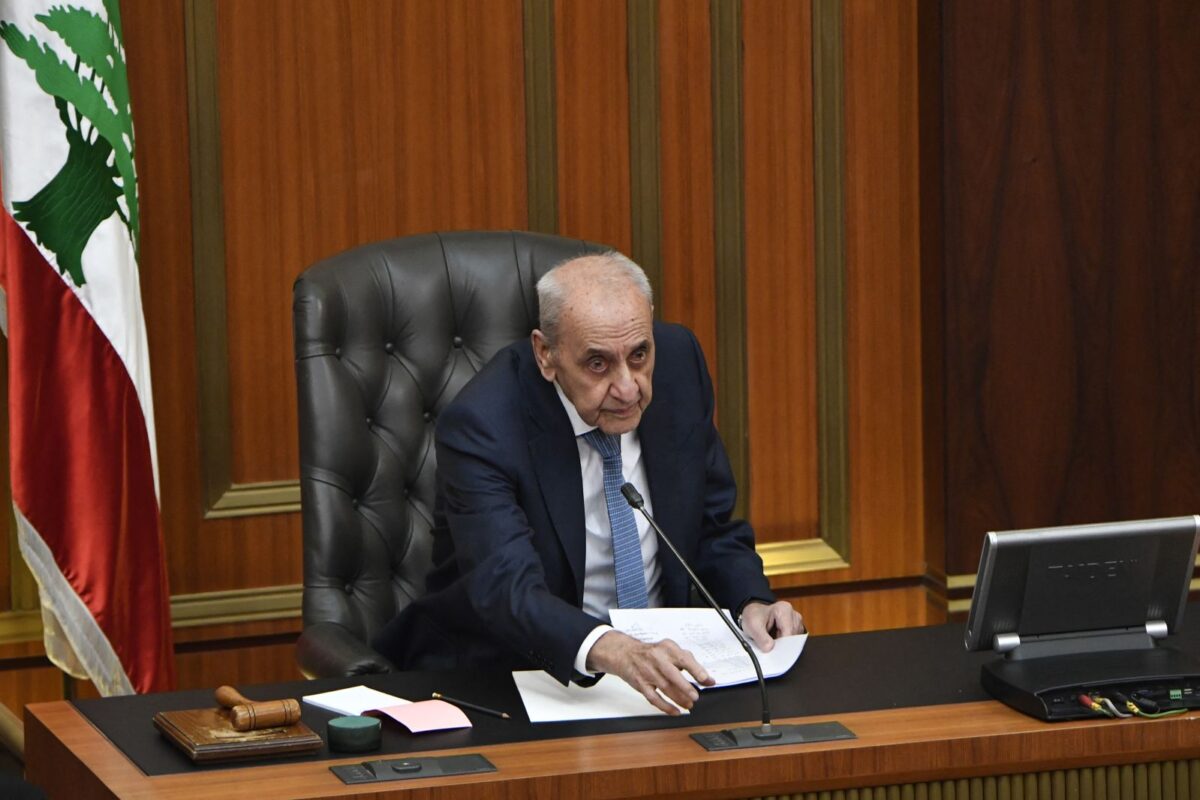
“Speaker Nabih Berri may not be enthusiastic about another election battle and the question of securing sufficient votes to retain the speakership,” he noted. “Other political actors may also find extension more convenient than entering a potentially destabilizing contest.”
Still, Mourani acknowledged that postponement raises questions of legitimacy. “Legally, parliament cannot simply disappear. An extension can be passed through legislation. But politically, there is an issue of legitimacy when a parliament elected for four years extends its own mandate without returning to voters.”
Unlike Abdel Samad, however, Mourani does not believe postponement would significantly alter public confidence. “Public trust in the political system is already extremely low,” he said. “It’s not as though postponement alone would dramatically change that reality.”
Regional instability adds another layer of uncertainty. “If there were to be a US-Iran confrontation, or an escalation between Israel and Hezbollah, that would increase the likelihood of postponement,” Mourani said. “In that scenario, security considerations could provide political cover for delay.”
Ultimately, Lebanon’s approaching elections highlight the tension between upholding constitutional timelines to restore legitimacy and managing short-term stability amid domestic and regional challenges.
As May 2026 approaches, the handling of this electoral milestone will signal more than procedural compliance. It will test whether Lebanon’s political system is capable of renewing its mandate through the ballot box or whether the logic of extension and expediency will once again prevail.