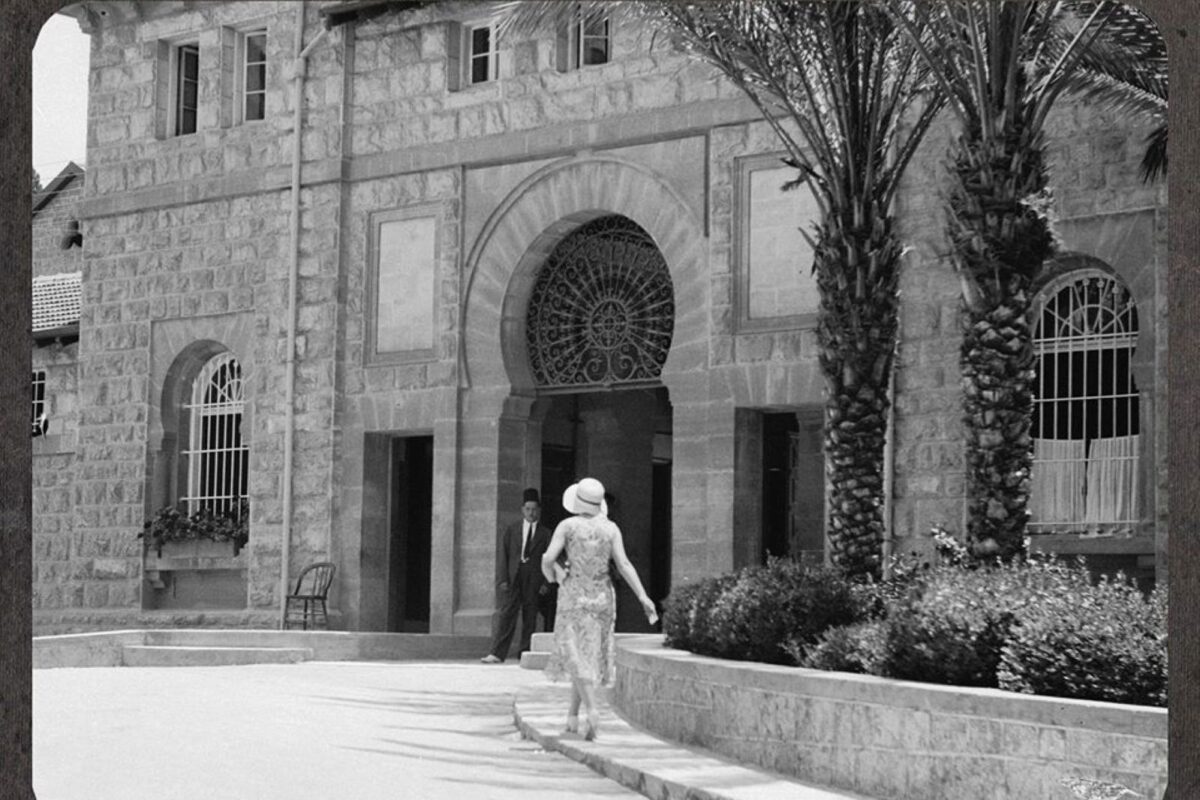
There is a particular kind of ignorance that does not arrive loudly. It dresses itself in the language of conviction, borrows the posture of principle, and mistakes hatred for lucidity. When the Islamic Revolutionary Guard Corps reportedly threatened American educational institutions in the Middle East, those threats were not merely repeated by Lebanese supporters of Hezbollah; they were applauded, and extended to the students themselves, who were recast as “American interests” and therefore legitimate targets. This is not the language of supposed “resistance”. It is the language of barbarism. For what it targets is not empire, but memory, learning, and the very institutions that helped give Lebanon and the Arab world their modern intellectual life.
The Arrival: 1819 and the First Foothold
In 1819, American missionaries dispatched by the American Board of Commissioners for Foreign Missions disembarked in Beirut, then a modest port town on the eastern edge of the Ottoman Mediterranean. By 1823, Beirut had been designated a permanent mission station, and the following year, in 1824, missionaries Isaac Bird and William Goodell established the city’s first American school. It taught English and Arabic and, in a socially significant gesture that would define much of what followed, attracted students from across confessional lines.
In 1835, the American missionary Sarah L. Smith opened a school for girls in Beirut, the first institution dedicated to women’s education in the Levant. It would later evolve into the American School for Girls. The implications of this act cannot be overstated: at a moment when female literacy was considered, at best, a curiosity, Smith’s school made an institutional claim that women’s education was not a privilege granted by grace, but a right secured by design. That decision still reverberates through the institutions that grew from it: the International College, the American Community School, and the Lebanese American University, all of which remain active in Lebanon today.
The Infrastructure of the Nahda
The missionaries did not arrive with Bibles alone. They came with printing presses, scholarly ambitions, and an instinct for collaboration that proved as consequential as any sermon. In 1834, the American Press, previously based in Malta, was transferred to Beirut, bringing with it the typographic capacity to reshape the region’s intellectual production. The press developed its own design for Arabic letter blocks, known as “American Arabic,” a technical innovation with outsized cultural consequences: it dramatically accelerated the production and circulation of Arabic-language texts at precisely the moment when Arab intellectual life was beginning to stir.
In that same period, a collaboration of historic proportions took shape: the translation of the Bible into Arabic, a joint undertaking involving the American missionaries Eli Smith and Cornelius Van Dyck alongside the local Nahda scholar Butrus al-Bustani. The resulting text remains in wide circulation to this day. More importantly, the scholarly methods it demanded, rigorous philological attention to classical Arabic and systematic editorial discipline, helped lay the grammatical and aesthetic groundwork for what would become the Nahda: the Arab cultural and intellectual renaissance of the nineteenth century.
Al-Bustani himself stands as a pivotal figure in this story. Working in close collaboration with American missionaries, he did not remain merely a translator. He became an institution-builder of the first order. In 1863, he founded al-Madrasah al-Wataniyyah in Beirut, the first secular national school in the Arab world. In 1875, he launched Dāʾirat al-Maʿārif, the first encyclopedia written in Arabic. Both projects embodied a conviction that knowledge was not the property of any single confession, dynasty, or empire, but a common inheritance to be organized, disseminated, and made available to all who could read.
The University and the Formation of Leaders
The political upheavals of 1860, the sectarian conflict that devastated communities across Mount Lebanon and Damascus, forced a fundamental rethinking of the missionary educational project. It was no longer sufficient to run schools. The moment demanded the formation of local leadership: minds capable of navigating modernity on their own terms, in their own languages, and within their own societies.
The institutional response came in 1866, when the American Board of Commissioners for Foreign Missions commissioned the missionary Daniel Bliss to establish the Syrian Protestant College in Beirut, the first modern university in the Arab world. Its founding was an act of profound ambition. Its motto, drawn from the Gospel of John, “That they may have life and have it more abundantly,” was not merely devotional. It articulated a philosophy: an absolute and enduring commitment to excellence and service in order to build better futures for the people of this region and beyond. That motto has been engraved on the university’s Main Gate since its founding, a public declaration older than the regime now threatening it.
In 1920, the Syrian Protestant College was renamed the American University of Beirut. The name changed; the ambition did not. By 1921, the university had opened its doors equally to men and women, becoming the first institution in the Middle East to do so. Its graduates would go on to reshape the Arab world: physicians, scientists, diplomats, writers, and reformers. Among them was Charles Malik, philosopher, diplomat, and AUB alumnus, who played a decisive role in drafting the Universal Declaration of Human Rights in 1948. To call AUB a “foreign interest” is not only historically illiterate. It is a slander against every Lebanese and Arab intellectual who passed through its gates and carried what they learned into the world.
The French Parallel: Lazarists, Jesuits, and the Francophone World
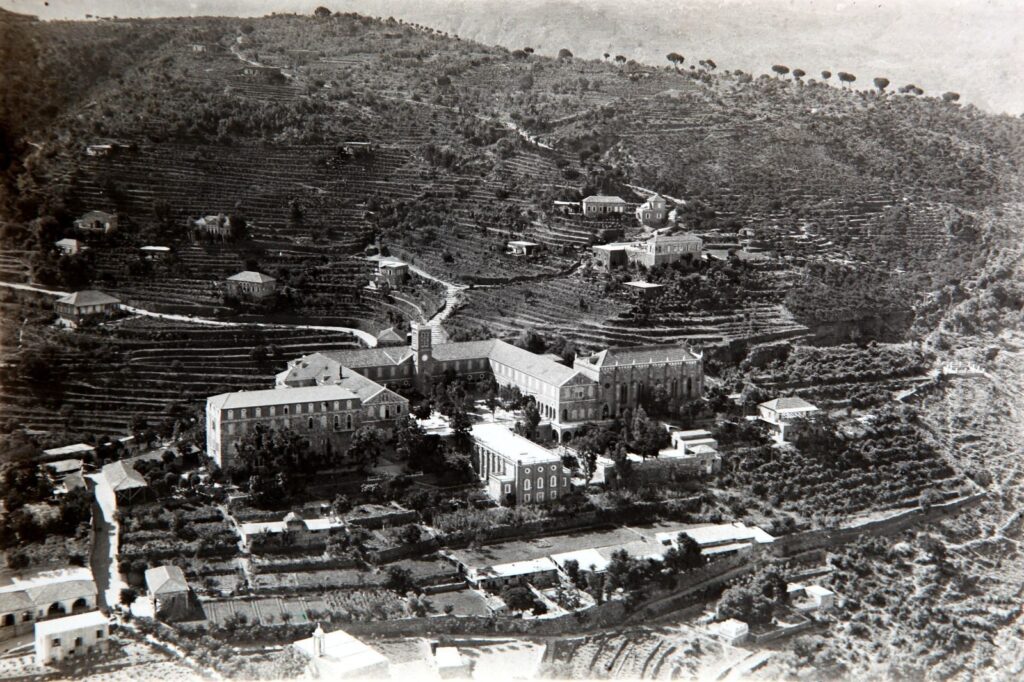
Saint Joseph Antoura Lazarist school, 1930’s, from the Archives and Special Collection of the school.
The American educational mission did not build in isolation. Alongside it, a parallel French Catholic network was taking shape across Ottoman Mount Lebanon and greater Syria.
In 1783, the Fathers of the Congregation of the Mission, known alternatively as the Vincentians or the Lazarists, established their mission in the village of Antoura on the slopes of Mount Lebanon. The school they founded, the Collège Saint-Joseph Antoura, became the first Francophone institution of learning in the Levant. Over the generations that followed, it played a formative role in spreading the French language across Lebanon and the wider Middle East, and in the making of a new modern elite open to political ideas and deeply invested in the question of Lebanon’s place among nations. The Lazarists would later call upon the Sisters of Charity to establish a network of schools, the Azariyyeh institutions, across Lebanon and Syria, extending educational provision for girls alongside an orphanage system that combined learning with humanitarian care.
In the 1830s, the Jesuits resumed their activities in the Levant. They would eventually establish the Université Saint-Joseph in Beirut, the first Francophone university in the Levant and a sister institution to AUB in the shared enterprise of making Beirut a city of universities. To these founding efforts must be added the schools of the local monastic communities, Maronite, Orthodox, and Greek Catholic alike, the Daoudiyya school in the Chouf, and the Maqased schools established in Beirut.
By 1900, both the Mutasarrifiyya of Mount Lebanon and the Vilayet of Beirut possessed the institutional framework necessary to participate fully in the cultural life of the region and, through their graduates, in that of the wider world. This was not the achievement of any single tradition or confession. It was the cumulative result of American Protestant missionaries, French Catholic orders, local monastic networks, and indigenous civic associations, each building, in parallel and at times in dialogue, the educational infrastructure of a country that did not yet formally exist.
The Vocation of a Country
What these schools and universities created was not merely a literate population. They created a vocation, a distinctive role that Lebanon came to occupy in the intellectual geography of the Arab world and the broader Mediterranean. Alongside the country’s commitment to freedom of expression and its confessional diversity, education became a third pillar of a distinct Lebanese identity: a place where knowledge was produced, circulated, and exported. Lebanese graduates of American and French missionary institutions became facilitators and leaders of change across the Arab world. Beirut became, and for many decades remained, the cultural capital of the Arabic-speaking world.
This inheritance is not a “Western” colonial imposition to be resisted. It is a Lebanese achievement to be defended. The missionaries provided resources, personnel, and institutional models. The Lebanese provided the intellectual labor, the cultural adaptation, and ultimately the ownership of what was built.
On Barbarians and Books
To threaten American universities in Lebanon and the wider Middle East is not, therefore, to strike a blow against foreign imperialism. It is to strike at the intellectual foundations of Lebanon and of Arab modernity itself; at the possibility of a more peaceful, more dignified, and more prosperous future. It is to wage war on the very processes through which Lebanon became something greater than a peripheral mountain district on the margins of the Ottoman world: a center of learning and culture, a country whose influence reached far beyond its borders precisely because it invested, across two centuries and across every community, in the life of the mind.
The schools remain. The universities remain. And the motto engraved on AUB’s Main Gate remains: that they may have life and have it more abundantly. This is not a foreign slogan. It is Lebanon’s own aspiration, written in stone and earned over nearly two centuries of teaching, learning, and building, one school, one classroom, one generation at a time.
To call students at these institutions “American interests,” and to imply that they are therefore legitimate targets, is not political analysis. It is the logic of those who celebrate the killing of intellectuals, and who fear books because books outlast them. It is the logic of those who mistake destruction for strength, and intimidation for purpose. In the end, it is always the same barren imagination: the one that knows how to threaten a library, but not how to build one; how to sanctify death, but not how to cultivate life. And history, though often slow, has never been kind to such people.
Charles H. al-Hayek, Public Historian, founder of Heritage and Roots.
The views in this story reflect those of the author alone and do not necessarily reflect the beliefs of NOW.