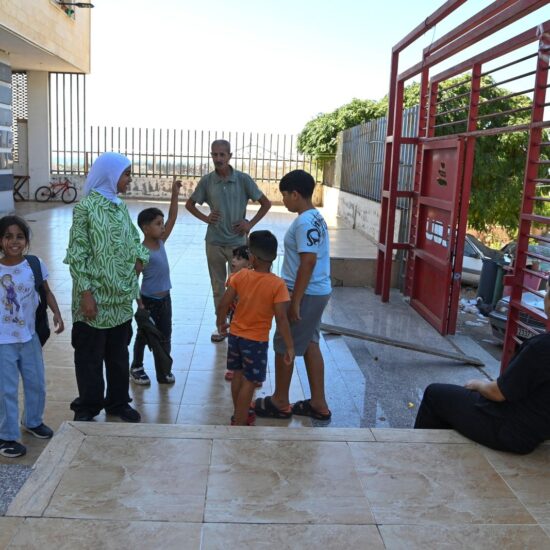
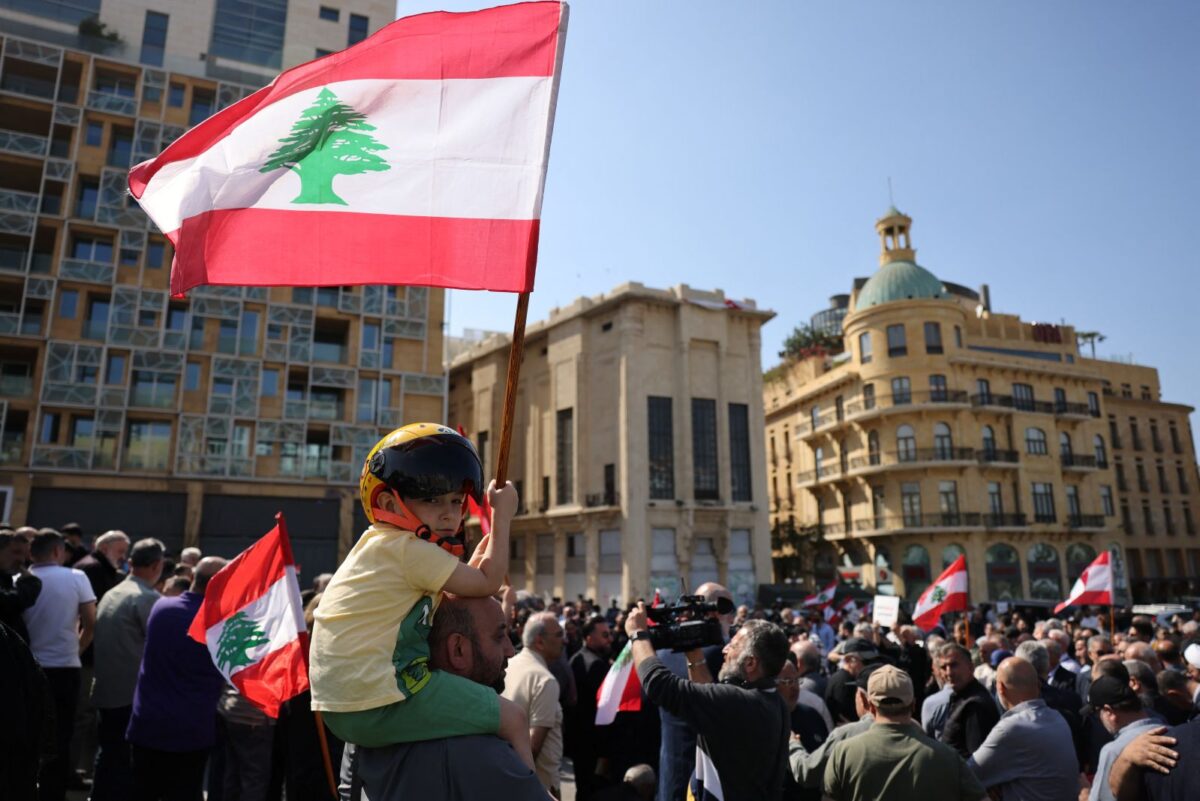
ANWAR AMRO / AFP, A child waves a Lebanese flag while residents, mukhtars, and inhabitants of the devastated southern Lebanese border villages protest against the destruction of their villages and being prevented from returning by order of the Israeli army, at Martyrs’ Square in central Beirut on April 30, 2026.
On April 30, an Israeli army spokesperson called for the evacuation of eight southern villages ahead of planned military action there. Shortly after the ceasefire began on April 17, Israel declared a so-called "Yellow Line", a strip of Lebanese territory about 10 kilometres deep along the border, where it has been operating and demolishing villages.
There is an old Arabic saying: whoever repeats a failed experiment must be sick in the head.
It applies perfectly to Lebanon today, as the country stands before a defining moment: between the logic of the state and the logic of the militia, between a peace that protects people and a weapon that uses them as fuel in wars they neither chose nor benefit from.
Every time the door opens to a discussion about negotiations or arrangements that could halt the war between Lebanon and Israel, Hezbollah, backed by Iran and accompanied by its usual chorus of accusations, rushes to declare that what the Lebanese state is doing amounts to “normalization.”
As if the Lebanese are expected to remain prisoners of a single word, one deployed as a political and moral weapon to prevent any serious attempt to rescue the country from war, destruction, isolation, and collapse.The truth is that this accusation is empty.
Normalization, in the traditional sense of the word, requires a strong central state, indeed sometimes an overbearing one, capable of imposing cultural, economic, and social measures on society. It requires a state able to push people, through law, coercion, or interest, into a direct relationship with the other side.
This model simply does not apply to Lebanon. Not in its composition, not in its history, and not in its political and social reality.
Lebanon is not a one-tone state. It is a diverse society that cannot be led by the stick. It is made up of sects, communities, and groups, each with its own memory, interests, fears, and calculations. Some reject any form of relationship. Others simply want to live in safety. Some want nothing more than the war to stop. Others place the economy first. Still others see sovereignty as the central issue.
For that reason, any peace agreement or cessation of hostilities, should it happen, will not automatically become “normalization” in the sense Hezbollah uses to frighten people. The Lebanese will not wake up the next morning to find themselves forced into cultural, economic, or social integration. That is a ridiculous simplification, and a deliberate one. Its purpose is to abort any serious national debate before it begins.
What any agreement would mean, quite simply, is the end of hostilities.
It would mean stopping the killing and the exchange of rockets. It would mean that no party, on either side, could continue using pretexts to drag people into war. It would mean borders becoming the borders of a state, not an open theater for militia adventures or an extension of a sectarian crescent. It would mean that the decision of war and peace would no longer rest in the hands of an armed organization tied to a regional project, but in the hands of the Lebanese state and its legitimate institutions.
Here lies the heart of the matter.
Hezbollah does not fear normalization as much as it fears peace. Because peace, even in its most limited form, strips the party of the central excuse upon which it built its weapons, power, and dominance.
Hezbollah does not fear normalization as much as it fears peace. Because peace, even in its most limited form, strips the party of the central excuse upon which it built its weapons, power, and dominance.
Hezbollah knows that the moment war stops, the real questions begin: Why the weapons? Against whom? Who decided to go to war? In whose name? And to what end?
For years, the Lebanese were told that these weapons protect them. Experience has proven the opposite. These weapons did not protect Lebanon. They turned it into an open battlefield. They did not protect the South. They made it a hostage. They did not protect the Shiite community. They forced it to pay the price of wars, displacement, fear, and destruction.
The claim that the “resistance” defends Lebanon no longer convinces anyone except those determined to close their eyes to reality. A weapon that brings war into people’s homes, then asks them to be patient, sacrifice, and remain silent, is not a weapon of protection. It is a burden. Worse, it is a political, security, and social curse.
More dangerous still is Hezbollah’s attempt to monopolize the definition of patriotism. Whoever rejects war becomes a traitor. Whoever demands the state becomes an agent. Whoever calls for protecting people becomes a normalizer. This is not patriotism. It is the confiscation of the nation.
Real patriotism today means saying that Lebanon is not a launchpad for Iran’s rockets. It is not a bargaining chip in the hands of the Revolutionary Guard. It is not a society condemned to live forever under the threat of war.
Real patriotism today means saying that Lebanon is not a launchpad for Iran’s rockets. It is not a bargaining chip in the hands of the Revolutionary Guard. It is not a society condemned to live forever under the threat of war.
The majority of Lebanese, including a wide segment of Shiites who have paid a heavy price in displacement, fear, and loss, know that this path is no longer acceptable. People want to return to their homes. They want schools, hospitals, work, stability, and safety. They want a state, not military communiqués. They want borders, not fronts. They want one army, not armies within the state.
These demands are not normalization. They are the most basic requirements of normal life in any country that respects itself.
As for Iran, it is the last actor entitled to lecture the Lebanese about sovereignty. The Iranian project in Lebanon did not build a state. It undermined one. It did not protect institutions. It weakened them. It did not give the Lebanese dignity. It dragged them into isolation and endless conflict.
What is called the “Axis of Resistance” has in reality become an axis of exhaustion for peoples, from Lebanon to Syria, Iraq, and Yemen.
This is why the language of blackmail must be rejected at its root. Not every attempt to stop war is normalization. Not every negotiation is treason. Not every settlement is surrender.
There is a vast difference between capitulation and protecting a country from collective suicide. There is a difference between a state selling its sovereignty and a state reclaiming that sovereignty from illegal arms.
Lebanon needs a peace that protects it, not slogans that destroy it. It needs a state that decides, not a militia that drags it along. It needs one army, one decision, and one national interest placed above the interests of regional axes.
Lebanon needs a peace that protects it, not slogans that destroy it. It needs a state that decides, not a militia that drags it along. It needs one army, one decision, and one national interest placed above the interests of regional axes.
Those who prevent the state from doing its job under the pretext of fighting normalization are in fact trying to keep Lebanon hostage to war. War is the only environment that justifies their existence and their weapons.
In the end, peace is not love, illusion, or emotional enthusiasm. In Lebanon’s case, peace is a national necessity to stop the bleeding.
The normalization they use to frighten us cannot be imposed on a diverse and complex Lebanese society that does not easily accept tutelage. What must be imposed, through a clear national will, is the end of weapons outside the state and the end of using Lebanon as a platform for other people’s wars.
The normalization they use to frighten us cannot be imposed on a diverse and complex Lebanese society that does not easily accept tutelage. What must be imposed, through a clear national will, is the end of weapons outside the state and the end of using Lebanon as a platform for other people’s wars.
The Lebanese have already tried the path of Hezbollah and Iran. The result was ruin upon ruin.
Perhaps the time has come to try the path of the state.Not because the state is perfect, but because it remains the only framework capable of protecting everyone.
Those who insist on repeating the same failed experiment are not defending Lebanon. They are defending their right to destroy it in the name of resistance.
Makram Rabah is the managing editor at Now Lebanon and an Assistant Professor at the American University of Beirut, Department of History. His book Conflict on Mount Lebanon: The Druze, the Maronites and Collective Memory (Edinburgh University Press) covers collective identities and the Lebanese Civil War. He tweets at @makramrabah
This article was originally published in Elaph.