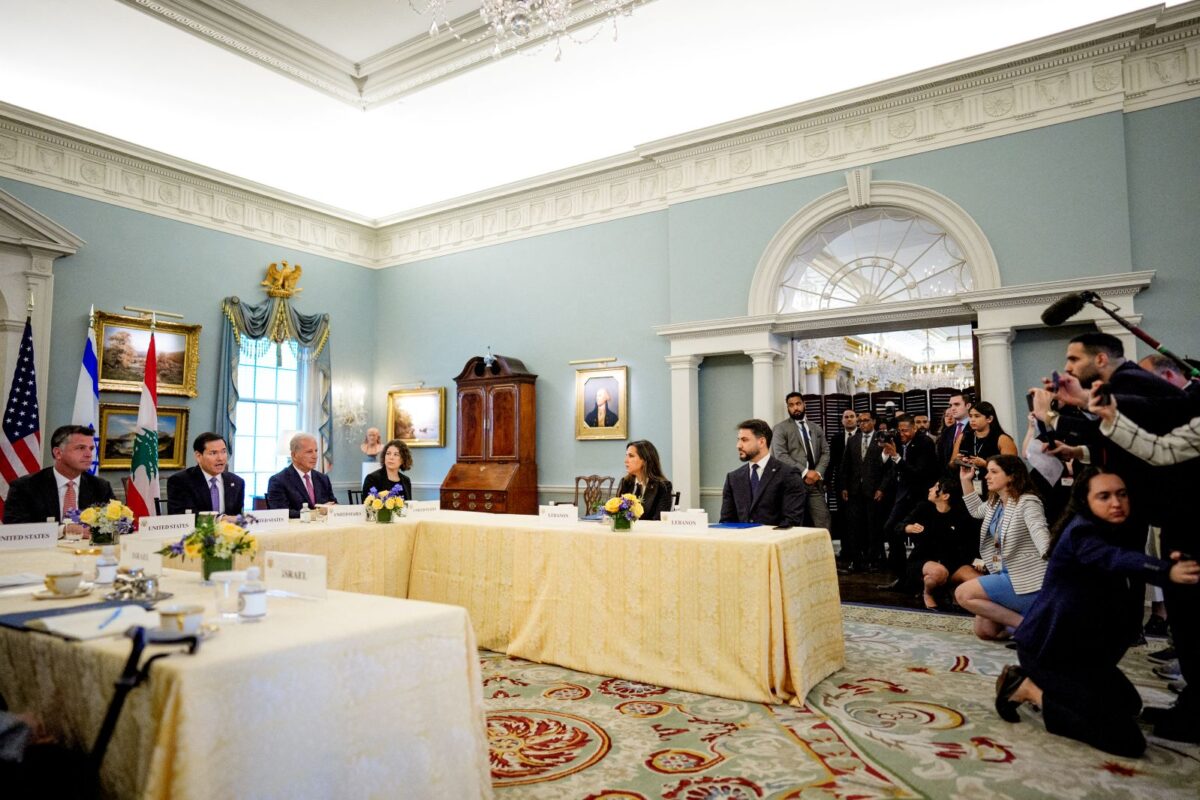
WASHINGTON, DC - APRIL 14: U.S. Secretary of State Marco Rubio (4th-L), accompanied by U.S. State Department Counselor Michael Needham (3rd-L), U.S. Ambassador to Lebanon Michel Issa (4th-R), Lebanese Ambassador to the U.S. Nada Hamadeh Moawad (2nd-R) and Israeli Ambassador to the U.S. Yechiel Leiter, speaks at the start of working-level peace talks at the U.S. State Department on April 14, 2026 in Washington, DC. In their first direct diplomatic talks in more than 30 years, Lebanon and Israel are preparing negotiations to potentially end Israel's conflict with the Lebanese militia Hezbollah. Andrew Harnik/Getty Images/AFP (Photo by Andrew Harnik / GETTY IMAGES NORTH AMERICA / Getty Images via AFP)
The Only Question That Matters Is Lebanon’s Interest
For decades, Lebanon has paid the price of wars, confrontations, and regional power struggles that repeatedly exceeded its capacity, fragmented its institutions, exhausted its economy, and wounded its society. Today, as negotiations begin in Washington between Lebanon and Israel under American sponsorship, the country faces a defining question that may shape its future for decades to come:
Will Lebanon finally negotiate according to its own national interest, or will it once again serve as an arena through which others negotiate their conflicts and ambitions?
This moment is not simply about ceasefires, borders, or diplomacy. It is about defining what kind of state Lebanon intends to become after years of collapse, paralysis, displacement, economic devastation, and internal fragmentation.
As Lebanon approaches a new round of negotiations in Washington, the country once again stands at a historic crossroads.
The first session was held on April 14, 2026, at the U.S. State Department in the presence of U.S. Secretary of State Marco Rubio and attended by Lebanon’s Ambassador to Washington, Nada Hamadeh Moawad, alongside Israel’s Ambassador to the United States, Yechiel Leiter.
The second session followed on April 23, 2026, in Washington as part of the continuation of direct talks sponsored by the United States and attended by President Donald Trump in addition to the officials who attended the earlier meeting.
A third round of talks is expected between May 13 and May 15, 2026, in Washington, led on the Lebanese side by veteran diplomat Simon Karam accompanied by military representatives. On the Israeli side, reports indicate the participation of Strategic Affairs Minister Ron Dermer together with Israeli security and military representatives.
These talks are intended to establish a framework for broader negotiations touching on security arrangements, border issues, ceasefire mechanisms, reconstruction, and potentially a wider political settlement between Lebanon and Israel.
According to diplomatic reports, the Lebanese side is primarily seeking:
A full and immediate ceasefire.
Complete Israeli withdrawal from Lebanese territories.
The return of prisoners and detainees.
Guarantees for reconstruction and international support.
Stabilization of the southern border under Lebanese state authority.
The Israeli side appears focused on:
Long term security guarantees.
The disarmament of Hezbollah.
Preventing future Iranian military infrastructure in Lebanon.
Durable security arrangements along the border.
Expanding negotiations toward a broader normalization framework.
These developments have exposed profound political divisions inside Lebanon.
One camp, largely aligned with Hezbollah and the so called “axis of resistance,” views these negotiations as an American Israeli attempt to weaken Hezbollah and reduce Iran’s regional influence. For this camp, opposition to negotiations is not merely resistance to American influence in the region. It is also the defense of Iranian geopolitical interests, even when those interests directly conflict with the interests of the Lebanese citizen himself.
The contradiction between Iranian regional priorities and Lebanese national interests was one of the central factors that dragged Lebanon back into war. The internal escalation has now reached a dangerous level where President Joseph Aoun and Prime Minister Nawaf Salam have been publicly accused by extremist voices of betrayal and collaboration with Israel, including the circulation and hanging of manipulated images portraying President Aoun as an Israeli Rabbi in areas under the influence of Hezbollah supporters.
Another camp, strongly anti Hezbollah and openly aligned with Western and Gulf positions, views these negotiations as an opportunity to decisively end Hezbollah’s military role and reposition Lebanon fully within the Western and Arab political order. Some within this camp speak openly about immediate peace as though Lebanon’s internal wounds and sensitivities no longer exist.
For parts of this camp, the process is no longer solely about security or stability. It has become equally about securing a political and psychological victory over Hezbollah itself, to the extent that proving total defeat increasingly appears more important than the disarmament question alone.
Both approaches carry the same risk: transforming Lebanon once again into a battlefield serving the agendas of others rather than protecting its own national interest.
This is precisely where the danger lies.
Lebanon must negotiate according to one standard only: the sovereign national interest of the Lebanese state and the protection of the Lebanese citizen, the Lebanese economy, Lebanese stability, and Lebanon’s future as a functioning state.
Any negotiation process that turns Lebanon into a platform for foreign agendas, proxy confrontations, ideological revenge, or geopolitical scoring risks reproducing the very conditions that repeatedly pushed the country toward destruction and institutional collapse.
The only legitimate standard must be Lebanon’s national interest.
Nothing else.
The Immediate Lebanese Interest
At the most urgent level, Lebanon’s priorities are clear and non negotiable:
An immediate and comprehensive ceasefire.
The full withdrawal of Israeli forces from all Lebanese territories.
The return of prisoners and detainees.
The safe return of displaced civilians to their homes and villages.
The launch of a serious international reconstruction effort for southern Lebanon and all affected areas.
These are not political luxuries. They are humanitarian necessities.
Entire villages have been devastated. Hundreds of thousands of Lebanese have experienced displacement, fear, economic collapse, and psychological exhaustion. The Lebanese people cannot continue paying the price of regional wars they neither control nor fully choose.
The Long Term Lebanese Interest
Lebanon’s interest cannot end with stopping the current violence.
The deeper national objective must be the establishment of a fully sovereign Lebanese state capable of producing sustainable stability for generations to come, a state in which the primary beneficiary is the Lebanese citizen himself.
Lebanon’s core interest is not temporary calm. It is continuous stability:
Political stability.
Security stability.
Economic stability.
Social stability.
Any future arrangement must therefore be judged according to whether it can produce:
Long term security.
Protection of Lebanese sovereignty.
Economic recovery.
International reintegration.
Investment and reconstruction opportunities.
Stability for future generations.
Whether this ultimately evolves into formal peace, long term security arrangements, or another negotiated framework remains secondary to the central question:
Will it protect Lebanon from perpetual destruction and recurring wars?
Hezbollah, the Shia Community, and Lebanon’s Future
One reality is becoming increasingly unavoidable:
There can be no future for any military structure operating outside the authority of the Lebanese state, including Hezbollah as an armed military force or as an Iranian military arm inside Lebanon.
At the same time, this must never become an attempt to marginalize, isolate, or humiliate the Lebanese Shia community.
The Lebanese Shia are a founding and essential component of the Lebanese national fabric. Their political, social, economic, and national role remains fundamental to Lebanon’s future and stability.
The objective cannot be replacing one form of domination with another.
Nor can negotiations become:
A project to humiliate the Shia community.
A process designed to create winners and losers inside Lebanon.
That would be a historic mistake.
Lebanon’s national interest requires that no Lebanese faction emerges feeling defeated, excluded, or humiliated. Sustainable peace and stability can only emerge through national inclusion, institutional legitimacy, and equal partnership under the authority of the state.
The objective is not the destruction of a community.
The objective is the reconstruction of a state.
Lebanon’s Regional Position Must Also Be Protected
Lebanon’s interests are not isolated from its Arab environment.
Any future agreement must preserve Lebanon’s relations with Arab countries, Gulf states, Syria, and the broader regional environment.
At the same time, Lebanon must preserve balanced and constructive international relations with major global actors including Europe, Asia, the United States, and the wider international community. Lebanon’s recovery and prosperity depend on remaining economically, diplomatically, and strategically connected to the world.
Lebanon cannot afford geopolitical isolation.
Nor can it continue functioning as a permanent ideological frontline for regional powers.
The country’s future recovery, reconstruction, tourism, investments, energy cooperation, and trade routes all depend on rebuilding balanced and stable regional relations.
Reconstruction Is the Real Battle
The central question is no longer simply how the war ends.
The real question is what kind of Lebanon emerges afterward.
Reconstruction is not merely about rebuilding destroyed villages in the South. It is about rebuilding:
The economy.
The state.
Institutions.
Investor confidence.
Infrastructure.
Social trust.
And the belief that Lebanon can once again become a functioning country.
This cannot be achieved through slogans.
It requires:
Stability.
Functioning state institutions.
Legal certainty.
International partnerships.
Economic reform.
And here lies another critical issue:
The legitimate private sector, which remains the primary engine of Lebanon’s economy and one of the few sectors still capable of driving recovery, continues to be largely absent from strategic national discussions.
Lebanon cannot rebuild its future through parallel economies, smuggling networks, illegal border activity, war economies, corrupt financial structures, or political protection systems that flourished under years of institutional weakness and conflict.
The private sector capable of rebuilding Lebanon is the productive, transparent, accountable, and legitimate sector that creates jobs, pays taxes, sustains GDP, attracts investment, and operates within the framework of the law and state institutions.
Any future reconstruction effort must also include serious accountability and the gradual dismantling of illegal economic structures that weakened the Lebanese state and distorted fair economic competition for years.
Those who sustain the economy and will ultimately carry the burden of reconstruction must have a seat at the table.
Those who contributed to destruction cannot alone design reconstruction.
The Lebanese State Alone Must Represent Lebanon
At this critical moment, one principle must remain absolutely clear:
Joseph Aoun, Nawaf Salam, the Lebanese government, and the official negotiating delegation are the sole legitimate representatives of Lebanon in these negotiations.
No parallel authority should negotiate on behalf of the Lebanese people.
No foreign capital should define Lebanon’s future.
No internal faction should monopolize national decision making outside constitutional institutions.
The Lebanese state alone must negotiate.
The Lebanese state alone must decide.
And Lebanon’s national interest alone must prevail.
After decades of serving as a battlefield for others, Lebanon now faces a defining test: whether it can finally become a sovereign state that acts first for its own people.
Farid Fakherddin is a Lebanese businessman and Board Member of the Lebanese Private Sector Network (LPSN).
The views in this story reflect those of the author alone and do not necessarily reflect the beliefs of NOW.