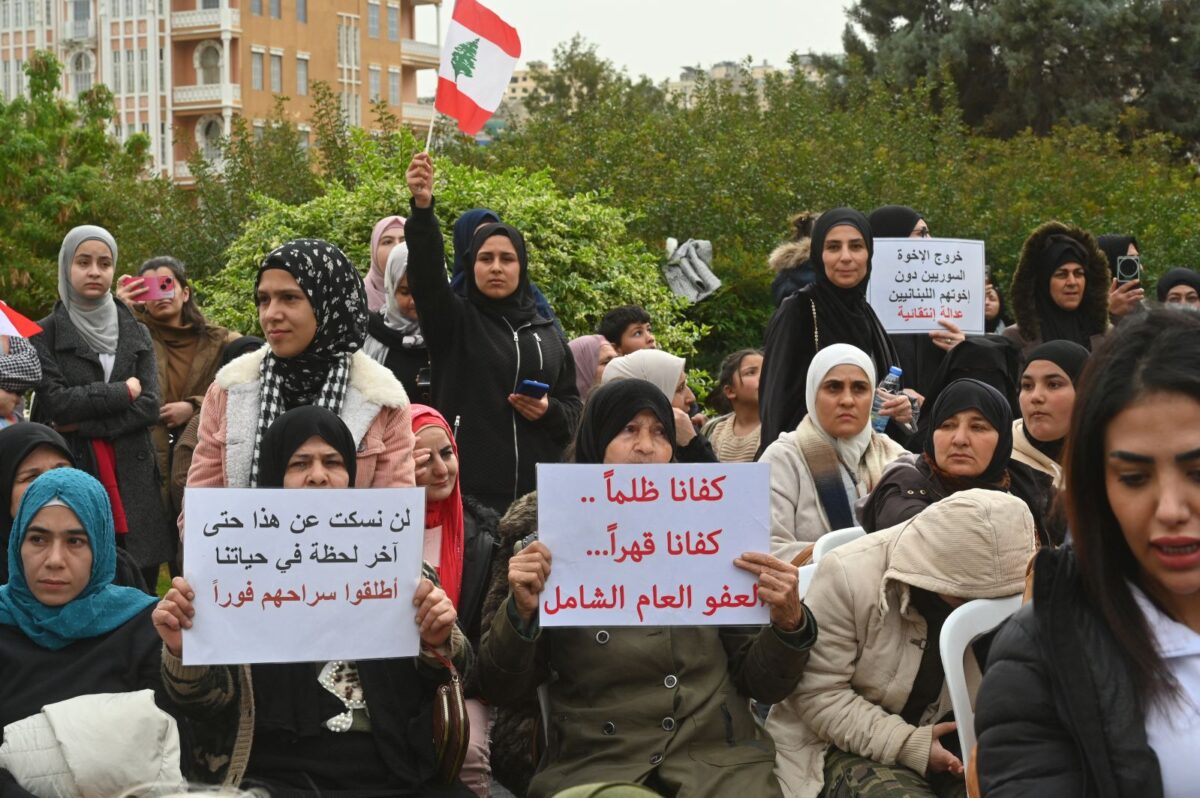
Relatives and families of Islamist prisoners at Roumieh prison carry pictures of their loved ones during a protest outside the Government Palace in downtown Beirut, Lebanon, on January 30, 2026. Some of the families of Syrians and Lebanese held in jails gather to protest after a group of prisoners at Roumieh prison announces an open-ended hunger strike. (Photo by Fadel Itani/NurPhoto) (Photo by Fadel Itani / NurPhoto / NurPhoto via AFP)
There is a particular kind of political theatre Lebanon has perfected over decades, the kind where a real crisis is addressed with a performative solution, and everyone in the room agrees to pretend the difference doesn’t matter. The current debate over a general amnesty law is one of the most vivid examples of this theatre I have witnessed in years.
The official justification is humanitarian. Lebanon’s prisons are overcrowded. Conditions are inhumane. People are suffering behind bars. All of this is true. But what the debate has carefully avoided naming what the parliamentary committees have spent weeks dancing around, is the statistic that should have ended the conversation before it started and redirected it entirely: approximately 85% of Lebanon’s prisoners have never been tried.
Let that number settle for a moment. Out of over 6,000 detainees, the overwhelming majority are not convicted criminals serving sentences handed down by a court of law. They are people waiting, some for months, some for years, for a judiciary that has neither the capacity nor, in many cases, the institutional will to process their files. In Lebanon, pretrial detention has ceased to function as a precautionary legal measure. It has become the punishment itself. The cell is the sentence, delivered without verdict, without defense, without the most basic architecture of justice.
This is not an overcrowding problem. This is a confession of systemic collapse.
This is not an overcrowding problem. This is a confession of systemic collapse.
And yet, rather than confront that collapse, rather than demand judicial reform, impose strict time limits on pretrial detention, or overhaul a prosecution system that operates as though due process were optional; Lebanon’s parliament has chosen the path of least institutional resistance. Empty the prisons. Move on. Call it compassion.
As a political psychologist who has spent years studying how societies process – or fail to process – structural failure, I can tell you precisely what happens when institutions substitute performance for repair. The underlying dysfunction does not disappear. It goes underground, accumulates pressure, and resurfaces, usually in a more destructive form. Lebanon’s prisons will fill again. The same logic that imprisoned 85% of today’s detainees without trial will produce the next generation of the unjustly held. Nothing in the amnesty law touches the mechanism. Only the output changes, temporarily.
The same logic that imprisoned 85% of today’s detainees without trial will produce the next generation of the unjustly held. Nothing in the amnesty law touches the mechanism. Only the output changes, temporarily.
But the social damage of this particular solution runs even deeper than the institutional one. When you release people through a political negotiation rather than a judicial process, you collapse the distinction between the innocent and the guilty in the public imagination. The man who spent three years in pretrial detention for a crime he did not commit walks out the same door, on the same day, under the same law, as the man whose sectarian bloc successfully lobbied for his inclusion. Society cannot tell them apart. And crucially the state has given society no language to tell them apart, because the state itself chose not to make the distinction.
What the amnesty law has become stripped of its humanitarian packaging, is a sectarian auction. Every political bloc has arrived at the table with an unannounced list: the Islamist detainees here, the figures connected to internal security incidents there, the families of those who fled to Israel in 2000 still waiting for a 2011 law that was passed and never implemented. The exceptions are not legal boundaries drawn around justice. They are the residue of negotiations between power brokers deciding whose people get out and whose people stay.
The structural inversion at the heart of the law makes this almost mathematically inevitable. Parliament voted early in the process to make amnesty the rule and accountability the exception. Meaning that anyone who wanted to hold someone accountable had to fight, clause by clause, to insert an exemption. The burden of proof was placed not on those seeking release, but on those defending the integrity of the system. In a parliament as politically fractured as Lebanon’s, that is not a legal framework. It is a blueprint for impunity.
There is a version of an amnesty law that would be both just and coherent: one targeted specifically at those whose detention has exceeded any reasonable legal threshold, who have never been charged or tried, and whose files have simply been swallowed by a dysfunctional system. That version would be honest about what it is, not a grand act of national reconciliation, but an emergency correction for a judiciary in failure. It would be paired, necessarily, with binding reform obligations: deadlines for pretrial detention, judicial capacity-building, prosecutorial accountability.
That version does not exist in the current proposal. What exists instead is political documents designed to look like a legal one, broad enough to serve every bloc’s interests, vague enough to be interpreted as needed, and framed in the language of mercy so that opposition reads as cruelty.
That version does not exist in the current proposal. What exists instead is political documents designed to look like a legal one, broad enough to serve every bloc’s interests, vague enough to be interpreted as needed, and framed in the language of mercy so that opposition reads as cruelty.
Lebanon is not releasing the wrongfully imprisoned. It is clearing its ledger without auditing its books. And two years from now, when the prisons fill again, we will have the same conversation, with a different set of detainees and the same broken system producing them.
Ramzi Abou Ismail is a Political Psychologist and Senior Research Fellow at the Institute for Social Justice and Conflict Resolution at the Lebanese American University.
The views in this story reflect those of the author alone and do not necessarily reflect the beliefs of NOW.