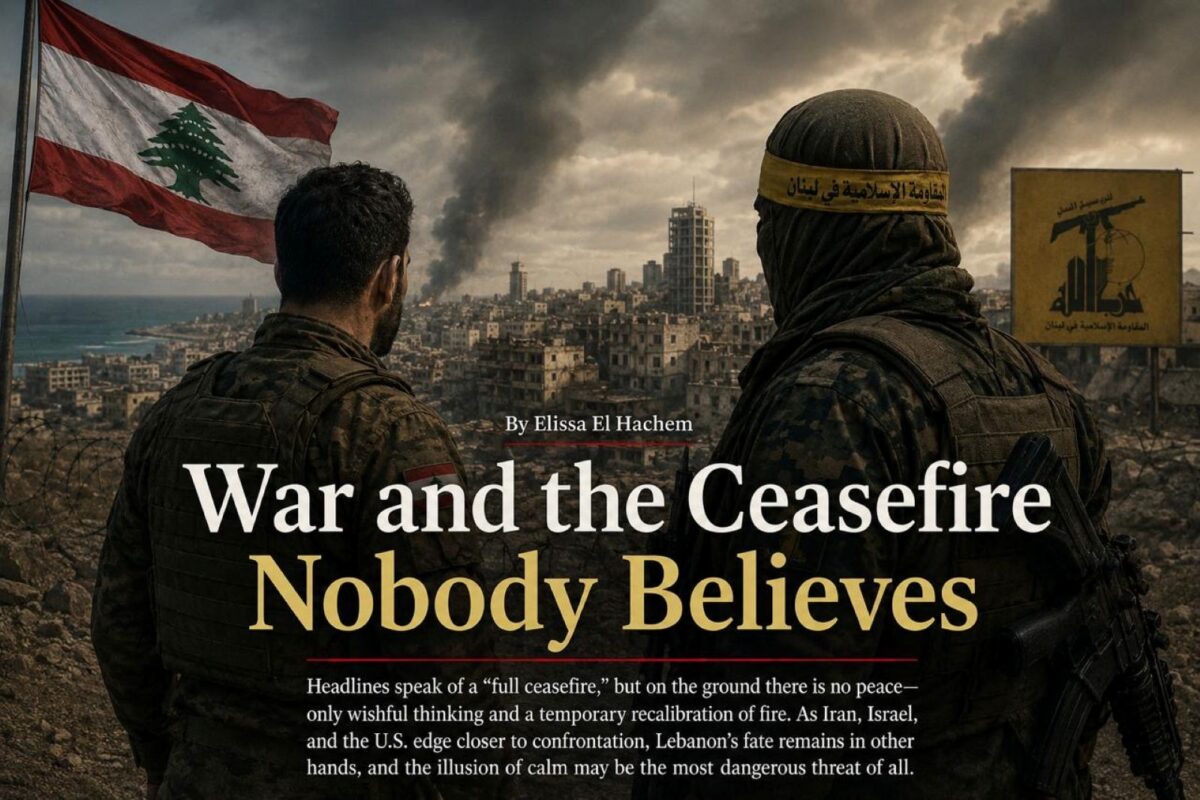
May 17 brought yet another “full ceasefire” narrative, circulated as though Lebanon had finally entered a phase of stability. Midnight headlines, diplomatic whispers, optimistic leaks, all selling the illusion that the war is somehow on hold.
But who exactly benefits from marketing a ceasefire that nobody on the ground truly believes in?
Certainly not Israel, which sees Hezbollah not as a Lebanese political actor, but as the forward military arm of Iran. Certainly not Hezbollah itself, whose leadership openly and repeatedly declares that it does not recognize the Lebanese state as the ultimate authority over its military decisions, nor the negotiations conducted in Lebanon’s name.
And certainly not Lebanon, whose territory remains suspended between occupation, deterrence, displacement, and the permanent threat of collapse.
The hard truth is this: there is no full ceasefire. There is only wishful thinking and a temporary recalibration of fire.
The regional drums of war are once again resonating between Iran, the United States, Israel, and the GCC states. President Donald Trump himself declared, on that same night of May 17, that “the clock is ticking” for Iran. If the clock is ticking for Tehran, then it is ticking for Lebanon as well.
Because Lebanon today no longer controls the timing of war or peace on its own soil.
The fundamental reality that many still refuse to confront is that Hezbollah’s strategic doctrine is tied first to Tehran’s regional agenda, not to Lebanese state interests. Hezbollah officials have publicly reaffirmed this repeatedly. They do not hide it. They do not apologize for it. And they do not subordinate their military calculations to the Lebanese government or the Lebanese Army.
Which raises the central question nobody wants to answer honestly:
If war resumes against Iran, will Hezbollah remain still?
Everything in Hezbollah’s ideological structure, military doctrine, and regional function suggests otherwise. And Israel knows this.
Which is precisely why Tel Aviv does not appear inclined to approve the full consolidation of any lasting ceasefire in Lebanon. From the Israeli perspective, granting Hezbollah a strategic breather without extracting irreversible concessions would amount to rewarding the very infrastructure it seeks to dismantle.
Nothing is free at a negotiating table.
Why would Israel permit Hezbollah time to regroup, redeploy, reinforce command structures, rebuild logistical corridors, and expand territorial influence across Lebanon without a measurable strategic return?
It will not.
This is why fears of a wide Israeli escalation in Lebanon remain very real. And if Hezbollah moves militarily in support of Iran during a renewed regional confrontation, Lebanon may witness a repeat, or worse, of what many already describe as a coming “Black Wednesday” scenario spreading across the country.
Yet while the public is distracted by ceasefire headlines, the facts on the ground tell an entirely different story. Hezbollah’s territorial expansion inside Lebanon is not slowing. Quite the opposite.
The group continues reinforcing its presence across Beirut’s entrances, strategic corridors, and sensitive sites, while networks operating under the cover of displacement increasingly function as demographic and operational buffers capable of rapid mobilization if confrontation erupts internally, as the Biel example suggests.
If the Lebanese state fails to act decisively, entire territories risk being permanently altered, while displaced populations become indefinitely stationed elsewhere under the pretext of temporary humanitarian management.
Lebanon has entered a phase in which every actor calculates sectarian, territorial, and strategic gain simultaneously.
And that includes international actors.
There is growing regional and international discussion, increasingly circulated, around replacing UNIFIL at the end of its term with a broader multinational force composed of varying powers, potentially involving the United States, Israel, European states, Arab countries, and Lebanon in coordination mechanisms.
Why?
Because confidence in the current arrangement has eroded.
The core objective would not merely be monitoring borders, but restructuring the entire southern security architecture, and consequently moving north.
But then comes the politically explosive question: can the Lebanese Army realistically create, or host, a separate force mandated to disarm Hezbollah?
The answer is brutally complicated.
The fantasy currently promoted in some circles, embedding Hezbollah further into the Lebanese Army as a path toward “containment,” may actually produce the exact opposite effect.
How naïve is the idea of strengthening Hezbollah through institutional integration while simultaneously claiming the goal is disarmament?
That is not dismantling parallel power.
It risks legitimizing and institutionalizing it.
In practice, it could mean granting Hezbollah expanded influence over the Army, the presidency, the state apparatus, and future security doctrine all at once, effectively rewarding armed leverage with constitutional permanence.
No sovereign state successfully restores a monopoly over force by absorbing an autonomous ideological militia into the core of its military structure without first resolving the issue of command loyalty.
And this is the issue Lebanon refuses to confront honestly.
Who ultimately decides war and peace?
Beirut?
Or Tehran?
This is no longer an abstract debate. It is an immediate strategic question with existential consequences. Lebanon is facing an accelerated countdown.
A state that cannot monopolize arms, cannot control borders, cannot decide war and peace, and cannot prevent external agendas from operating on its territory ceases to function as a sovereign state and becomes merely an arena.
This is the reality behind the illusion being sold today.
The ceasefire narrative is not designed to solve the conflict. It is designed to buy time, manage optics, and postpone the unavoidable confrontation over who truly governs Lebanon.
But postponing reality does not change it.
Israel is preparing for the possibility of a larger regional war. Iran is preparing its deterrence network. Hezbollah is repositioning internally and strategically.
Meanwhile, the Lebanese state continues behaving as though ambiguity itself is a strategy.
It is not.
Because the longer Lebanon delays confronting the question of sovereignty, the more others will answer it on its behalf. In the Middle East, when others begin deciding your future for you, they rarely return what was taken, or what was naively given away.
Elissa E Hachem is a journalist and political writer specializing in regional affairs and governance. Former Regional Media Advisor at the U.S. State Department’s Arabic Regional Media Hub, with broad experience in strategic communication across government and private sectors.
The views in this story reflect those of the author alone and do not necessarily reflect the beliefs of NOW.