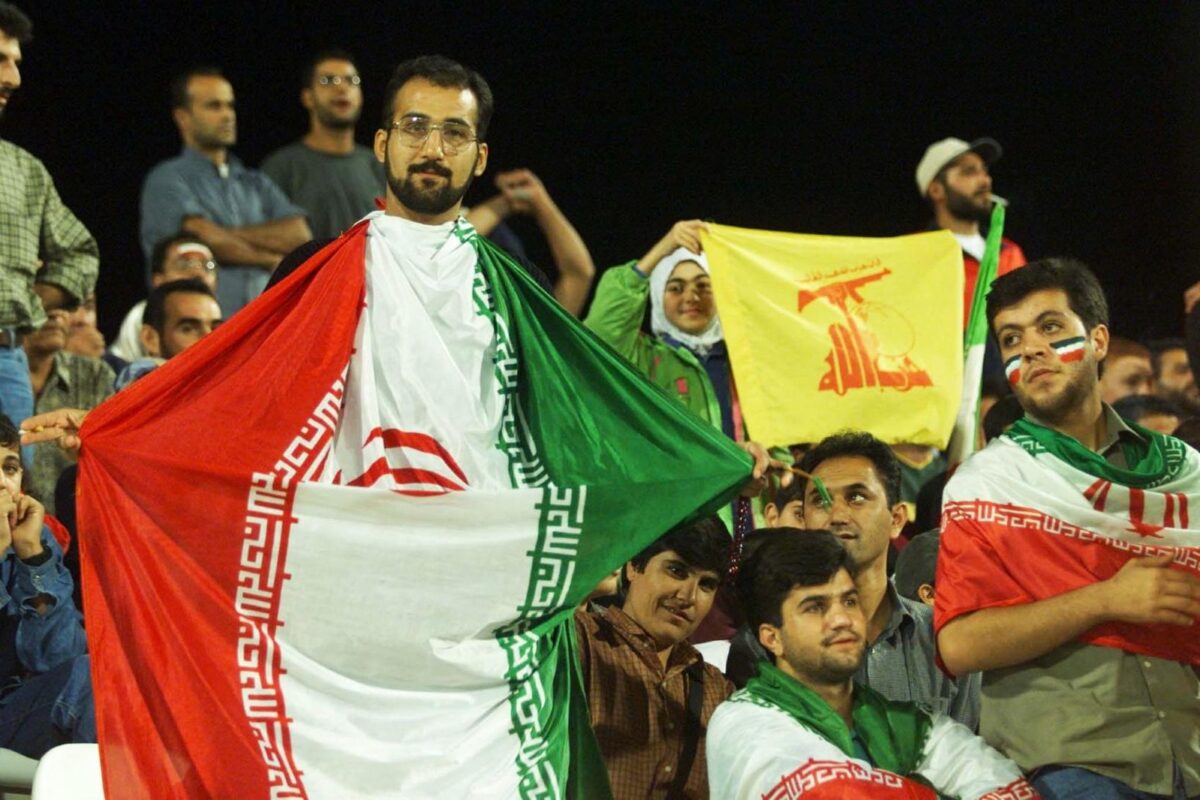
Sidon, LEBANON. Photo by RABIH MOGHRABI / AFP
Iran supporters wears their nation's flag as another holds up a Hezbollah flag during the Iran-Iraq Group A match at the Asian Cup 2000 soccer tournament in Sidon 18 October 2000.
If the region is dismantling parallel armed structures in the name of sovereignty, why is Lebanon the only country where the same objective is considered untouchable?
Across the Middle East, a new regional reality is taking shape. States are moving—through different circumstances and at different speeds—to reassert authority over armed groups operating outside state control, many of them linked to Iran’s regional network. In Iraq, the government is moving toward placing all weapons under state authority. In Yemen, restoring state control remains central to any sustainable political solution. Across the region, the principle is increasingly clear: a state cannot function normally when another armed force competes with it over security decisions and national authority.
Only in Lebanon is this same principle often portrayed as too dangerous to pursue. The idea that the state alone should decide questions of war, peace, and national security is repeatedly met with warnings of instability and civil conflict. Yet if restoring sovereignty is considered necessary elsewhere, why should Lebanon remain the exception?
For years, Lebanon has been viewed through the lens of its past: its wars, divisions, and repeated crises. But the regional environment around Lebanon is changing. The question facing Beirut today is no longer only how to manage old conflicts; it is whether Lebanon will adapt to a Middle East increasingly defined by stronger states, clearer sovereignty, and the return of national authority as the foundation of stability.
Lebanon is not being asked to follow an unfamiliar path. It is facing the same question confronting countries across the region: can a state fully protect its future when decisions of war and peace remain divided between official institutions and armed actors outside them?
Iraq’s experience is particularly significant. After years of confronting corruption, institutional weakness, and the influence of armed factions outside full state control, Baghdad has moved toward strengthening state institutions through measurable steps. Iraqi authorities have pursued accountability measures and challenged illegal networks, demonstrating that state institutions must ultimately prevail over parallel structures.
The most important development, however, is Iraq’s move toward a clear framework regarding weapons outside state authority. The Iraqi government’s announcement of 30 September 2026 as a deadline for armed groups to surrender unauthorized weapons and place military activity under state control reflects a different approach: one based on implementation, responsibility, and accountability.
A deadline transforms a political objective into a national commitment because it creates responsibility for results.
A deadline transforms a political objective into a national commitment because it creates responsibility for results.
Iraq’s approach does not suggest that the process is simple or without risks. Rather, it recognizes that long-term stability cannot be achieved while questions over security authority remain unresolved.
Yemen represents another dimension of the same regional challenge. The conflict has demonstrated the consequences of a state’s authority being challenged by an armed actor with regional connections. The Houthi movement’s relationship with Iran has become central to debates over Yemen’s sovereignty and regional security. Events such as the confrontation surrounding Iranian-linked support networks and incidents involving Iranian aircraft have highlighted how proxy dynamics can draw national conflicts into wider regional struggles.
The Yemeni case demonstrates a broader lesson: when armed actors operate outside exclusive state authority, the consequences extend beyond domestic politics. They affect regional stability, foreign relations, and the ability of governments to make independent decisions.
If Iraq and Yemen are seeking to restore state authority over armed actors linked to foreign influence, why is Lebanon’s attempt to strengthen sovereignty so often portrayed as a path toward conflict?
Lebanon’s history makes the issue sensitive. The country has experienced devastating wars, and every Lebanese citizen understands the consequences of instability. But the demand that the Lebanese state exercise its constitutional responsibilities should not be viewed as a threat. It should be recognized as the normal process through which every sovereign country protects its future.
The difference cannot be in the principle. Sovereignty is accepted as necessary in one country and rejected as dangerous in another.
The difference cannot be in the principle. Sovereignty is accepted as necessary in one country and rejected as dangerous in another.
These developments are part of a wider regional transformation. For years, Iran’s strategy relied on a network of aligned actors extending across Iraq, Syria, Lebanon, Yemen, and Gaza. This structure allowed Tehran to project influence beyond its borders and shape regional conflicts through partners rather than direct state-to-state relations.
Today, that regional equation is under pressure. Across the region and internationally, there is growing recognition that lasting stability requires governments capable of controlling their own territories and decisions.
The future of the region cannot be built on permanent parallel powers; it must be built on sovereign states.
The future of the region cannot be built on permanent parallel powers; it must be built on sovereign states.
Lebanon cannot remain the last unresolved arena of this transformation. It’s circumstances are different from Iraq and Yemen. It has functioning institutions, a constitutional framework, and a national army. It is not starting from zero. In many ways, Lebanon has stronger foundations than countries that have attempted similar transitions.
Yet the central challenge remains the existence of a military structure outside the authority of the Lebanese state and the continuation of strategic decisions affecting the entire country without being exclusively controlled by constitutional institutions. Lebanon’s sovereignty question is also directly connected to its economic survival. Financial reform, international assistance, investment, and restoring confidence all require a state whose decisions are credible, and enforceable. No country can fully recover when responsibility for national security and strategic choices remains divided.
This is why President Joseph Aoun’s visit to Washington represents a rare national opportunity. It should not be viewed as an initiative belonging to one political side, but as a moment for Lebanon to reaffirm its position as a reliable state.
Lebanon does not need confrontation with any country. It needs the ability to decide its own future, protect its citizens, and engage with the international community from a position of strength and independence.
The moment requires responsibility from all Lebanese actors. History occasionally creates opportunities that may not return.
Lebanon’s choice is not between sovereignty and stability, it is between salvation or total collapse.
Elissa E Hachem is a journalist and political writer specializing in regional affairs and governance. Former Regional Media Advisor at the U.S. State Department’s Arabic Regional Media Hub, with broad experience in strategic communication across government and private sectors.
The views in this story reflect those of the author alone and do not necessarily reflect the beliefs of NOW.