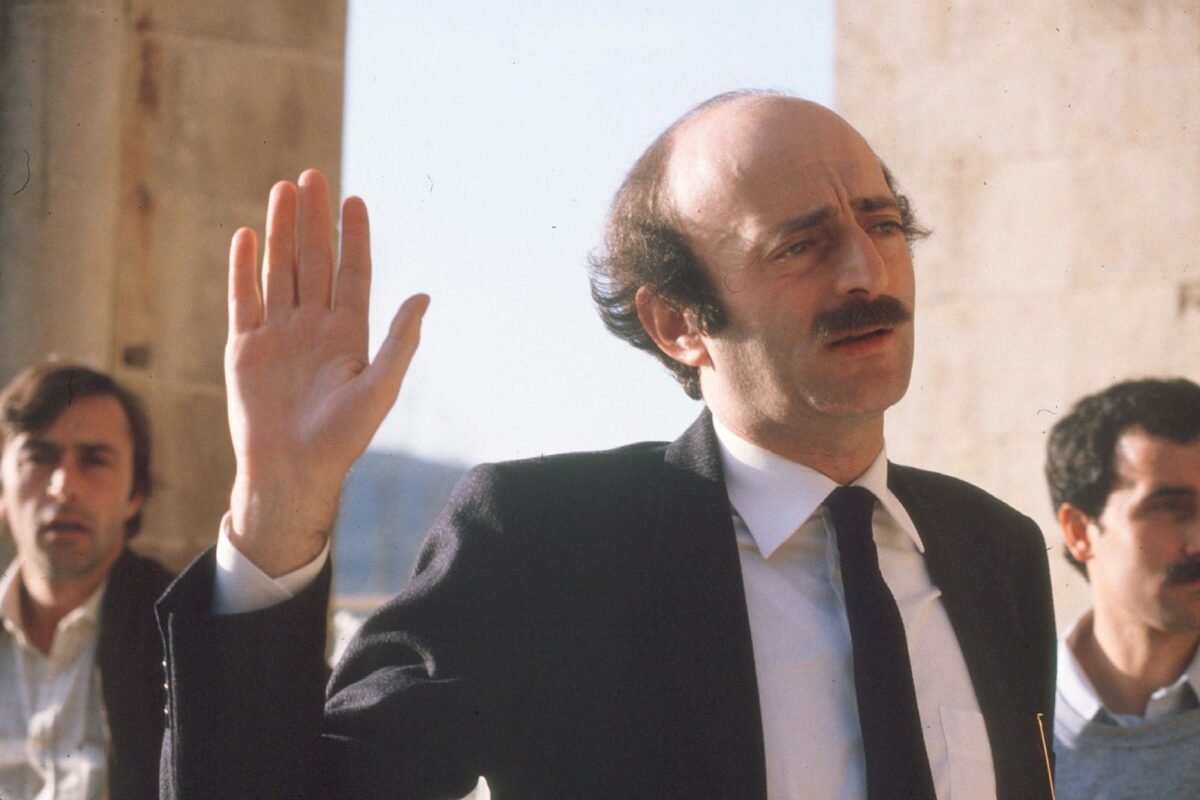
01/01/1978. Guerre au Liban. Le leader Druze Walid Joumblatt, président du Parti socialiste progressiste, à Mouktarah. FDM-702-16 (Photo by © Françoise De Mulder / Roger-Vi / Roger-Viollet via AFP)
He is right that the framework agreement gives Israel more than it gives Lebanon. But before condemning the state for accepting what it could obtain, Walid Jumblatt must answer for the choices that prevented Lebanon from negotiating from strength.
The agreement is plainly unequal. Lebanon is expected to recover security control, dismantle Hezbollah’s military infrastructure and prevent armed groups from operating, while Israel’s withdrawal remains gradual, conditional and tied to the performance of the Lebanese state. It begins with limited “pilot zones”, while important security details remain undisclosed.
Jumblatt has therefore described the framework as unilateral and imposed, criticized the omission of the 1949 Armistice Agreement and declared that peace with Israel is impossible. His diagnosis of the imbalance may be correct. But politics cannot end at diagnosis. The real question is not whether Lebanon obtained everything it deserved. It did not. The question is: what alternative did the state possess?
Was it expected to reject the framework and return to war? To demand an unconditional withdrawal it had no military or diplomatic power to impose? Or to leave the decision of war and peace once again in Hezbollah’s hands?
Lebanon did not negotiate from strength because it did not possess strength. It negotiated from the consequences of decades in which its territory, security and foreign policy were repeatedly placed in the hands of militias, external patrons and sectarian intermediaries.
The framework may not be just. It may simply be the only available path away from continued war, occupation and paralysis. Jumblatt understands this kind of politics better than almost anyone. His own career has repeatedly been defended through the same argument: there were no better options. That is why the standard he now applies to the Lebanese state must also be applied to him.
The return of the “isolationists”
In his recent Al Jazeera appearances and historical retrospective, Jumblatt returned to the vocabulary through which he has interpreted Lebanon for half a century: progressive Arabists on one side and Christian “isolationists” on the other. He even suggested that some Lebanese do not consider the south part of Lebanon.
But the contemporary Lebanese nationalist position is not that the south lies outside Lebanon. It is that the south must finally and exclusively belong to Lebanon, not to Israel, Iran, Hezbollah, the Palestinian armed struggle or any other regional project.
The Christian right’s wartime crimes (like all wartime crimes committed by everyone), militia rule, relationship with Israel and own violations of the state-first principle should not be denied. Yet national sovereignty can no longer be dismissed as a Christian obsession or an updated form of in‘izaliyya. To demand that the state alone control Lebanon’s borders, weapons, diplomacy and decisions of war is not to abandon the south. It is to reject a south that is Lebanese geographically but governed strategically from outside the constitutional order.
Jumblatt’s use of the old accusation allows him to avoid confronting how far Lebanese nationalism has expanded beyond its former Christian base. It recasts the demand for one state as sectarian suspicion and portrays opposition to permanent regional entanglement as hostility toward Arab identity, Palestine or the south.
But this is no longer 1975. The sovereignty constituency now includes Sunnis, Shia, Druze, Christians, secular citizens and former supporters of armed regional projects. The idea has outgrown the caricature.
The politics of having no choice
To judge Jumblatt fairly, one must acknowledge the conditions under which his leadership began. He inherited the Druze leadership in 1977 after the assassination of his father, amid civil war, Syrian intervention, Palestinian militarization, Israeli expansion and state collapse. Although he believed Syria had killed Kamal Jumblatt, he later accommodated Damascus, fought the Lebanese Forces in the mountain and aligned with Syria and the Palestinian movement under genuine existential pressure.
Threat narrows political time horizons. Leaders facing the possibility of massacre, displacement or communal defeat tend to prioritize immediate survival over uncertain institutional gains. Jumblatt’s willingness to retreat, reconcile and reposition probably protected the Druze from several disastrous confrontations.
But a strategy that is adaptive in an emergency can become destructive when made permanent. Every accommodation weakened the institutions that might have eliminated the need for the next one. Every alliance with a stronger external actor made the community safer temporarily while leaving the state less capable of protecting it later. Manoeuvring gradually ceased to be an emergency tactic and became a political system.
Jumblatt preserved the Druze not primarily by building institutions capable of protecting them, but by making himself indispensable to every balance of power that passed through Lebanon. He survived the civil war, Syrian tutelage, Israeli occupation, the Palestinian armed presence, Hezbollah’s rise, March 14’s decline, the Syrian revolution and Lebanon’s economic collapse. He maintained access to rival capitals and preserved Druze influence far beyond the community’s demographic weight.
That was a formidable achievement in elite brokerage. It was not state-building.
After 1990, survival was no longer enough
The strongest defence of Jumblatt applies to the war years. It becomes far weaker after 1990. The Taif Agreement offered precisely the tools through which a small community could replace militia protection and personal brokerage with institutional guarantees: administrative decentralization, a Senate representing religious communities, and a gradual reduction of political sectarianism. Jumblatt could have made their implementation the central Druze political project.
A Senate could have protected communities on existential questions. Decentralization could have given the mountain meaningful administrative and developmental autonomy without turning it into a canton. An independent judiciary, competitive elections and an impartial army could have reduced Druze dependence on Mukhtara.
Instead, Jumblatt became a central participant in the Syrian-managed postwar order. He did not merely survive it. He occupied ministries, distributed appointments, managed patronage and consolidated his authority through it. State weakness justified his brokerage, while his brokerage helped reproduce state weakness.
The 2001 reconciliation with Patriarch Nasrallah Sfeir was a genuine historical achievement. It established that Druze security did not require the permanent exclusion of Christians from the mountain, and that Christian return did not require Druze defeat. Yet even this success remained personalized. It reconciled communities through their traditional leaders rather than creating institutions capable of sustaining coexistence independently of them. Jumblatt proved that former enemies could reconcile. He did not use that achievement to build a state in which reconciliation no longer depended on him.
The missed opportunity of 2005
The Syrian withdrawal in 2005 was perhaps the greatest opportunity of Jumblatt’s career. As a central figure in the Cedar Revolution and March 14, he could have redefined “Lebanon first” as more than a Christian historical project. He could have made it a national position: Lebanon is Arab in belonging, plural in identity and sovereign in decision-making. No foreign army may rule it, no party may retain an autonomous military structure, and no external cause – however just – may decide war on behalf of the country.
Jumblatt was uniquely qualified to make that argument. He had witnessed the consequences of Palestinian arms, Syrian tutelage, Israeli occupation and militia rule. He could have drawn the obvious lesson: no cause can justify a state within the state.
Instead, March 14 remained more an alliance against Syria than a coherent project for Lebanese sovereignty. When Hezbollah demonstrated its military superiority in May 2008, Jumblatt repositioned. The calculation was understandable: his forces were outmatched, his allies could not protect the mountain, and continued confrontation risked dragging the Druze into a Sunni-Shia war.
Avoiding that war may have saved lives. But avoiding military confrontation did not require abandoning a consistent state-first position. Jumblatt could have rejected civil war while continuing to insist that Hezbollah’s weapons were exceptional, temporary and incompatible with a sovereign republic. He could have built a peaceful, cross-sectarian movement around state sovereignty rather than converting his pivotal position into another balancing act between March 8 and March 14.
His withdrawal preserved his manoeuvrability but weakened the coalition in which he had asked others to invest their hopes. The message was devastating: sovereignty could be demanded when the balance of power permitted it, but abandoned when its cost became too high. That may be survival. It is not leadership toward a state.
After 2019, there was no longer an excuse
The October 2019 uprising offered another opening, and this time the language of communal survival was no longer convincing. There was no Syrian army in Mukhtara, no Israeli advance through the Chouf and no Palestinian militia threatening the mountain. The danger was not to the Druze. It was to Lebanon’s ruling class.
The uprising challenged hereditary leadership, patronage, political immunity and the sectarian networks through which citizens were forced to seek employment, services, protection and justice. It demanded structural change after decades of corruption and institutional failure.
This was Jumblatt’s opportunity to tell the Druze that the system which may once have protected them had become the system impoverishing them. He could have transformed the Progressive Socialist Party into a genuinely democratic and social-democratic institution, opened its leadership to competition, separated communal representation from family ownership, supported judicial independence and accepted electoral uncertainty. But that required a different kind of sacrifice.
Before 1990, choosing the state may genuinely have endangered the Druze. After 2019, it primarily endangered the political machinery through which the Jumblatt family exercised power. By then, “protecting the community” had become inseparable from preserving the structure that claimed the exclusive right to represent it.
What does it mean to preserve a minority?
Jumblatt’s defenders will argue that history vindicated him because the Druze survived. If preservation means avoiding annihilation, mass displacement and catastrophic defeat, then he often succeeded. That achievement is real and should not be minimized.
But community resilience cannot be measured only by the disasters that did not happen. It must also be measured by institutions, economic opportunity, political pluralism, leadership renewal, social trust and the ability to disagree without being treated as a traitor. By those standards, the record is far less impressive.
Jumblatt preserved Druze political relevance, but did not build institutions capable of surviving his departure. He maintained access to power, but not a sustainable economic model for the mountain. He protected the community through brokerage, while leaving it dependent on the judgment, health and calculations of one political household.
The succession exposes the problem. Taymour Jumblatt inherited the presidency of the Progressive Socialist Party, but a party office is easier to inherit than political legitimacy. Walid Jumblatt’s authority was accumulated through war, fear, patronage, international relationships and nearly five decades of personal decision-making. It cannot simply be transferred through family succession. Nor can any succession establish a monopoly over Druze opinion.
The weakening of traditional parties in Chouf-Aley and the election of opposition figures reflected more than temporary dissatisfaction. Druze citizens no longer agree on who represents them, what threatens them or what their future should look like. Some continue to prioritize Arabism and confrontation with Israel. Others see Hezbollah and Iranian power as the principal danger. Some favour civic reform, while others seek a stronger Lebanese nationalism. Still others, particularly when looking toward Syria and Israel, contemplate forms of minority protection that Jumblatt rejects.
He did not create all these divisions. But he failed to create a political space in which they could be negotiated democratically. When representation is personalized, disagreement becomes betrayal. When leadership is inherited, plurality appears as fragmentation. And when one man speaks for a community for half a century, the community eventually discovers that it never developed the mechanisms required to speak for itself. This matters because the Druze are a minority.
That is neither an insult nor an invitation to isolation. It is a demographic and political reality. Refusing to name it does not make the community stronger. It prevents an honest discussion of the conditions required for its long-term survival.
Minorities do not survive securely by pretending they are not minorities. Nor do they survive indefinitely by attaching themselves to the strongest external actor, balancing among rival coalitions or preserving a permanent capacity for communal mobilization.
They survive through a political system in which being a minority is not dangerous.
That requires constitutional protection, equal citizenship, an independent judiciary, a national army, accountable institutions and a shared identity strong enough to prevent political disagreement from becoming an existential conflict among communities.
This is why Lebanon needs a Lebanese ‘asabiyya.
Not ethnic nationalism. Not Christian supremacy. Not an isolationist project that denies Lebanon’s Arab geography and history. What Lebanon needs is a shared Lebanese solidarity: a civic attachment capable of transforming coexistence from an arrangement among frightened minorities into a political society.
Lebanon contains several communal, historical and cultural identities. It contains competing understandings of its relationship with the Arab world, the West, Syria, Palestine and the wider region. Most importantly, it contains national imaginaries that have repeatedly failed to coexist: one sees Lebanon as the final political community, while another treats it as part of a wider cause whose demands may supersede the state.
The answer is not to erase these identities. It is to construct a Lebanese political identity capable of containing them. Lebanese nationalism should therefore not be understood as an ideology of purity or exclusion. It is a practical response to plurality. It is the framework through which the Druze can remain Druze, Christians can remain Christians, Muslims can remain Muslims, and all can nevertheless recognize that no external actor has a greater claim on their political loyalty than the republic in which they live. That is the form of preservation Jumblatt never fully built: not the survival of a community through the manoeuvring of its leader, but the security of a minority through the strength of a state.
The same standard for Jumblatt and the state
Jumblatt now condemns the Lebanese state for accepting an agreement shaped by weakness. His own history should be judged by the same standard. If Lebanon should have rejected the framework despite lacking the power to impose better terms, then Jumblatt must explain why he repeatedly accepted Syrian tutelage, militia exceptionalism, patronage and hereditary leadership when alternatives – however difficult – could have been built.
And if his answer is that the balance of power left him no choice, then he must extend the same understanding to the state today. Lebanon did not create the conditions from which it negotiated. It inherited a south repeatedly turned into a regional battlefield, an armed organization stronger than its institutions, and a political class that valued communal bargaining over state-building. It inherited fifty years of leaders who survived by adapting to external power rather than accumulating national power.
Walid Jumblatt was one of the most intelligent among them. He was also one of the most consequential.
I write this as a Druze scholar, a pluralist and someone who believes in Lebanese nationalism not as a right-wing ideology, but as the only way out of the mud into which our competing identities have repeatedly dragged us. Mr Jumblatt succeeded at survival. He succeeded, perhaps too well, at making himself the indispensable mediator through whom the Druze relationship with Lebanon and the region had to pass. But he failed to convert survival into statehood.
He did not build the institutions that would make his manoeuvring unnecessary. He did not create a democratic political inheritance. And he left behind a community increasingly divided over the meaning of its security, identity and future.
History is not evidence that his method worked. It is evidence that it postponed the question.
His rejection of the framework is therefore not a sufficient political position. Not because Israel should be trusted, or because the agreement is balanced, but because Jumblatt offers no viable alternative while condemning the state for lacking the power that his own politics did little to build.
He no longer speaks for me. Nor does he speak for many Druze who refuse to tie their future to hereditary leadership, regional manoeuvring or permanent fear of the other.
We are free Lebanese. We believe in a society built through plurality but held together by common political belonging. Coexistence requires a distinctly Lebanese national solidarity, one capable of protecting difference without turning difference into separate sovereignty.
Walid Jumblatt spent fifty years positioning himself in the middle so that no victorious side could eliminate him. This time, he stands between a state with no better option and an armed project with no national solution. He is no longer at the centre of Lebanese politics. He is in the middle of nowhere.
Ramzi Abou Ismail is a Political Psychologist, Researcher and Analyst.
The views in this story reflect those of the author alone and do not necessarily reflect the beliefs of NOW.