Washington, United States
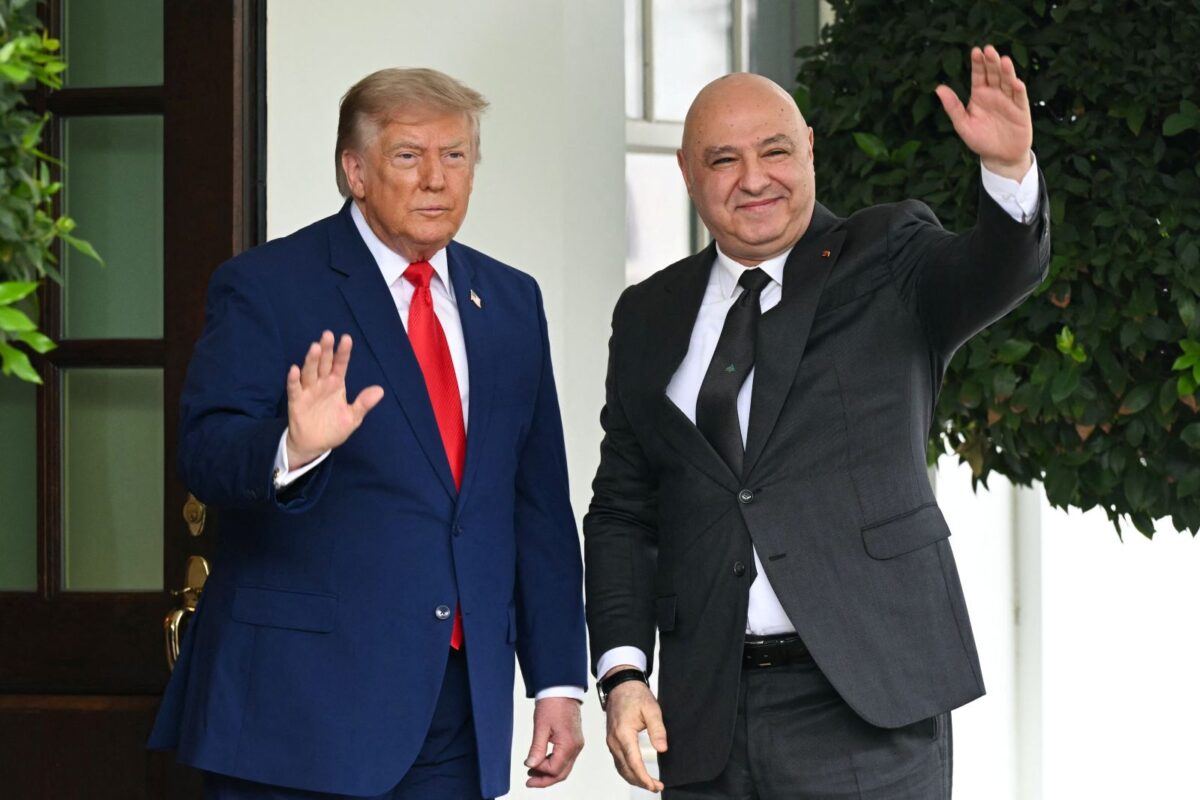
US President Donald Trump greets Lebanese President Joseph Aoun at the entrance to the West Wing of the White House in Washington, DC, on July 21, 2026. (Photo by SAUL LOEB / AFP)
Yesterday’s Oval Office meeting between President Donald Trump and President Joseph Aoun was about much more than diplomatic protocol. It was a public test of Lebanon’s leadership—and more importantly, a public commitment by that leadership that the world will now expect it to honor.
Most headlines focused on Trump’s announcement that direct commercial flights between the United States and Lebanon will resume after more than four decades. For millions of Lebanese and Lebanese-Americans, this is welcome news. It signals confidence in Lebanon’s future and promises to reconnect a country whose greatest resource has long been its diaspora.
But airplanes do not fly on optimism. They fly when security permits them to.
But airplanes do not fly on optimism. They fly when security permits them to.
The return of direct flights will ultimately depend not on presidential declarations, but on whether Lebanon succeeds in establishing genuine sovereignty over its own territory. That requires one army, one chain of command, and one authority over weapons. In other words, it requires the implementation—not merely the discussion—of Hezbollah’s disarmament.
The Oval Office meeting was significant for another reason that received far less attention.
President Trump publicly spoke positively about Parliament Speaker Nabih Berri, describing him as an important statesman, while President Aoun reaffirmed his confidence that Lebanese Armed Forces Commander General Rodolphe Haikal would carry out the mission entrusted to him.
These were not casual remarks. They placed both men squarely under the international spotlight.
For years, Berri has positioned himself as the indispensable intermediary between Hezbollah and the Lebanese state. General Haikal, meanwhile, now commands the institution that will ultimately be responsible for extending the state’s exclusive military authority across all Lebanese territory.
Whether fairly or unfairly, both men have also become associated with the slow pace of implementing that objective. The international community has repeatedly heard promises about state sovereignty. It now expects results.
President Aoun’s public endorsement of General Haikal carries particular weight because it is, in many respects, a personal guarantee. As the former commander of the Lebanese Armed Forces himself, Aoun knows exactly what the institution is capable of accomplishing—and what excuses no longer hold.
President Aoun’s public endorsement of General Haikal carries particular weight because it is, in many respects, a personal guarantee. As the former commander of the Lebanese Armed Forces himself, Aoun knows exactly what the institution is capable of accomplishing—and what excuses no longer hold.
If the commander has been entrusted with implementing the state’s decisions, then he must be allowed to do so without political interference, sectarian calculations, or competing centers of authority. The same applies to Nabih Berri.
If he wishes to remain one of Lebanon’s principal statesmen, then statesmanship today requires more than mediation between competing factions. It requires publicly embracing the principle that the Lebanese state alone possesses the legitimate monopoly over force. There is no longer room for strategic ambiguity.
Supporting state sovereignty cannot coexist indefinitely with protecting an armed organization that operates outside the state’s constitutional framework.
The political landscape has fundamentally changed.
Hezbollah today is not the military organization it was even a few years ago. Regional dynamics have shifted dramatically. International patience has diminished. Lebanon’s economic collapse has made the cost of maintaining parallel institutions unbearable.
The question is therefore no longer whether implementation will occur .The question is who intends to participate in that implementation—and who intends to obstruct it. Those choices will define Lebanon’s next political era.
The question is therefore no longer whether implementation will occur .The question is who intends to participate in that implementation—and who intends to obstruct it. Those choices will define Lebanon’s next political era.
This is why yesterday’s meeting matters.
Washington did not simply offer Lebanon political support. It implicitly accepted President Aoun’s promise that the Lebanese state is capable of asserting itself.
That promise now belongs to the entire political class.
Every institution will be measured against it.
Every security agency will be judged by it.
Every political leader will eventually have to answer a simple question: do they support the exclusive authority of the Lebanese state, or do they continue to accommodate an armed structure that exists beyond it?
For too long, Lebanon has survived on declarations, dialogue, and carefully crafted ambiguity. Yesterday changed the equation.
The commitments made in Washington transformed political aspirations into measurable expectations.
Direct flights may become the most visible symbol of renewed confidence in Lebanon. But they will also become the easiest way to judge whether that confidence was justified.
Because the future of Lebanon will not be determined by what was said inside the Oval Office. It will be determined by what happens next in Beirut.