Hezbollah did not stage a coup. It did not need to. The Lebanese state is dissolving itself into Hezbollah, instead of dissolving Hezbollah. On Tuesday, the cabinet’s own defense minister proved it.
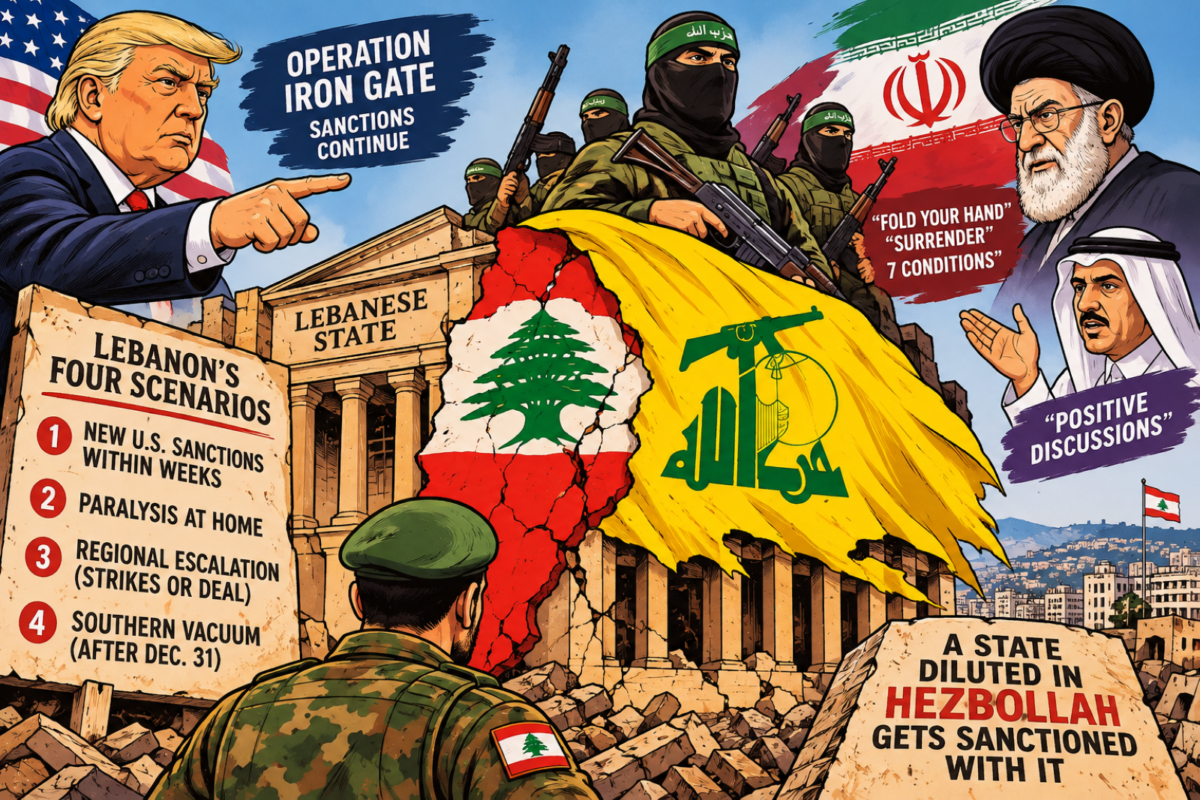
Three statements followed Monday’s Qatari meeting in Washington. Iran’s Rezaei told the US to “fold your hand” and “surrender” to Iran’s seven conditions. Qatar’s prime minister spoke of “positive discussions” on a deal. Trump said the blockade continues under “Operation Iron Gate,” on land and sea, that Gulf states prefer the status quo, and that America is “locked and loaded,” though he called that unlikely. No deal soon, no war yet, and a long squeeze. Pressure in a squeeze flows to the weakest link. That is Lebanon.
No deal soon, no war yet, and a long squeeze. Pressure in a squeeze flows to the weakest link. That is Lebanon.
On May 21 Washington sanctioned nine people, including a General Security brigadier general and a Military Intelligence colonel accused of passing intelligence to Hezbollah. Reports now describe a longer list: judges, officers and politicians, with whispers of names near the three presidencies.
Then came Detroit. Lebanon’s consul general, Ibrahim Charara, was declared persona non grata over 2021 posts praising the 1983 Marine barracks bombing. His aides say the account was hacked. The State Department said it will “never forget” the victims.
For Washington, Hezbollah is not only Iran’s proxy. It is the group blamed for the deaths of 241 Marines. A deal with Tehran can reshape the Iran file. It cannot close that one.
That word is the message. For Washington, Hezbollah is not only Iran’s proxy. It is the group blamed for the deaths of 241 Marines. A deal with Tehran can reshape the Iran file. It cannot close that one.
Hezbollah is back on its feet, reportedly rebuilding with Iranian money. The state chose no confrontation. Let Israel finish the job was the unspoken policy. Hezbollah reads through the regime’s book and eyes: Netanyahu “leaving”, Trump “weakened”, the mullahs “winning”. All premature. But perception moves Lebanon faster than facts.
On Friday, army commander Rodolphe Haykal told his officers that Israel is “the first threat” and that critics act against “national belonging.” Hezbollah’s weapons did not appear in the reported remarks. On Tuesday, Defense Minister Michel Menassa backed him, and hit his own government. The cabinet’s powers, he said, are limited to general defense and security policy, and do not include issuing orders, which belong exclusively to the army command.
The army adheres to the political decision, “but” its grave national responsibility is the supreme priority: any decision must protect the army’s capabilities and morale, preserve the unity of its people and prevent any sedition that a step taken “under any pressure” might cause. Read that “but” slowly. Obey, unless obeying is dangerous, and the army decides what is dangerous.
Now the law. Article 65 of the constitution says executive authority is vested in the Council of Ministers, “the authority to which the armed forces are subject,” and that it supervises military and security institutions “without exception.” The minister did not interpret the constitution. He inverted it. Disarming Hezbollah is the step the army can now call sedition.
A state that dilutes Hezbollah disarms it. A state diluted in Hezbollah gets sanctioned with it.
A state that dilutes Hezbollah disarms it. A state diluted in Hezbollah gets sanctioned with it.
Lebanon faces four scenarios. The nearest is a new US sanctions round within weeks, reaching judges, officers and politicians. Next is paralysis at home: the disarmament decision stays on paper because the army treats its orders as optional. Then comes the region, either renewed strikes on Iran that drag Hezbollah in, or a US-Iran arrangement that freezes Lebanon with Hezbollah armed. Last, a southern vacuum once UNIFIL leaves on December 31. Help from Congress is not on the list. It will fight Trump over Iran and Israel, not for Lebanon.
Everyone is busy with their own mess, and that is exactly when a small country gets sold. Menassa asked the Lebanese not to be “a dagger in the army’s back.” Fair. But the dagger is already in the state’s back, and nobody in Beirut will say whose hand is on it.
Elissa E Hachem is a journalist and political writer specializing in regional affairs and governance. Former Regional Media Advisor at the U.S. State Department’s Arabic Regional Media Hub, with broad experience in strategic communication across government and private sectors.
The views in this story reflect those of the author alone and do not necessarily reflect the beliefs of NOW.