Rural identity has constituted a pillar of Lebanon’s national narrative since the formation of the State of Greater Lebanon in 1920. Traditional historiography grounded this narrative in the mountain, treated as the country’s historical backbone, later extended to Akkar, the Beqaa, and Jabal Amel, regions rural in their own right, while urban history occupied a marginal place. The result is a national self-perception in which rural identity permeates Lebanon’s cultural landscape, its music, and the way many Lebanese understand themselves.
In recent years, this self-perception has taken a specific and increasingly visible form: the “Rural Nostalgia” trend, circulating across social media and television, which claims that earlier generations lived a purer, more “natural” life in rural Lebanon. Favoring romanticized depictions of farming life and food imagery, this trend remains disconnected from rural space itself, sidelining the challenges rural life posed for centuries. Tourism advertising and identity politics have made heavy use of it, amplifying its reach well beyond the cultural sphere. At its core, the trend functions as an urban phenomenon: a vision constructed by city dwellers who never worked the land, projecting an imagined rural past onto the present. Does the image behind this trend belong to fact, or to fiction?
The historical record offers a counterpoint to this imagined past. Among the primary sources that complicate it stands a vernacular poem (zajaliyya) composed around 1791 by an unnamed peasant from the Dayr al-Qamar region, collected by historian Issa Iskandar al-Ma’luf and published in al-Mashriq (Beirut, 1920). The document represents a rare case of authorship: a peasant, himself literate, recording directly the hardships of rural existence. Together with the Rukayni chronicles from the same period in Jabal Amel, treated in an earlier article, this poem offers one of the few moments in Lebanese historiography where the eighteenth-century peasant voice speaks for itself.
The farmer composed these verses to lament a series of catastrophes that struck him, his family, and the mountain’s society around 1791, writing under the early, turbulent years of Emir Bashir II Shihab’s rule. His testimony offers a wealth of information on what happened when the fragile balance of rural life broke down, exposing the precariousness underlying agrarian existence more broadly. The verses selected below address one dimension of this precariousness: famine in rural space.
“…Black days like pitch
and our provisions ran out early
Had it not been for chicory and watercress,
we would have ended up in Arwad…”
(Translated from the original Vernacular Lebanese Arabic by the author)
Famine recurred as a feature of rural life in this region, echoing a pattern common to most agrarian societies before the advent of modern agriculture. Subsistence farming remained vulnerable to environmental shocks and political disruption alike, and this verse captures that vulnerability at its most severe. The image of “days black like pitch” conveys the weight of this crisis, while the reference to depleted mouneh, the traditional winter provisions prepared between August and November, marks the collapse of the household’s basic food security.
The mouneh referenced here differed considerably from the version now celebrated as emblematic of Lebanese rural tradition, and it is precisely this version that content on rural nostalgia relies upon most heavily. For example, sugar and tomatoes, staples of several modern mouneh recipes, only became widely available at the beginning of the twentieth century, placing them beyond the reach or knowledge of an eighteenth-century peasant household. The mouneh of this earlier period consisted instead of grain, burghul, flour, pickled products, some dairy, olive oil, vinegar, and other basic foodstuffs, a far narrower repertoire than the elaborate preserves popularly associated with the tradition today. The mention of chicory and watercress points instead to foraging, an older agrarian skill requiring intimate familiarity with wild plants and their dietary uses, and marking a survival strategy far removed from the pantry imagery nostalgia now projects onto the past.
The reference to Arwad carries similar historical weight. The city-island off the coast of Tartus served Ottoman authorities as a place of exile. For a rural public, Arwad meant the farthest place imaginable, a metaphor the peasant uses to convey the depth of his family’s desperation. The poem continues:
“…My wife’s name was Zad al-Khayr
the year she gave birth, goodness vanished.
From need, we grew gaunt,
our hands bound helpless.
And when hardship closed in on us,
we said: let us go to another land
We said, what about the land of Batroun
tell me, how might it be there
They said, no doubt
you’ve gone mad
there’s nothing there but
goats and manure…”
(Translated from the original Vernacular Lebanese Arabic by the author)
Here the farmer laments the burden of another mouth to feed. His wordplay turns on his wife’s name, Zad al-Khayr (“Abundance of Goodness”): the year she gave birth, goodness itself vanished. High birth rates were a demographic necessity in this context, driven by high child mortality and the constant need for labor to work the land. In times of crisis, however, this same imperative became a burden: a large agrarian family had to be fed even when the harvest failed. Malnutrition was a constant condition of rural life, far removed from the romantic imagery of rural self-sufficiency, and scarcity pushed families toward mobility as a survival strategy. Peasants often left their villages in search of better opportunities elsewhere.
This mobility is largely absent from the traditional narrative, a silence that serves to reinforce notions of sectarian purity within Lebanon’s rural areas. The historical record tells a different story. The verse referencing Batroun documents a northward movement from the Shuf toward the Batroun district in search of food, a movement that yielded little relief: Batroun ranked among the poorest agrarian regions of the period, and the poem describes it as offering nothing but goats and manure. A longer list of place-names in the full text, spanning both rural and urban locations, confirms that famine and need extended across the region.
Child mortality figures as another defining feature of this world, and also absent from the romanticized narrative of rural life. The farmer recounts:
“…My daughter Marjan died
and the next day, my son Radwan
We buried them without shrouds,
and my wife (Zad al-Khayr…)
followed after them…”
(Translated from the original Vernacular Lebanese Arabic by the author)
Child mortality in the eighteenth-century rural world remained high, with a substantial number of children dying before the age of five, driven by recurring plagues, smallpox, malaria, and waterborne illnesses tied to poor sanitation, itself a defining feature of village life. Urban centers benefited from state-secured food supplies and access to physicians. The countryside, by contrast, relied almost exclusively on folk medicine and local midwives, whose interventions often did more harm than good. Rural women responded to this immense loss by maintaining high fertility rates, averaging six to seven births each, and by relying on prolonged breastfeeding, a practice that came at devastating cost to women’s own health.
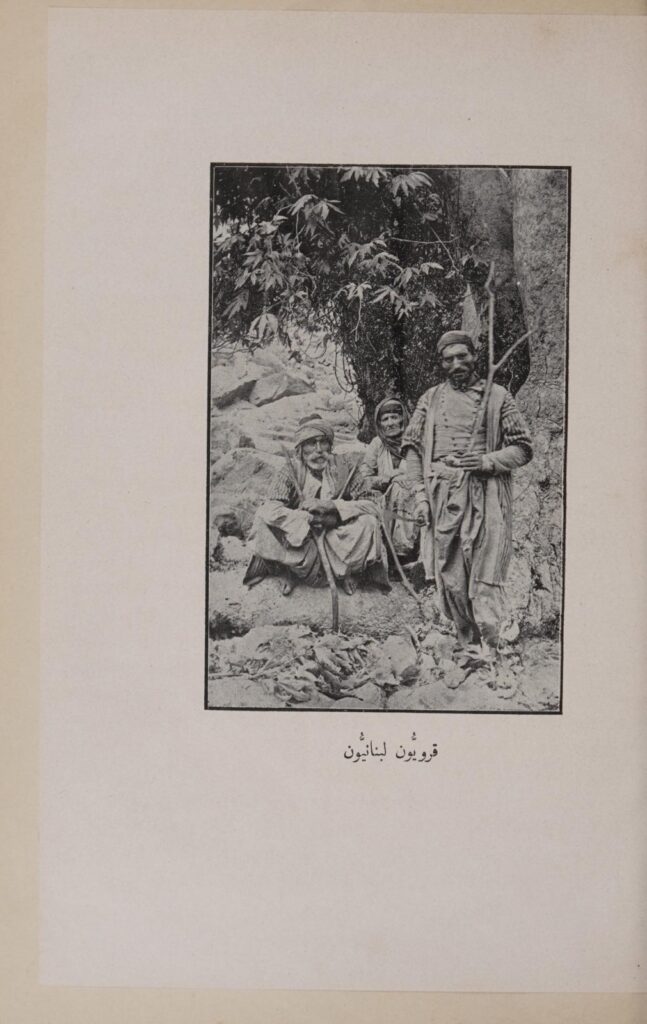
Photograph of Lebanese villagers, Mount Lebanon Mutasarrifiyya period. From Ismail Haqqi Bey, Lubnan: Mabahith ‘Ilmiyya wa Ijtima’iyya (1918).
Institutional sources corroborate this picture from a different vantage point. Bayard Dodge, American scholar and third president of the American University of Beirut (1923–1948), wrote down observations of Near Eastern rural life in “Renaissance of the Middle East: Part 3,” in the section “Peasant Life: The Land and Its Problems” (Bayard Dodge Collection, AUB Archives and Special Collections). His account carries particular weight in dating to the formative period of the post-Ottoman Near East, the 1920s and 1930s, when nation-states were being formed under the French Mandate for Lebanon and Syria. The agrarian relations Dodge describes were themselves in transition during this period, caught between older legal codes and a changing economic context.
Land ownership among peasants remained the exception rather than the rule throughout this period. Earlier, the Ottoman Land Code of 1858 formalized individual title, yet few peasants ever came to possess landholdings large enough to sustain significant production, and this pattern persisted well into the Mandate period. Sharecropping prevailed instead, particularly across the most fertile agrarian land, the coastal and interior plains, where a large share of the peasantry worked land they did not own. On the mechanics of sharecropping, Dodge writes:
“…Share-cropper has the right to leave his land, but the landlord usually binds him by debts, so that he cannot go. Owners often borrow from the banks, so as to loan money to peasants and thus get them under their control. Share-cropper own movable furniture in his house, animals, clothing, but nothing else…”
This passage also identifies debt as the mechanism binding peasants to land. Dodge’s observation that banks lent to landlords, who in turn lent to peasants, describes a credit chain in which formal financial institutions reinforced older patterns of agrarian dependency rather than dissolving them. The peasant’s property, limited to furniture, animals, and clothing, marks the ceiling of accumulation available within this system: capital in land and its yield remained permanently out of reach.
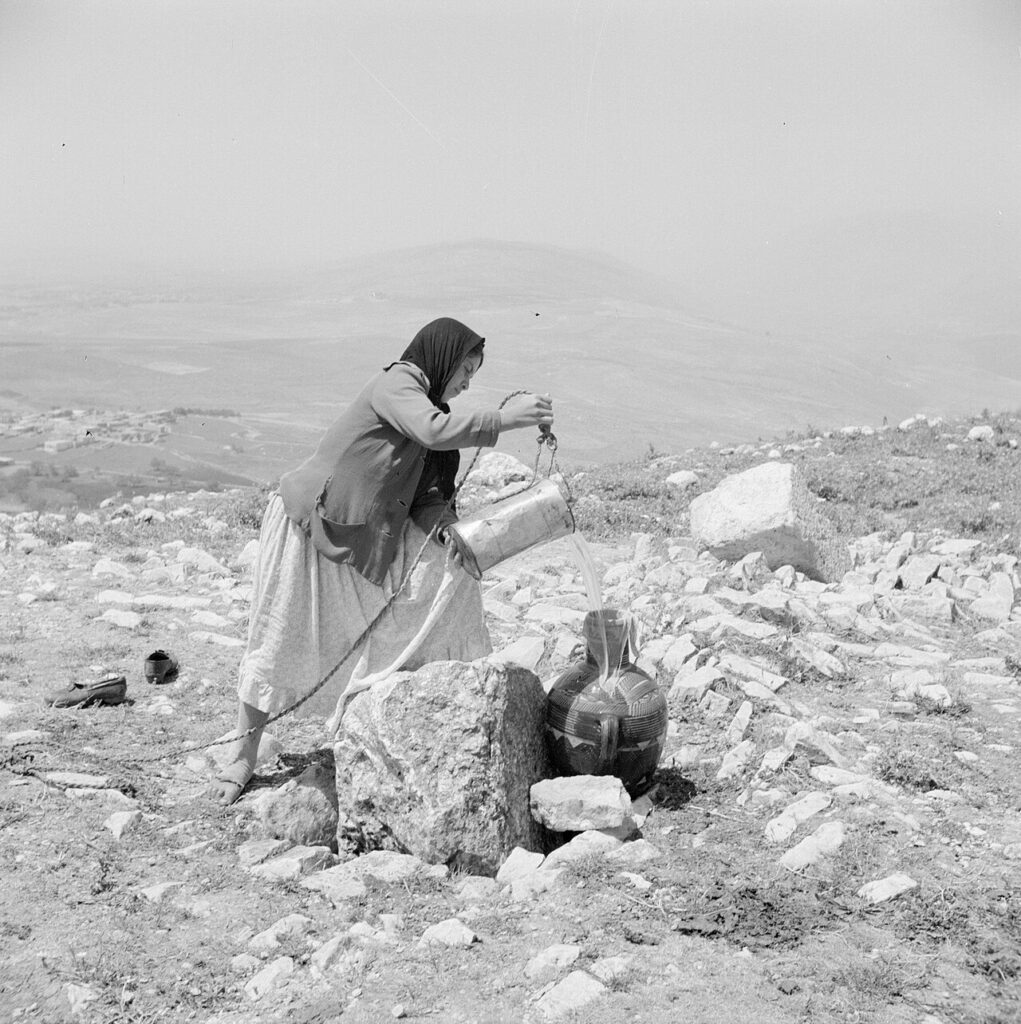
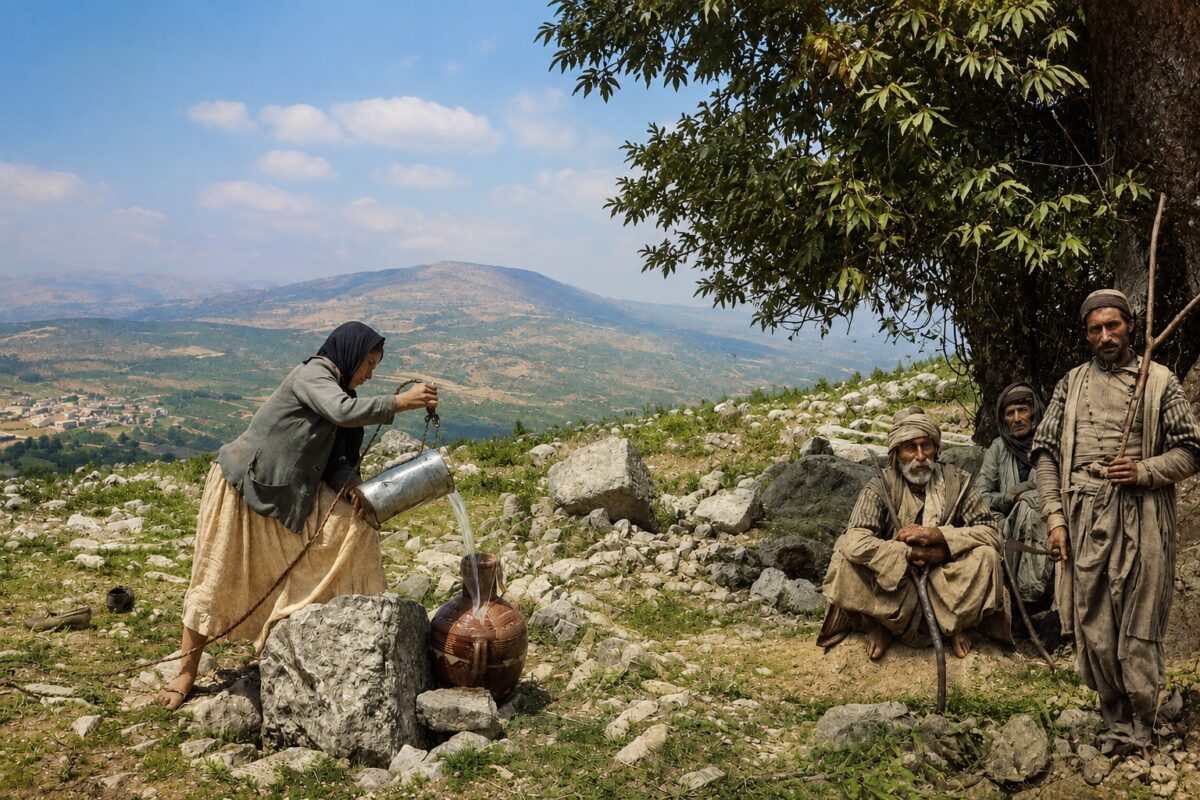
Woman fetching water from a well, Arnoun, South Lebanon, 1050, Van De Poll Collection, Dutch National Archives
This system of servitude through debt, compounded by the peasant’s exclusion from land ownership, finds little place in the romanticized image of rural life. Equally absent from that image stands the figure of the wakil, the landlord’s agent, who exercised oppressive authority on the owner’s behalf and added a further layer of hardship to already difficult conditions. On the role of the agent, Dodge continues:
“…Landlords disdain manual labor and usually live in towns. They use money for bettering their conditions in the city, rather than for the improvement of their farms. Usually, the absentee landlord appoints a wakil, whose one idea is to squeeze the peasants. Good work on the part of the peasant usually means paying more to the landlord and the government….”
This passage locates the extraction of surplus within a specific social geography: capital generated in the countryside flowed toward urban consumption, while the wakil served as the mechanism translating absentee ownership into daily coercion on the ground. Dodge’s phrase “good work… means paying more” identifies a perverse incentive at the heart of the system, in which increased productivity exposes the peasant to greater cost rather than greater reward. Dodge’s additional observation addresses the consequences of this system for agricultural dynamism:
“…Laziness is rewarded by leniency, as the landlord does not want the tenant to leave land idle. Intelligent work on the part of the peasant goes unrewarded, and the peasant becomes a fatalist (this is not true in gardens and homesteads). The peasant provides for his family needs; extra products must go to the landlord, or else are sold through some local dealer. The peasant has no interest in export or wider markets…”
Here Dodge offers something close to an economic diagnosis: a system that rewards idleness and produces fatalism as a response. Dodge’s parenthetical exception for gardens and homesteads sharpens the point further: where peasants retained direct control over yield, productivity followed. The absence of any peasant orientation toward export markets appears, in this light, as the predictable output of a system engineered around local extraction.
This “Rural Nostalgia” offers little institutional support capable of strengthening agriculture’s place in the Lebanese economy or slowing the drain of villages toward the cities. It offers instead a seasonal, limited encounter, in which peasants play prefabricated roles for urban dwellers, diaspora visitors, and, diminished in recent years, but present still, tourists.
The zajaliyya and Dodge’s account represent two entries within a much larger body of testimony offering a fuller and more textured understanding of rural life across several centuries.
Against this record, the contemporary image of rural life reveals itself as a construction. It draws less on the historical record than on a lost sense of belonging, compensated by the fabrication of what might be called fictional heritage. A peasant from what is now Lebanon, invited to a dinner in 2026, would find most of what is served unfamiliar, foreign sometimes in origin, or beyond his means in his own lifetime.
This “Rural Nostalgia” offers little institutional support capable of strengthening agriculture’s place in the Lebanese economy or slowing the drain of villages toward the cities. It offers instead a seasonal, limited encounter, in which peasants play prefabricated roles for urban dwellers, diaspora visitors, and, diminished in recent years, but present still, tourists. These roles cast peasant life as simple, static, and continuous with an unchanging ancestral past. Nostalgia, in this framing, hardens into mania.
Between the village that is imagined and the village the sources describe lies a silenced gap, and the evidence assembled here offers a more complex image of what that gap contains. A culture that builds its future on a fictional past risks losing the very heritage it claims to protect.
The rural mania stands, in the end, as a symptom of crisis: a misreading of heritage that mistakes the past for a guide to the future. The lifestyle and cuisine it celebrates are themselves recent constructs, products of a modernity dating no earlier than the mid-twentieth century, born alongside urban food ways and rising living standards rather than in opposition to them. This trend, in turn, contributes to the erosion of authentic ancestral knowledge and foodways, recast to serve culinary trends circulating on social media at the expense of a far more diverse and genuinely rural cuisine. It sidelines, too, the generational skills a farmer must acquire to read the land, the climate, the seasons, and the demands of animal husbandry, skills silenced by a constructed image that romanticizes rural life rather than respects it.
Between the village that is imagined and the village the sources describe lies a silenced gap, and the evidence assembled here offers a more complex image of what that gap contains. A culture that builds its future on a fictional past risks losing the very heritage it claims to protect.
Charles al-Hayek is a public historian and the founder of Heritage and Roots.
The views in this story reflect those of the author alone and do not necessarily reflect the beliefs of NOW.