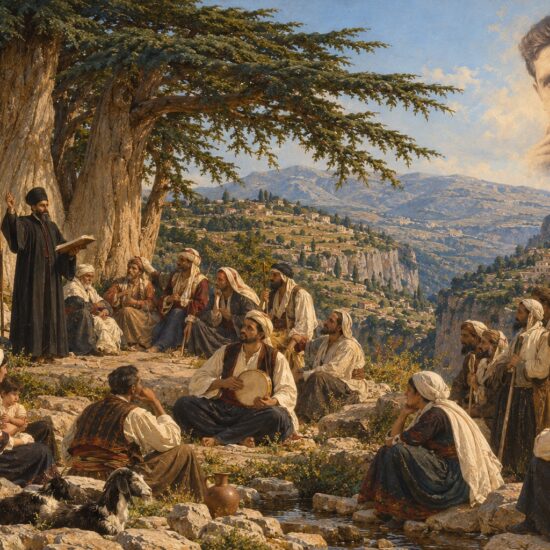
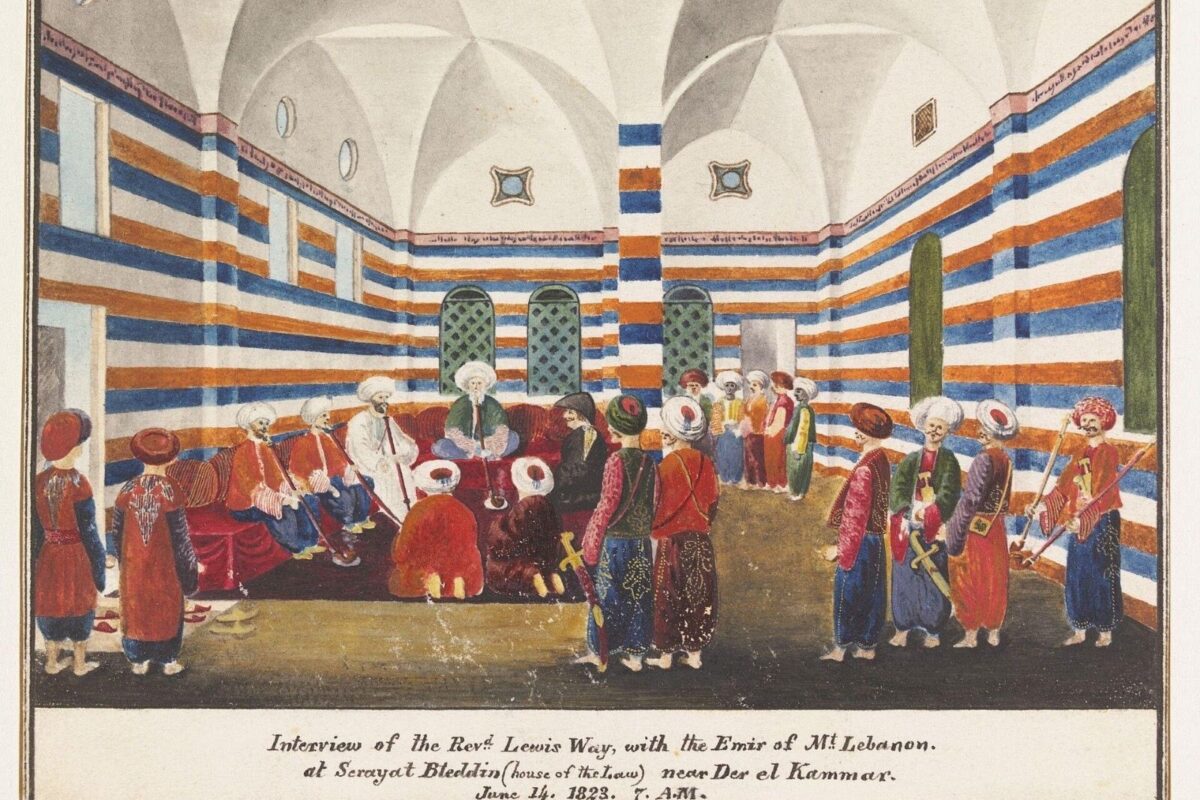
Interview of the Revd. Lewis Way with the Emir of Mt. Lebanon, 1823, V&A Museum Collections
Few questions in Lebanon’s social memory generate as much heated, and often uninformed, debate as the religious identity of the emirs who once ruled Mount Lebanon. In contemporary public discourse, and on social media in particular, the dynasties are regularly claimed, in turn, as Sunni, Druze, or Maronite, each community reading its own confessional narrative back onto a history that was, in fact, considerably more layered.
To move beyond such claims, the historian must pose a different set of questions: Which dynasties are under discussion? What primary sources document their history, and what do those sources actually say? When, and under what circumstances, did conversions take place? And what does this reveal about Lebanese history more broadly?
Beyond oral tradition preserved within the families themselves, and private archives that remain largely unstudied where they survive at all, four primary sources anchor any serious inquiry into this question. One of the earliest is Nasif al-Yaziji’s Risala Tarikhiyya fi Ahwal Jabal Lubnan al-Iqta’i (around 1833), by Charles Henry Churchill’s Mount Lebanon: A Ten Years’ Residence, from 1842 to 1852 (1853), then by Tannus al-Shidyaq’s Akhbar al-A’yan fi Jabal Lubnan (1859), and finally by the memoirs of Rustum Baz (1897).
These authors served as secretaries and scribes and private secretaries of the Shihabi emirs; Churchill, for his part, was a British officer who spent ten years resident in Mount Lebanon and left one of the most detailed outside accounts of its society. The local sources, in particular, were composed as the iqta’ system itself was cracking apart or had already collapsed, in part, it seems, as a last attempt by its chroniclers to justify the existence and legitimacy of an authority that was slipping away. This context matters: these are not neutral administrative records, but documents written from within, or immediately alongside, a system at the moment of its unraveling.
Two major houses experienced religious conversion in this period. The Shihab, originally Sunni Muslim, split into two branches: one remained Sunni, the other became Maronite. The Abi al-Lama’, originally Druze, converted to Maronite Christianity as a family, their Druze branch eventually dying out. Al-Yaziji documents this composition directly in his treatise on the iqta’ system of Mount Lebanon, where he reports the religious makeup of these lineages as follows:
“…The other two became Christian through conversion: the Shihab family converted from Islam, while the Abi al-Lama’ family converted from the Druze faith…” (p. 30)
It is worth noting that, in the local chronicles of the period, “Islam” referred to what we today call Sunni Islam, while Twelver Shiites were identified by the local name Matawila, and Christians as Nasara.
Al-Shidyaq’s Akhbar al-A’yan documents this process of conversion in detail. In the section on the genealogy of prominent Maronite princes and sheikhs, he records the death of Emir ‘Ali Haydar Shihab in Wadi Shahrur in 1811, at the age of ninety, buried as a Maronite in Kfarshima. Al-Shidyaq calls him “the first member of the Shihab family to embrace Christianity.” (p. 51)
Elsewhere, in the chapter devoted to the wilaya (the governorship) of the Shihabi emirs, al-Shidyaq gives the precise circumstances of that conversion: in 1754, the Maronite priest Mikhail Fadil of Beirut converted Emir ‘Ali Haydar to Christianity. The conversion did not stop with him. Among the sons of Emir Mulhim, Emir Qasim, Emir Sayyid Ahmad, and Emir Haydar, also embraced Christianity, and they were followed by the majority of the Shihab emirs, and subsequently by the Abi al-Lama’ emirs as well. (p. 322) A decade later, in 1764, Patriarch Yusuf Istifan personally converted Emir Qasim ‘Umar to the Maronite faith. (p. 327)
Additional evidence for this layered picture comes from the memoirs of Rustum Baz, private secretary to Emir Bashir II, who records of the Shihab conversions: “It wasn’t long before Prince Qasim and his sons converted to Christianity.” (p. 3)
What the sources make clear is that conversion never produced a single, uniform confessional identity for either house. Generations later, the descendants of the celebrated Emir Bashir II illustrate just how far religious plurality persisted within the very same family. Writing on the deaths of the emirs in exile, Al-Shidyaq records:
“In 1850, Emir Khalil Bashir died in Istanbul at the age of sixty-one and was buried there. He was survived by four sons: Emir Mahmud, Emir Sa’id, Emir Mas’ud, and Emir Sa’d….In the same year, his brother, Emir Amin, died in Istanbul as a Muslim, leaving no offspring…” (p. 53)
Khalil died a Maronite Christian in exile, while Amin had converted to Islam. Rustum Baz also reports the death of Emir Bashir II in exile in 1851, describing the delicate negotiations his household had to conduct with the Armenian Catholic Church over the funeral rites, since there was no Maronite church in Istanbul:
“…The Maronites are subject to the Latins in all their religious affairs, and until now they have not buried either their relatives or their notable men without the presence of the Patriarch’s representative or a priest.”
Rustum Baz then describes the funeral itself:
“1851. The funeral service and burial lasted two hours. They brought two master stonemasons and three laborers, who prepared the burial site. The church floor was paved with polished white marble…They remarked that, since his conquest of Istanbul, no Christian had been buried with such magnificence.”
If the Shihab case shows conversion unfolding within a single family across generations, the Abi al-Lama’ also illustrates this act of conversion. This Druze dynasty, having converted to Maronite Christianity as of 1754, went on to lead the newly created Christian caimaqamate, established after the dissolution of the emirate in 1842. One of history’s more striking turns is that several of its caimaqams carried names more readily associated with Muslim naming conventions, even as they represented the emerging political power of the mountain’s Christian community: Haydar Abi-Lama’ (1843–1854), followed by Bashir Ahmad Abi-Lama’ (1854–1859), and finally Hassan Abi-Lama’ (1859–1860).
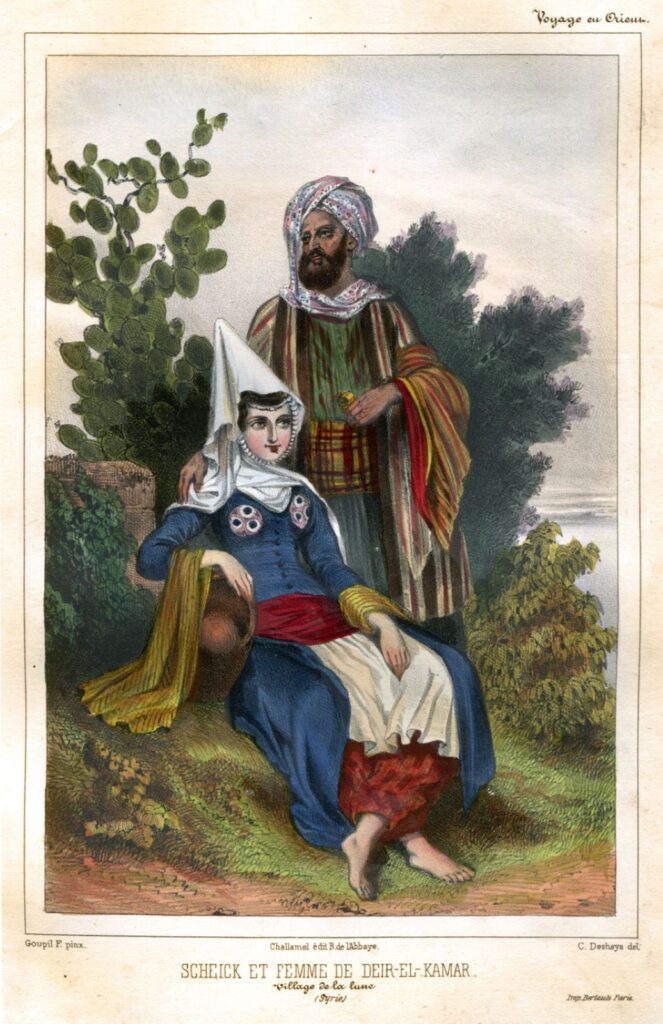
Sheikh and his wife from Deir el-Qamar, Goupil-fesquet Frederic Auguste Antoine, 1843
A further, and important, perspective on the motives behind the conversion comes from the testimony of Charles Henry Churchill, who spent ten years in Mount Lebanon and recorded crucial information for reconstructing this history. In his account, Churchill writes of the Abi al-Lama’:
“…They were until very lately, Druses. But when the House of Shehaab, from political reasons, chose to abandon the faith of their ancestors, with that facility of conversion for which they are remarkable,* and embrace Christianity, the House of Bilemma, with whom they intermarried, followed in their steps, at no considerable distance. One old lady of the family, however, still delights in the mysterious doctrines of Hamza, and declares she will be buried in the faith in which she was brought up. Her obstinacy may be lamented, but at least, it has the redeeming quality of sincerity; whereas the Roman Catholicism of her relations, has too evidently not penetrated beyond the external demeanour of its professors…” (p. 100)
In a footnote that illustrates the dynamic, and not always final, character of these conversions, he adds:
“*Several of the Shehaab Emirs have lately returned to the Mahommedan faith.”
The old lady Churchill mentions is al-Sitt Zihr, who is still revered to this day in a maqam in Salima by the Druze community. With her death, the Druze branch of the Abi al-Lama’ died out, and only the Maronite branch survives to the present.
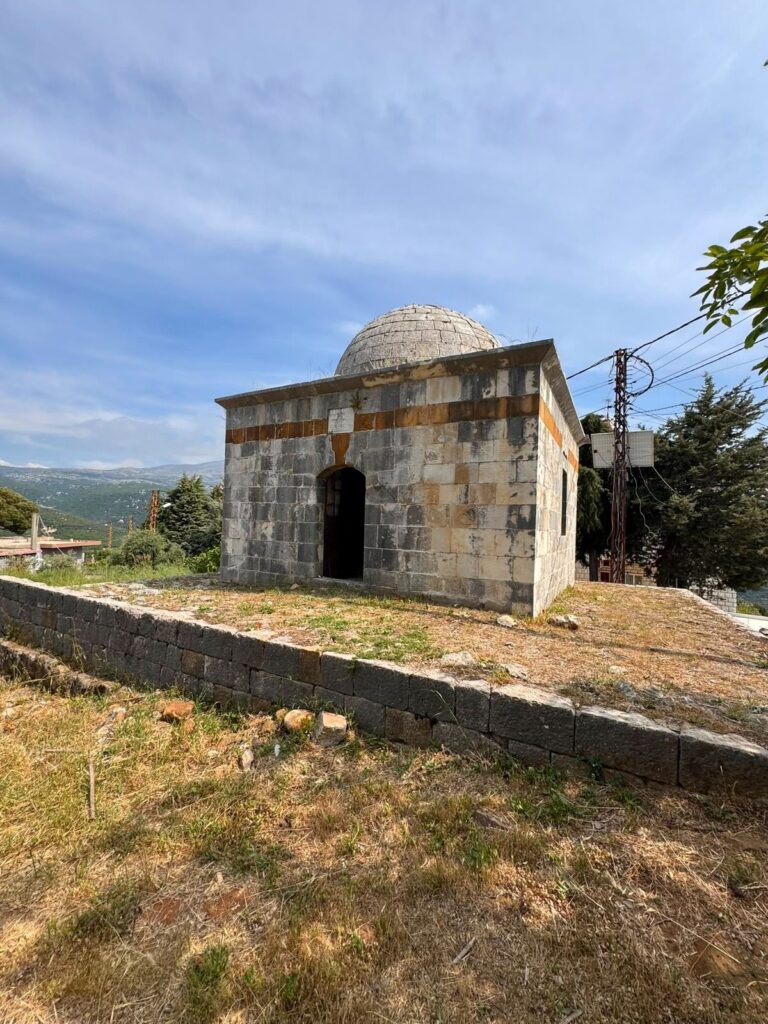
Abi al-Lama’ mausoleum of al-Mtein, picture by the author
Among the many material traces of this layered history, two monuments stand as particularly telling testimony. The first is the mausoleum of al-Mtein, a unique monument in several respects. It was built in 1648 by the muqaddam (a local highland leader) Alam al-Din Abi al-Lama’, in his capacity as governor of the nahiya of al-Matn. The structure reflects Ottoman artistic and cultural influence in Mount Lebanon, and it was used by both Druze and Maronite members of the dynasty until 1871.
The second is the qubba (dome-shrine) in Ghazir, originally built for the Turkmen Assaf dynasty. It was later reused by both the Sunni and Maronite branches of the Shihab family, and it is there that President Fouad Chehab is buried.
Read together, these entries resist any single confessional claim on either dynasty. Conversion within the Shihab and Abi al-Lama’ houses unfolded gradually, unevenly, and incompletely across generations, leaving Sunni, Druze, and Maronite branches coexisting, sometimes within the same household, well into the nineteenth century, and, for the Shihab, into the present day.
This wave of conversion also responded to a changing demographic and political landscape. It opened the ruling houses to growing European influence, expanding markets, consular patronage, and, more broadly, to modernity itself, a modernity the Maronite and Christian communities of the mountain had already begun to access through education. Whether this represents a genuinely unique historical phenomenon, a ruling class converting to the faith of its own peasants and commoners, is a question that still deserves closer examination.
This composite reality is precisely what gets elided when a single confessional community claims these emirs as exclusively its own in contemporary social discourse. The historical record, read directly from al-Shidyaq, al-Yaziji, Churchill, and the memoirs of Rustum Baz, yields a more analytically rigorous account than any of the competing narratives in circulation: that of an elite whose religious identity constituted a living, contested, and continually negotiated dimension of Mount Lebanon’s social and political history.
Charles al-Hayek is a public historian and the founder of Heritage and Roots.
The views in this story reflect those of the author alone and do not necessarily reflect the beliefs of NOW.