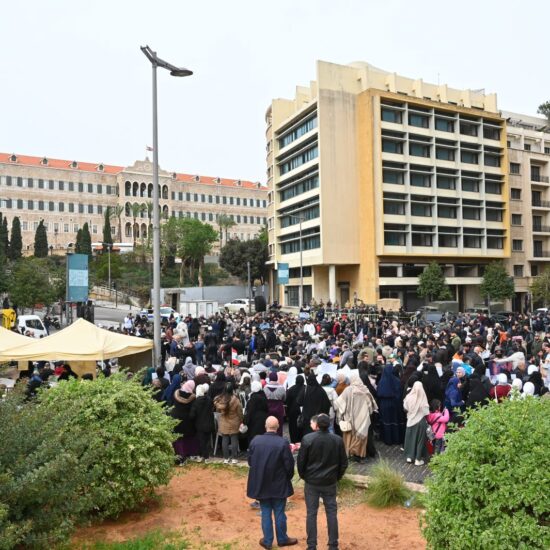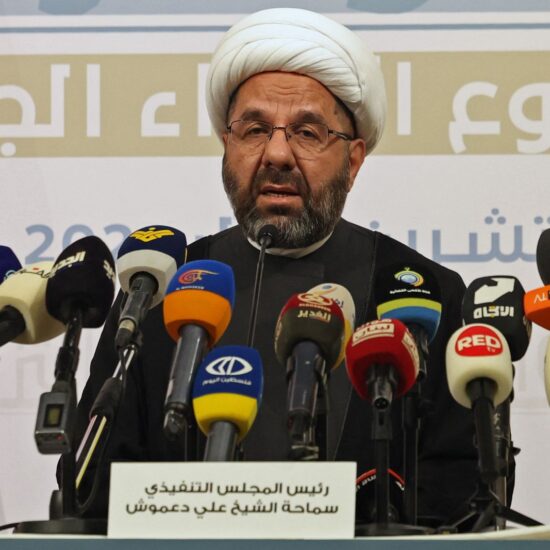

Baabda, Lebanon. Photo by ANWAR AMRO / AFP

Justice Minister Adel Nassar arrives at the presidential palace in Baabda where the first meeting of Lebanon's new government was held on the eastern outskirts of Beirut, on February 11, 2025.
Lebanon is taking steps to abolish the death penalty and replace it with life imprisonment. This decision comes at a crucial moment, as regional powers like Israel are moving in the opposite direction, Lebanese Justice Minister Adel Nassar told Now.
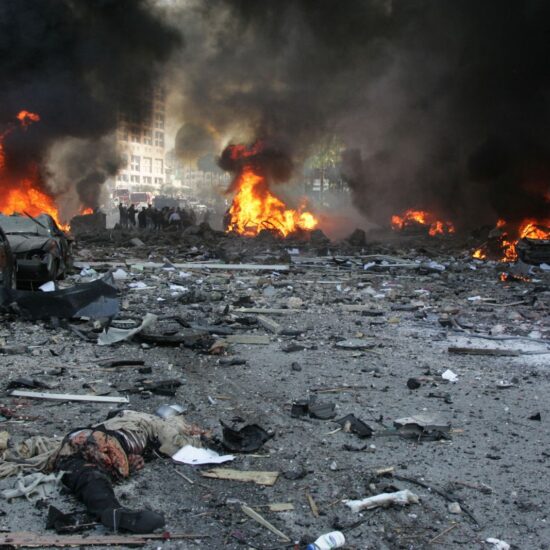
Since March, Lebanon has found itself in the middle of a war between Hezbollah and Israel, with millions of people displaced, houses destroyed and territory occupied by the Israeli military. Amid the chaos, Lebanon is working to abolish the death sentence. “Making such a national decision at a time when the country is itself affected by war and violence — and when Israel … has reinstated it in a selective manner — carries significant meaning,” Adel Nassar told Now.
“Making such a national decision at a time when the country is itself affected by war and violence — and when Israel … has reinstated it in a selective manner — carries significant meaning,” Adel Nassar told Now.
Nassar’s comments come as several countries in the region continue to actively use or expand capital punishment. In Iran, 1,639 people were executed last year, according to two human rights NGOs, Iran Human Rights and Together Against the Death Penalty. This is not only a record since 1989 but also a 68 percent increase compared to the year before.
Lebanon’s initiative also stands in contrast to the developments in Israel. In March, the Israeli parliament approved a new death penalty law for Palestinians accused of terrorism. The decree has taken effect in the West Bank through a “military order” issued in May. While the new law sparked major criticism internationally, reactions in Israel were mixed. Some activists warned about the law, while far-right politicians such as National Security Minister Itamar Ben-Gvir celebrated with champagne.
Nassar said Lebanon’s approach stands apart in this regional context. “More than any other country in the region, Lebanon is capable — even in wartime — of being at the forefront of progress in human rights,” he argues.
Aligning Lebanon’s justice system with international law
The newly declared goal of Nassar received international attention on Tuesday, during the International Congress Against the Death Penalty in Paris. The Justice Minister reiterated his support for ending the country’s practice, receiving applause from French President Emmanuel Macron, according to L’Orient le Jour.
Lebanon last carried out an execution in 2004. Three men convicted of murder were killed by firing squad and hanging. Amid strong international pressure after the incident, Lebanon stopped executions, while courts continued to occasionally issue death sentences. The country is now seeking to make the de facto rule a legislative reality. The draft law was approved in early May by parliament’s justice committee, but still has to pass parliament.
According to Nassar, the state will replace the death penalty with life imprisonment. This might increase citizens’ trust in the government, he argues. To underline his point he gave copies of Victor Hugo’s The Last Day of a Condemned Man to ministers and members of parliament. “Capital punishment has no place in a modern society respectful of human rights,” he said about the book’s message.
Abolishing the death penalty also has other benefits for Lebanon. Suspending the death sentence without outlawing it “creates an obstacle to extradition requests for accused persons who have taken refuge in countries that have abolished capital punishment,” Nassar explains. This either prevents trials or postpones them, thereby also delaying justice.
A prominent example is the investigation into the Beirut port blast. Last year, a Bulgarian court rejected the extradition of a suspect related to that case. Bulgaria sought assurance from Lebanon that Igor Grechushkin would not face the death penalty once extradited and tried. Grechushkin was the owner of the vessel MV Rhosus, which transported the ammonium nitrate to Beirut that was later stored in Beirut before exploding in 2020. To Nassar, there is, however, “no link” between the abolition of the death penalty and the port explosion investigation.
A moral question
While the death penalty has not been used for more than 20 years, officially outlawing it could help Lebanon. It is not only a symbolic act, but also one that might speed up trials. There is little evidence for the effectiveness of the death sentence. “No study has been able to demonstrate that the death penalty has a deterrent effect on crime,” Nassar argues.
While families of victims have a legitimate and natural right to demand justice, they will not find consolation in the death of the perpetrator, the Justice Minister says. “Witnessing an execution does not bring relief”. In the process of issuing a life sentence, there are many actors involved — including the judge and the executioner. “A judge should not bear the responsibility of taking a life,” Nassar says.
Without the death penalty, these moral questions cease to exist. In the coming weeks and months, it is up to the Lebanese Parliament to determine whether the 20-year practice will be codified into law. If passed, Lebanon would become one of the few countries in the region to fully remove the death penalty from its legal system.